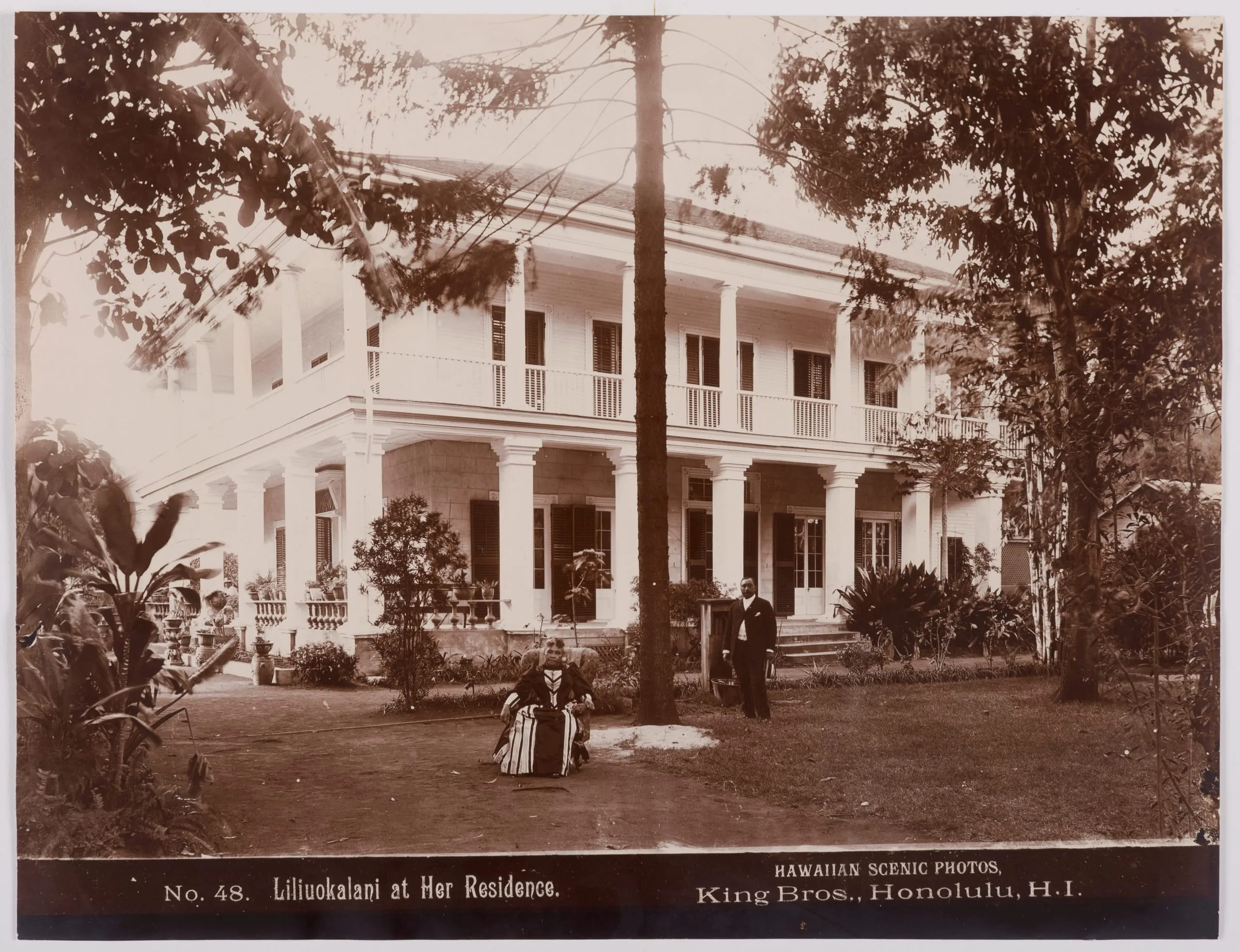
Queen Lili'uokalani sits in front of her home, Washington Place, with Samuel Nowlein, Captian of the Royal Guards, standing behind her. At this home is where her most famous song, Aloha Oe, was written (Library of Congress).
Queen Lili‘uokalani was the last sovereign of Hawai‘i. Many continue to admire Lili‘uokalani for her resolute and peaceful resistance to the US businessmen who ended her reign and to the United States’ annexation of Hawai‘i during the 1890s. The 1892 Highways Act was one example of her diligent labor as queen for the welfare of her people. It defined and protected Hawaiian trails and endures as a tool that the state of Hawai‘i uses to claim public trails and maintain rights of access despite private land ownership, including much of the Ala Kahakai National Historic Trail.
Lili‘uokalani became queen in 1891 and worked to restore power to the Hawaiian monarchy and her people. In 1892, along with the Legislature of the Kingdom of Hawai‘i she passed an act to protect public lands from privatization. This Highways Act declared existing trails, roads, and bridges, as well as future government-built ones to be public highways. In 1893, after Lili‘uokalani attempted to push forward a new constitution, American landowners staged a coup. Between 1893 and 1898, Lili‘uokalani and her fellow Kānaka Maoli (Native Hawaiians) mobilized against US annexation of Hawai‘i through political parties, in the press, and with petitions. They also sent delegations to Washington, DC. Lili‘uokalani published Hawaii’s Story by Hawaii’s Queen to lay out her arguments against annexation and to counter racist representations of herself and Kānaka Maoli in the US. When some of her supporters sought to restore the monarchy through an armed revolt in 1895, the provisional government imprisoned Lili‘uokalani and forced her to surrender the throne. Still, Hawaiian newspapers published songs she managed to smuggle from house arrest. She and other Kānaka Maoli used song to resist cultural and political imperialism. Her song “Aloha ‘Oe,” originally written in 1878 but transcribed while she was under house arrest, became a popular national song.
Lili‘uokalani continued to advocate for Hawaiian sovereignty and cultural retention for the rest of her life. Despite Native Hawaiians’ extensive resistance, the US annexed Hawai‘i in 1898. In 1909 she established a trust for Hawaiian children in need, and left her estate to help Hawai‘i’s children. She died on November 11, 1917, and was given a royal burial. Her life remains an inspiration to Kānaka Maoli and many others. The Ala Kahakai National Historic Trail, established in 2000, preserves a network of ancient, historic and modern trails, only possible due to the foresight of Lili‘uokalani’s Highways Act of 1892 , and is just one of the many ways that her legacy is visible in the Hawaiian landscape.