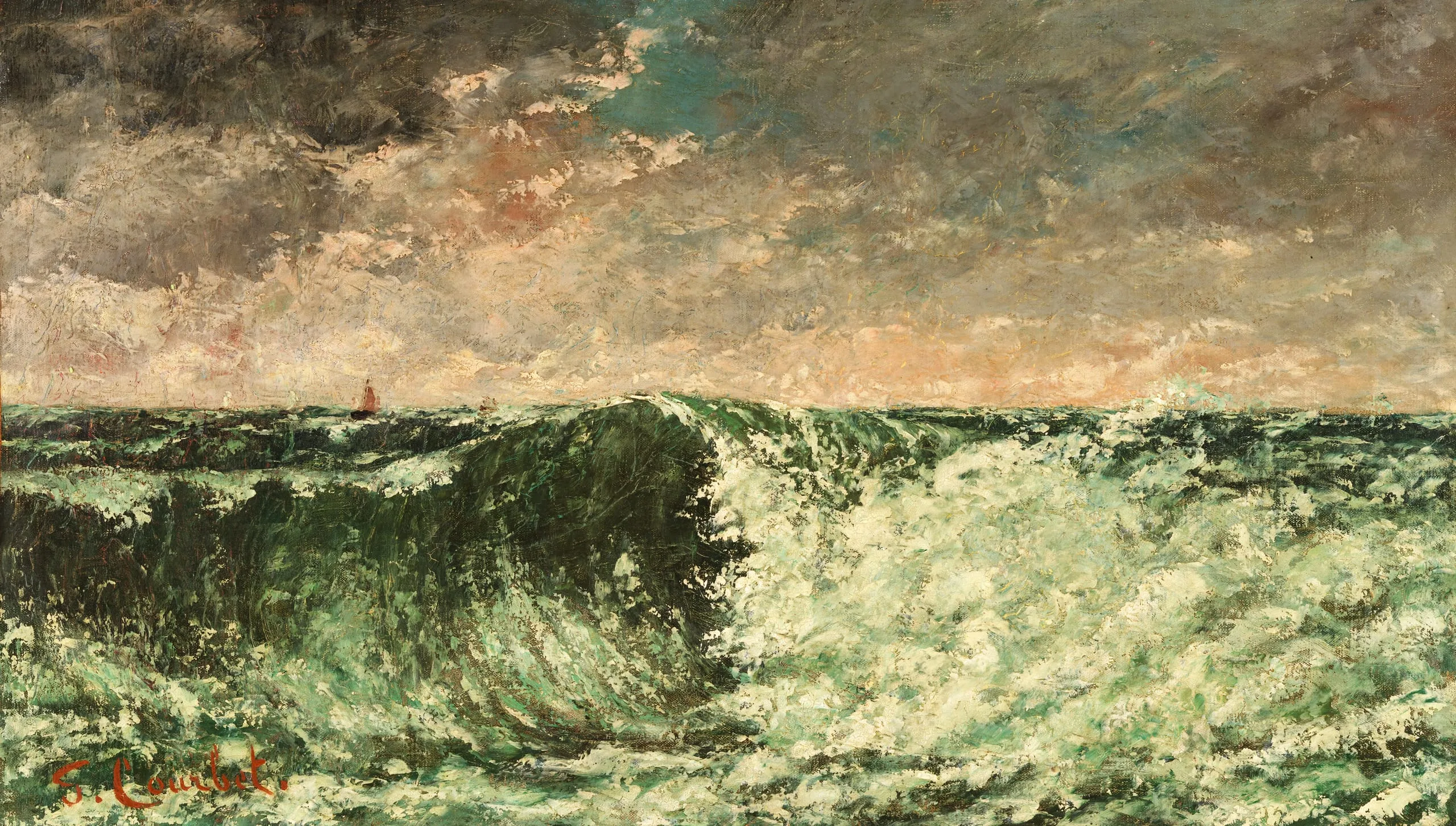
At the center of this painting, a single wave crests as a blue sky breaks through stormy clouds, almost dividing the composition into four quadrants. After making several trips to the Norman coast in the 1860s, Gustave Courbet began to paint what he termed “paysages de mer,” or landscapes of the sea. In these marines—a significant subgroup of Courbet’s oeuvre—the artist’s dynamic paint application mirrors the force of the natural world. Here, his signature technique is on full display, exuberant textures in the air and water formed by pushing his palette knife across the canvas. Courbet returned to the theme of a single crashing wave on multiple occasions. About these pictures, Paul Cézanne remarked that Courbet’s “tide comes from the depth of ages.” As a subject, the sea offered romantic, psychological, and even political appeal.
Courbet was profoundly shaped by his upbringing in rural Ornans, in eastern France. This influence was not only expressed through his depictions of life in the countryside but also by his attention to the landscape itself, rendering it with documentary-like specificity. He championed Realism—the belief that art should depict contemporary experience without idealization—and even wrote a manifesto outlining the movement’s goals. Unafraid of challenging the status quo, Courbet shocked audiences at the 1850 Salon when he exhibited monumental scenes of everyday life in Ornans in a room dedicated to history paintings. Known for his rejection of academic tradition, his depictions of the quotidian, and his radically free handling of paint, Gustave Courbet paved the way for later experiments in French painting.
2024