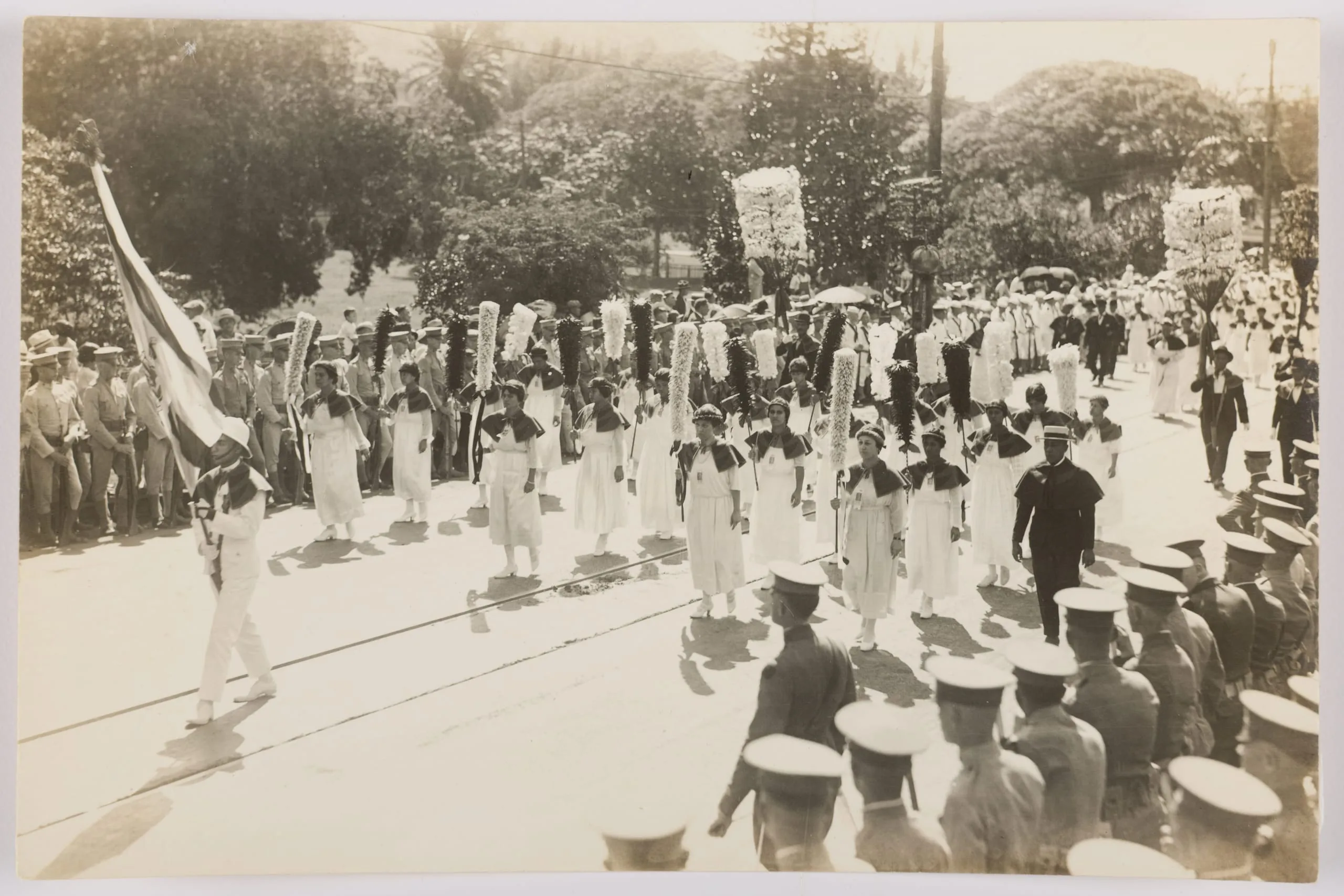
"Funeral procession of Prince Kalaniana'ole - last of royal Hawaiians. Honolulu- January 1922" enscribed on back.
While in office, Prince Kūhiō worked tirelessly to promote policies that benefited and advanced the Hawaiian people. He found early in his service in Washington, D.C. that people knew little about Hawai’i and he worked to educate them about Hawai’i, its culture, and people, by sponsoring trips to the islands for legislators out of his own pocket, so they could better understand the issues involved. During his tenure as delegate, he restored the Royal Order of Kamehameha I in 1903; introduced the first bill for Hawai‘i statehood (1919); introduced the Hawaiʻi National Park bill in 1916, which sought to establish a Hawaiʻi National Park covering land on Kilauea, Mauna Loa, and Haleakala; the establishment of the Makapu‘u Point Lighthouse; and worked to get funds for the construction of the Pearl Harbor naval base. His landmark achievement was working to introduce the Hawaiian Homes Commission Act (1920), a homesteading program for native Hawaiian people sponsored by the government. Last July, Hawai’i celebrated the centennial of the program, which continues today; more than 10,000 Hawaiian families live on homestead lands administered by the commission.
Prince Kūhiō’s most important legislative achievement was his last. The Hawaiian Home Commission Act passed on July 9, 1921; he died of a heart attack and exhaustion in Wakīkī on January 7, 1922. He was given the last state funeral for an ali’i with full military honors at home in Hawai’i.
On January 16, 1893 the Hawaiian Kingdom was invaded by United States marines which led to the illegal overthrow of the Hawaiian government the following day.