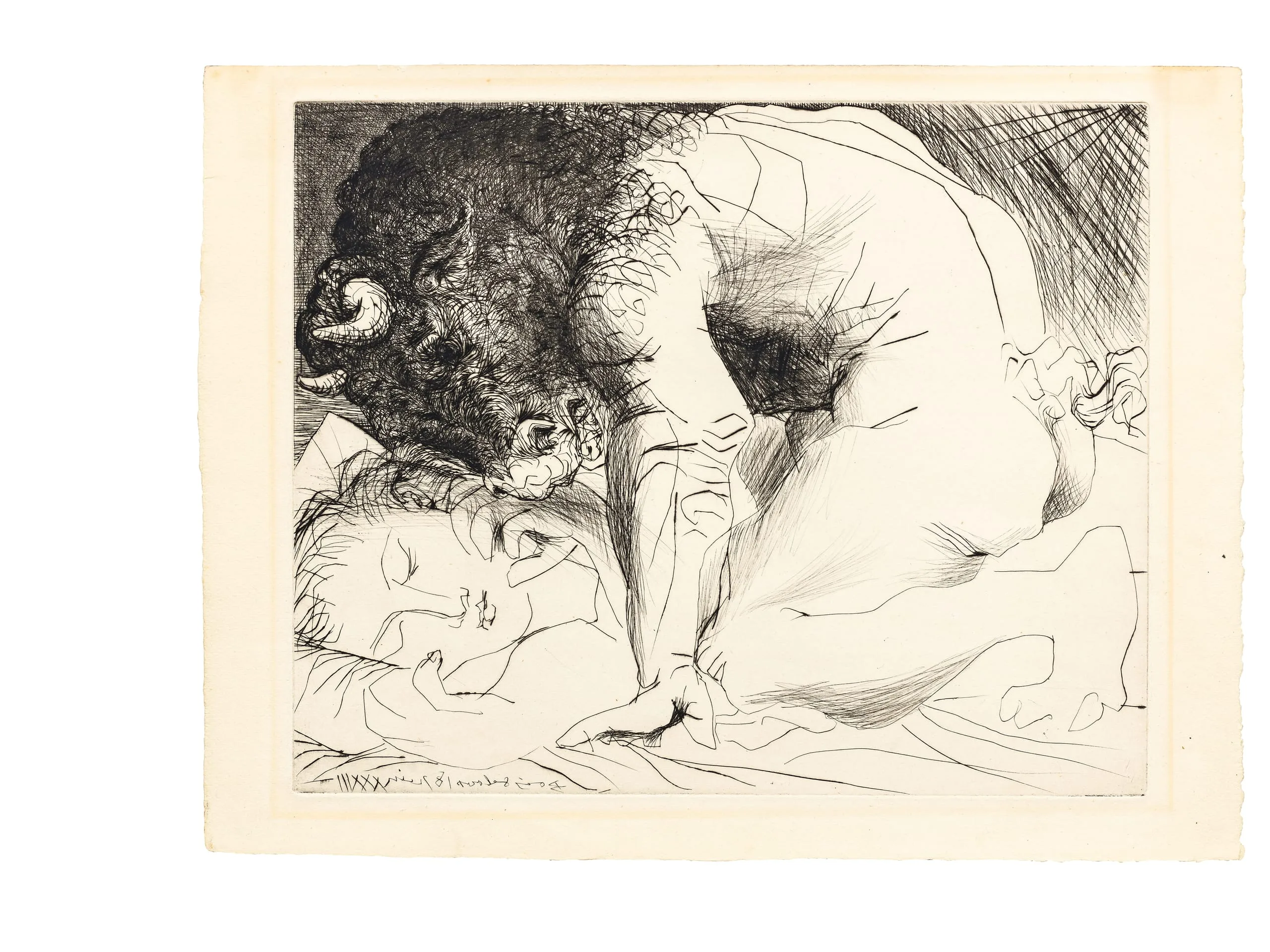
In 1927, the dealer and publisher Ambroise Vollard commissioned Pablo Picasso to create a portfolio of 100 intaglio prints. Vollard had been publishing prints by artists like Henri de Toulouse-Lautrec and Paul Cézanne since the turn of the century, pairing them with skilled master printers to produce technically excellent and formally innovative works on paper. Picasso, who explored all artistic media with an open and experimental mindset, approached Vollard’s commission in a similar manner. In 1934, he met Roger Lacourière, his printer and collaborator on the project. Together, they delved into etching processes, pushing the boundaries of what one could do to a copper printing plate to create line and tone. The resulting tour de force of intaglio printmaking is one of the most inventive bodies of graphic art published in the twentieth century.
The subject matter for the series is wide-ranging, but a few recurring themes emerge. One is that of the minotaur, a mythological half-man, half-bull who embodies humankind’s dual nature. The Surrealists viewed the classical creature as a personification of the brute power of subconscious desires. Picasso, who was involved with the Surrealists throughout the 1920s and 1930s, identified the minotaur as a personal alter ego. LACMA’s prints from the portfolio, Minotaur Caressing a Sleeping Woman and Bacchic Scene with Minotaur (M.2025.64.41) represent different aspects of the creature’s dual nature. In Bacchic Scene, the minotaur cavorts with a sculptor and his models, indulging in wine and women. Man’s duality is represented literally: both sculptor and minotaur are stand-ins for different sides of the artist’s personality. The two women resemble Marie-Thérèse Walter, Picasso’s then (very young) lover. Walter is a recurring character in the Vollard Suite and serves as muse for the artist and temptation for his beastly avatar. Minotaur Caressing a Sleeping Woman shows a different side of the relationship between the mythical monster and his muse. His gesture can be read as tender, though the latent threat of his animal nature is suggested in the way he hovers over the woman’s prone body.
Leah Lehmbeck and Erin Sullivan Maynes
2016/2024