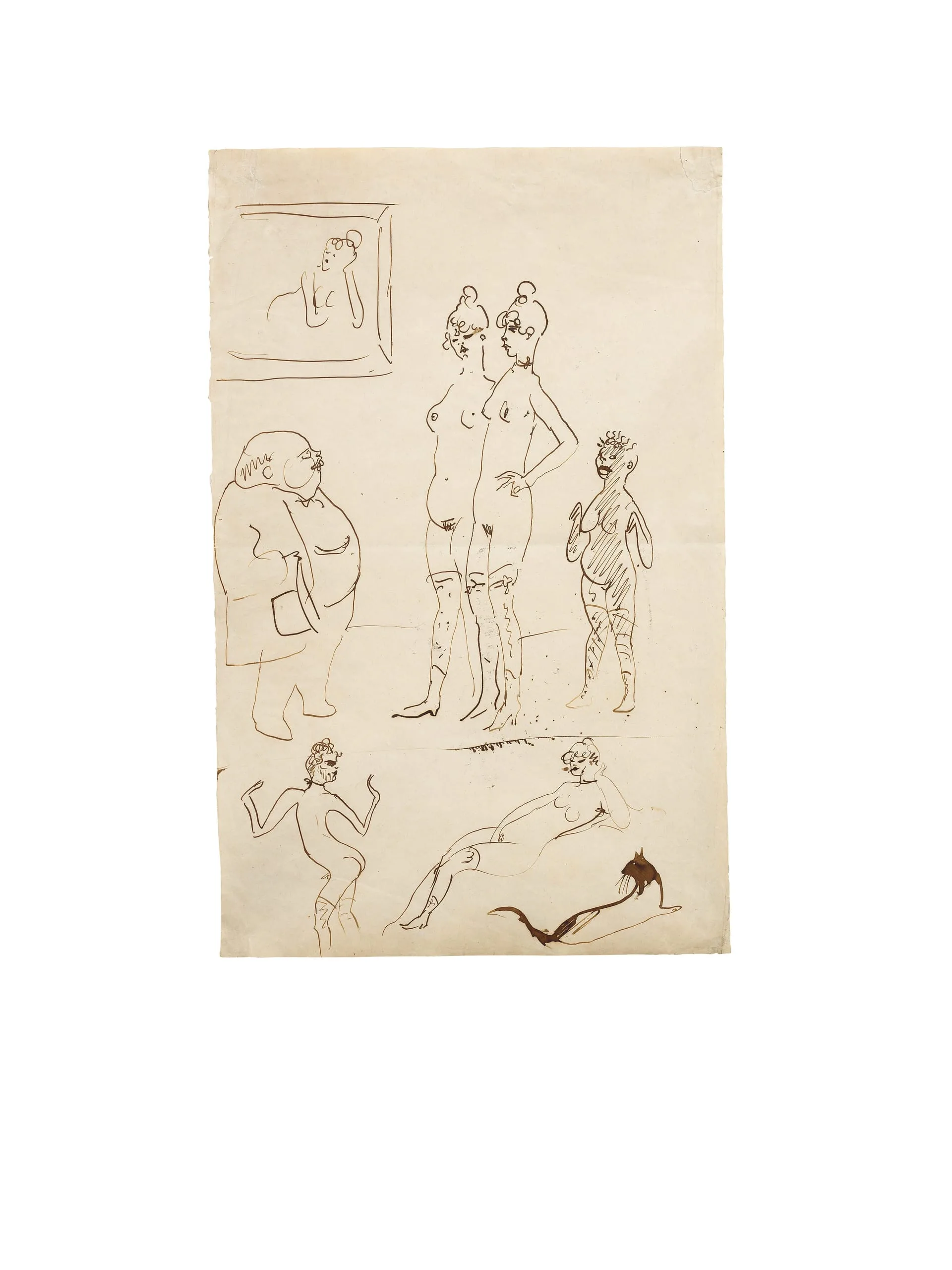
A pair of young women, seemingly joined at the hip and torso, stand at the center of The Twins, naked except for boots and stockings. On the left, a short, stout man, fully clothed, examines them. Their exchange, and the inclusion of other nude figures arranged across the page for his (and our) inspection, suggest the setting is a brothel. One of the nudes is a feminized man, and the reclining female, African woman, and cat allude to Manet’s Olympia (1865; Musée d’Orsay); by the time of this drawing, these elements were well-known tropes in depictions of modern brothel scenes.
In spite of the suggested intimacy, the only individuals here with any real connection are the twins, whose bodies enact a physical closeness more intimate than that promised by the sex they are selling. Picasso made the drawing at a moment when he was deeply focused on the fringe figures that populated the entertainment and pleasure palaces of Montmartre, the creative, radical, and seamy Parisian neighborhood where the artist lived in a building called the Bateau Lavoir. This is where, two years later, he created one of his most transformative paintings, Les Demoiselles d’Avignon. Although The Twins represents an earlier moment in Picasso’s development, both works explore his obsession with sexual exchange, power, and gender identity in a brothel setting.
The Twins was a gift—one among dozens—from Picasso to the writer Guillaume Apollinaire; the latter’s inscription on the reverse dates the drawing and identifies the place of its creation. By the time of his early death in 1918, Apollinaire had amassed a collection of more than 100 works by the artist (Read 2008: 25). Picasso befriended Apollinaire early in his career, and the writer became a vocal supporter of Cubism. The two shared a sense of humor and a fascination with the arts of Africa and Oceania, which would be among Picasso’s greatest artistic influences. Despite the artist’s outsized ego, the gift reflects his generosity, and Apollinaire considered it a privilege to be included among his friends: “Picasso . . . lived only among poets, one of whom I am honored to be” (Apollinaire 1993: 131). The feeling was mutual, and Apollinaire’s tragic early death did not curb his continued influence on this master of twentieth-century art.
Leah Lehmbeck and Erin Sullivan Maynes
2016/2024
Bibliography
Apollinaire, Guillaume. “La Vie anecdotique” (1912). In Oeuvres en proses complètes. Gallimard, 1993.
Read, Peter. Picasso and Apollinaire: The Persistence of Memory. University of California Press, 2008.