LACMA

ShopMembershipMyLACMATickets
LACMA
Los Angeles County Museum of Art
5905 Wilshire Blvd.
Los Angeles, CA 90036
info@lacma.org
(323) 857-6000
Sign up to receive emails
Subscribe
© Museum Associates 2026
  • About LACMA
  • Jobs
  • Building LACMA
  • Host An Event
  • Unframed
  • Press
  • FAQs
  • Log in to MyLACMA
  • Privacy Policy
© Museum Associates 2026
Collections

Pablo Picasso
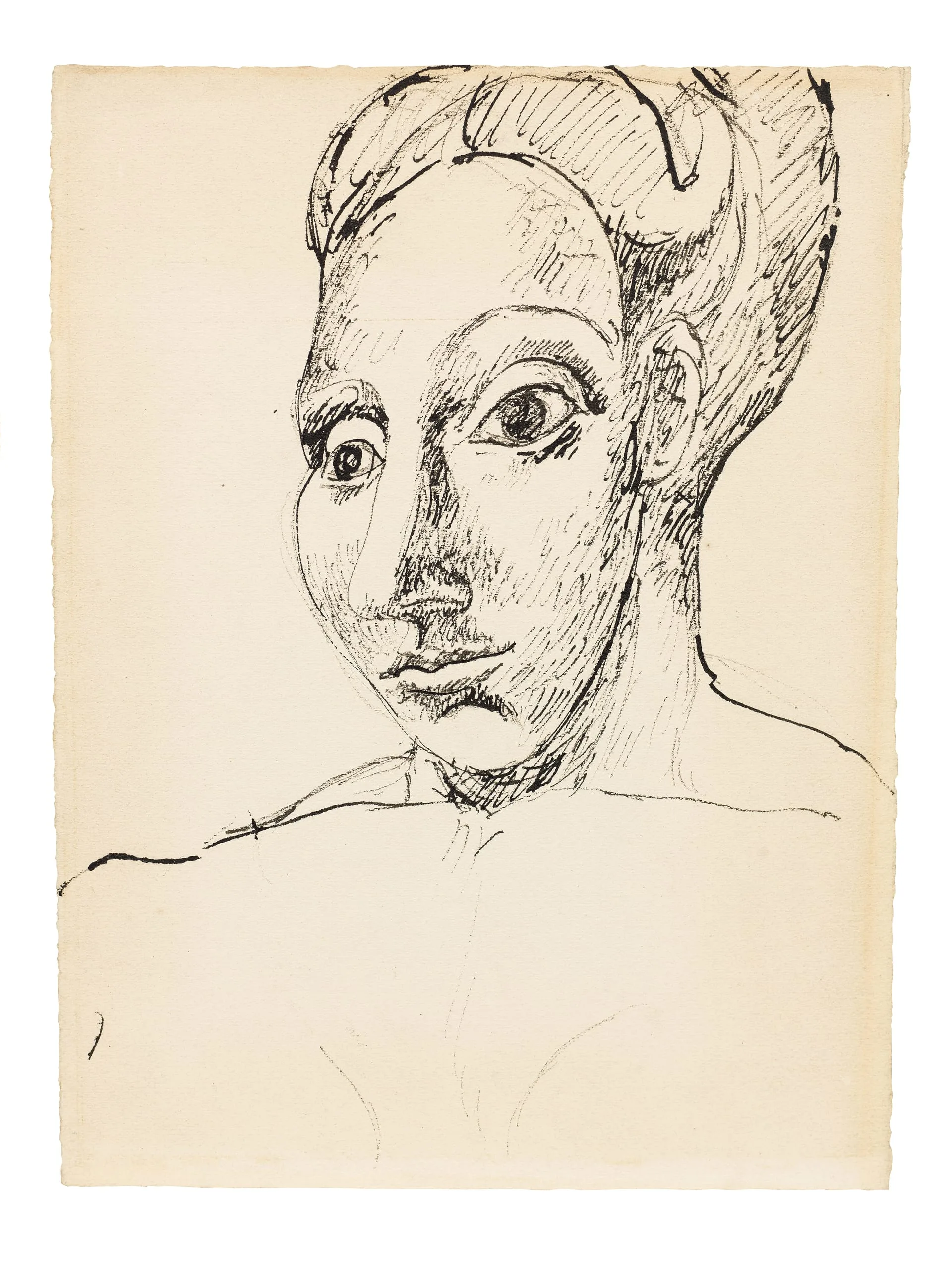
Head of a Woman1906-1907

Not on view
Ink drawing on cream paper, head-and-shoulders portrait of a figure with wide-set eyes and upswept hair, rendered in fluid contour lines and loose crosshatching
Artist or Maker
Pablo Picasso
Spain, 1881-1973, active France
Title
Head of a Woman
Culture
Spanish
Date Made
1906-1907
Medium
Ink on paper
Dimensions
Sheet: 12 1/2 × 9 1/2 in. (31.75 × 24.13 cm) Frame: 20 3/8 × 17 3/8 × 2 1/2 in. (51.75 × 44.13 × 6.35 cm)
Credit Line
Gift of A. Jerrold Perenchio
Accession Number
M.2025.64.42
Classification
Drawings
Collecting Area
European Painting and Sculpture
Curatorial Notes

Picasso created Head of a Woman in the midst of painting his groundbreaking portrait of Gertrude Stein. Moving to Paris in 1903, Stein hosted an important salon and began to assemble a major collection of modern art. The painter and the writer met in 1905 and immediately connected. By the time he began her portrait later that year, their creative and personal identities were powerfully intertwined. According to Stein, Picasso subjected her to eighty or ninety sittings, then painted over her face in frustration before abandoning the portrait in the spring of 1906. He finished it that fall without Stein, employing a new visual vocabulary shaped by his study of archaic forms, especially Iberian sculpture. The final portrait looks more like an angular mask than Stein’s actual face. In answer to her comment that it did not resemble her, Picasso replied, “It will.”

Head of a Woman is a mirror image of the oil portrait: the figure gazes to the left, her face in three-quarter profile. Her strong nose, large eyes, and flat expression likewise recall the Iberian masks that Picasso first saw in the Louvre. The drawing also exhibits similarities to a small group of self-portraits from the same period and, in fact, Picasso included elements of his own face in the Stein canvas. The correspondences between Picasso’s self-portraits and his painting of Stein have been much discussed in relation to creative identity, effacement, and iconicity. LACMA’s drawing should be considered part of that dialogue.

Leah Lehmbeck and Erin Sullivan Maynes

2016/2024

Provenance

The artist, sold to; Leo Stein (1872–1947) and Gertrude Stein (1874–1946), Paris;(1,2) Gertrude Stein, Paris, from 1913, bequeathed 27 July 1946 to; Alice B. Toklas (1877–1967), Paris, sold in 1947 to;(3) Georges E. (1896–1998) and Edna Horn (1902–1982) Seligmann, New York (sale, New York, Sotheby’s, 4 November 1982, lot 13, to);(1,4) [Coe Kerr Gallery, New York, purchased for]; A. J. Perenchio (1930–2017), Los Angeles, gifted 2025 to; Los Angeles County Museum of Art

Footnotes

(1) Alice B. Toklas–signed letter written in 1947 on the stationery of the Hotel Continental in Paris at 3 rue de Castiglione, confirming the provenance of this work, affixed to the backing: “Drawing in pen and ink on white paper. Size 95⁄8 × 127⁄8˝. Large head seen in three quarter view facing left on page. Face is modeled, shoulders sketched. / This drawing is from the collection of Gertrude Stein who bought it directly from Picasso./ Alice Toklas.” Additional details appear in Sotheby’s, New York, Seligmann sale, 4 November 1982, preface. Two other Picasso drawings with the Stein-Toklas-Seligmann provenance are in the Hegewisch Collection at the Hamburger Kunsthalle.

(2) The American writer Gertrude Stein and her brother Leo, an art critic and collector, assembled one of the most important art collections in Paris. The two split the collection in 1913, largely over the directions in which the avant-garde was headed.

(3) Alice B. Toklas met Gertrude Stein in Paris in 1907, and the two quickly became friends, remaining inseparable companions until Gertrude’s death in 1946. In 1933 Stein penned her own autobiography, titled The Autobiography of Alice B. Toklas, and while the book centers around Stein, Toklas’s character and humor is abundantly clear. When Toklas died in 1976 she was buried beside Stein at Père-Lachaise cemetery in Paris.

(4) The Paris-born Manhattan art dealer Georges E. Seligmann was a member of the Paris Seligmann art dealer family. Along with his father, Simon, his uncles Jacques and Arnold Seligmann started their business in Paris in 1879, later expanding to London and New York. With the outbreak of World War II in France, Georges, who had joined the family business in Paris, relocated to New York in 1940 to work in the New York branch of the Jacques Seligmann Gallery. Later in 1949 Georges opened his own gallery, which operated until his retirement in 1971. He married Edna Horn Mandel in 1946.
Selected Bibliography
  • Lehmbeck, Leah, ed. Impressionist and Modern Art: The A. Jerrold Perenchio Collection. Los Angeles: Los Angeles County Museum of Art; Munich: DelMonico Books/Prestel, 2016.
Copyright
© Estate of Pablo Picasso / Artists Rights Society (ARS), New York, photo © Fredrik Nilsen

Related Unframed

Q&A with Ken Gonzales-Day
  • October 19, 2011