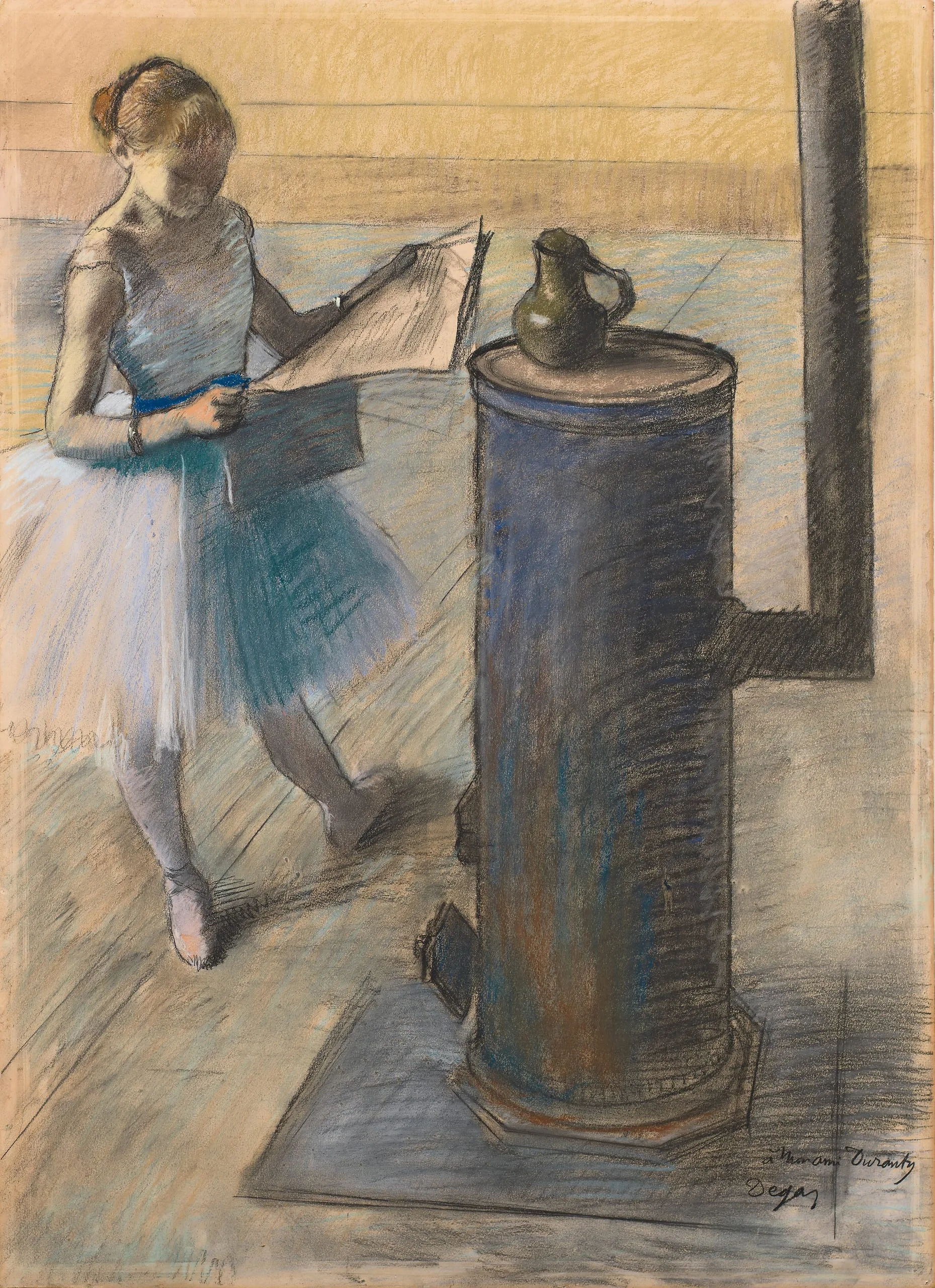
The artist, about 1880, gift to; Louis-Emile Edmond Duranty (1833–1880), Paris (sale, Paris, Hôtel Drouot, 28–29 January 1881, lot 17, to);(1) Henri Rouart (1833–1912), Paris (sale, Paris, Galerie Manzi-Joyant, 16–18 December 1912, lot 76, to);(2) Alfred Strölin (1871–1954) (sequestered sale, Paris, Hôtel Drouot, 7 July 1921, lot 42, to);(3) [Galerie Durand-Ruel, Paris and M. Knoedler & Cie., Paris, sold 22 December 1921 to];(4) [Galerie Durand-Ruel, Paris, sold 22 December 1921 to];(4) Joseph Early Widener (1871–1943), Philadelphia;(5) Mrs. Peter A. B. Widener, Philadelphia, by 1950;(6) Mr. and Mrs. Peter A. B. Widener III (1925–1999), Philadelphia, by 1970.(7) Mr. and Mrs. Eugene V. Klein (1921–1990), by April 1983.(8) Anonymous (sale, New York, Christie’s, 15 November 1983, lot 50, to);(9) A. J. Perenchio (1930–2017), Los Angeles, gifted 2025 to; Los Angeles County Museum of Art
Footnotes
(1) Commissaire-priseur Maurice Delestre’s official Procès-verbal for the Duranty sale records the buyer “Rouart” for this lot, for Fr 555. Boggs, Degas, p. 331, no. 215, cites Alphonse Portier buying at the sale, with Portier selling the pastel to Durand-Ruel on 12 February 1881 for Fr 200, stock no. 816. According to Durand-Ruel, that pastel is entitled Danseuse à l’éventail, and seems to have been confused with the present pastel. Durand-Ruel did not own the picture until after the Strölin sale in 1921 (document prepared by Flavie and Paul-Louis Durand-Ruel for Leah Lehmbeck, 8 December 2015).
(2) Stanislas-Henri Rouart (1833–1912), French industrialist, art collector, and amateur Impressionist painter, was Degas’s lifelong friend and supporter. In addition to this Degas, Rouart owned Degas’s At the Café-concert: The Song of the Dog, cat. 9.
(3) The J. Paul Getty Museum’s Cooper copy of Rouart auction catalogue (c. 5) is hand-annotated in ink: “37000 Strolin.” The publisher, printer, and dealer Alfred Strölin was active in Paris. However, at the outbreak of World War I, France declared Strölin, a German national, an enemy alien. As a result his stock and belongings were seized and sold later in a series of French sequestration (liquidation) sales organized by J. Zapp in 1921 and 1922 at Hôtel Drouot.
(4) M. Knoedler & Co., [New York] Painting stockbook 7: 15140–17039, 1921 January–1927 December, no. 15240, along with Durand-Ruel, Paris, stock no. 11907, showing half shares. Durand-Ruel purchased the half share back from Knoedler on 22 December 1921 and the same day sold the painting to Joseph Early Widener (document prepared by Flavie and Paul-Louis Durand-Ruel for Leah Lehmbeck, 8 December 2015).
(5) Joseph Early Widener (1871–1943) was an American art collector and founding benefactor of the National Gallery of Art.
(6) In 1950 the pastel was exhibited at the Philadelphia Museum of Art, lent by Mrs. Peter A. B. Widener. Without more detailed information it is uncertain if this is Mrs. Peter A. B. (Gertrude) Widener II, who died on 3 February 1970, or Mrs. Peter A. B. (Louise Van Meter) Widener III, who married Peter A. B. Widener III in 1947. See also note 7.
(7) According to the Philadelphia Museum of Art exhibition label on the back of the frame for their 1970 exhibition, the lender was “Mr. Peter A. B. Widener 3rd.” Peter A. B. Widener III is the grandson of Joseph Early Widener, and he likely inherited the painting from his grandfather or his father, Peter Arrell Brown Widener II (1895–1948).
(8) According to the San Diego Museum of Art exhibition label on the back of the frame, the lender was “Mr. & Mrs. Eugene V. Klein.” Eugene V. Klein, known as “Gene,” is best known in the sports field as owner of the NFL’s San Diego Chargers and his thoroughbred race horses.
(9) It is probable that the seller in this sale is Eugene V. Klein, as the painting was in his collection through at least June 1983.