As Fernand Léger’s political commitments matured, changes in his art naturally followed, and he actively sought ways to make his work more accessible. By the 1930s, his engagement with architecture had evolved into the production of monumental murals for public spaces. The architect Le Corbusier recognized this feature in his friend’s work, noting that Léger’s painterly approach was “the sister of architecture. The link is so intense that he is, among all the painters, the one whose paintings [can be] called a new architecture.” Much of this shift had to do with a renewed involvement in urban life and a concern for broader societal conditions affecting the working class—a commitment that was not just political in nature but also aesthetic. Yet, even as he adopted more broadly legible subject matter and, during the postwar period, explored mediums such as mosaic, stained glass, and ceramic, the core tenets of the visual vocabulary he developed in 1913—line, form, color—still held.
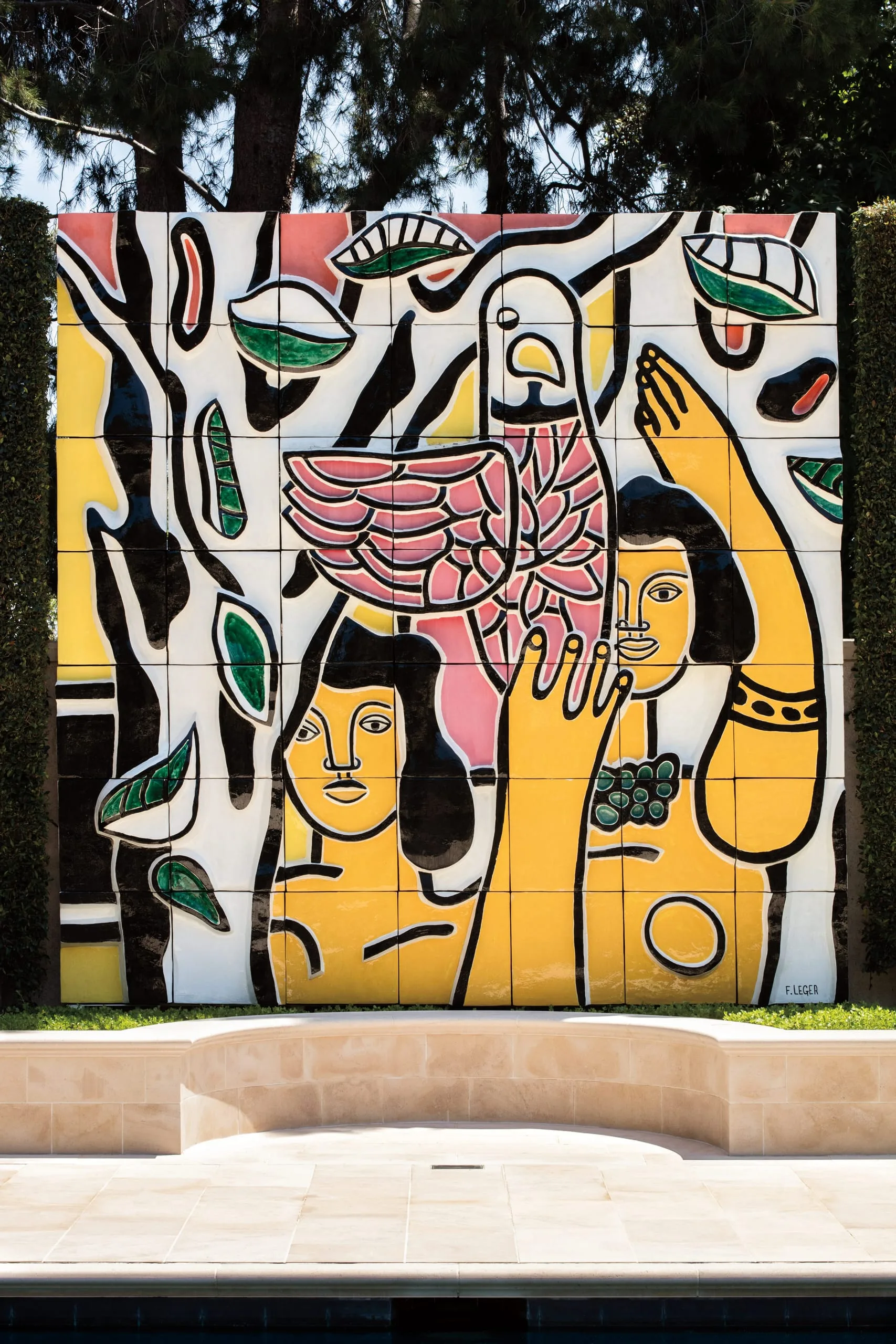
In his final years of work, Léger tapped the possibilities of polychrome ceramic to advance his program of monumental subject matter and public engagement, creating graphic reliefs composed of tiles for installation on building facades. He developed a unique technique of high-fired enameled clay at a time when fellow painters Pablo Picasso, Henri Matisse, and Marc Chagall were also experimenting with ceramic. The artist admitted he was “cautious” at first, using his own paintings as a starting point, but he soon embraced the interaction with space that the medium naturally afforded. He made his first grand-scale ceramic work, Women with a Parrot, in 1952 (Fernand Léger National Museum, Biot, France). For the present relief, Leger extracted about half of the original black-and-white composition and applied pure yellows, reds, and greens. With an upraised arm, the figure on the right gestures toward the red-feathered parrot, a longtime recurring motif in Léger’s art. The figure on the left seems to raise her hand in greeting and holds up the bird for inspection. Leaves float around the totemic trio, all of whom gaze directly at the viewer. The image seems to acknowledge the relief’s presumed outdoor location, as if the women were hailing passersby, inviting them to stop, look, and enjoy.
2024