LACMA

ShopMembershipMyLACMATickets
LACMA
Los Angeles County Museum of Art
5905 Wilshire Blvd.
Los Angeles, CA 90036
info@lacma.org
(323) 857-6000
Sign up to receive emails
Subscribe
© Museum Associates 2026
  • About LACMA
  • Jobs
  • Building LACMA
  • Host An Event
  • Unframed
  • Press
  • FAQs
  • Log in to MyLACMA
  • Privacy Policy
© Museum Associates 2026
Collections

Max Ernst
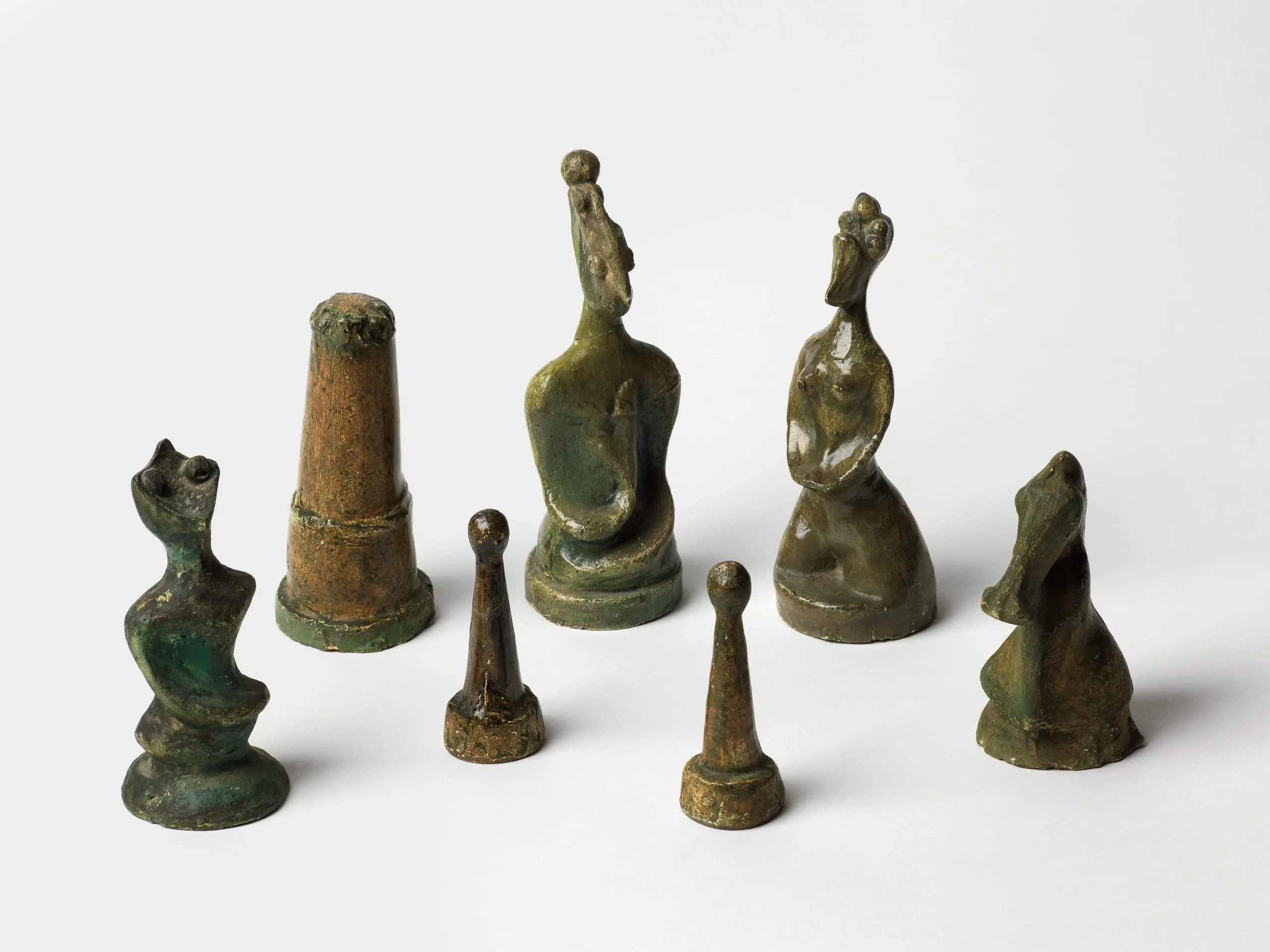
Chess setmodelled and cast circa 1929–1930

On view:
Geffen Galleries
Seven small ancient bronze sculptures with green and brown patina, including seated figurines, a tall cone, and small peg-shaped pieces, arranged on a white surface
Artist or Maker
Max Ernst
Germany, also active France and United States, 1891-1976
Title
Chess set
Culture
German
Date Made
modelled and cast circa 1929–1930
Medium
Cast plaster with paint and varnish
Dimensions
Variable heights: 3 in. (7.62 cm) to 5 ½ in. (14 cm)
Credit Line
Gift of A. Jerrold Perenchio
Accession Number
M.2025.64.30
Classification
Tools and Equipment
Collecting Area
European Painting and Sculpture
Curatorial Notes

Over the course of his long life, Max Ernst had a profound impact on the artistic communities in three different countries, a testament to his innovative practice and relentless curiosity. His immersion in Dada and Surrealism defined his work in Germany, France, and later America. Ernst’s motifs drew on his early interest in Gothic fantasy and German Romanticism, tending toward recognizable elements rather than the abstract. He produced landscapes that seemed familiar, and blended human forms with the avian, aquatic, and inanimate. These elements carried over from his collages and paintings into his sculptural work, begun in the mid-1930s. Chess Set can be seen as a precursor to this three-dimensional work.

This is the only complete surviving set from his 1929 design and was likely the artist’s own. The pieces, which Ernst modeled and formed himself, differ from his mature sculptures, which were chiefly cast from found objects or made from molds and then assembled. This intimate engagement with material reflects Ernst’s personal attachment to the game: like many of his friends, he was deeply attracted to its intellectual and strategic challenges, and the camaraderie it provided. The forms of the pawns, rooks, and knights, although they resemble their traditional counterparts, are simplified and slightly off-kilter, while the bishop, king, and queen echo the imaginative hybrid creatures of his paintings and collages. The bishop’s corkscrew-shaped body, large eyes, and pointed nose suggest an amphibian. The king has a narrow birdlike head that may be a reference to the artist’s alter ego Loplop, a part-fish, part-bird, part-man that Ernst invented in 1929. The queen, with her voluptuous figure and equally birdlike head, may recall Ernst’s wife at the time, Marie-Berthe Aurenche.

2024
Provenance

Max Ernst (1891–1976).(1) Anonymous (sale, London, Christie’s, 3 December 1996, lot 319, to); A. J. Perenchio (1930–2017), Los Angeles, gifted 2025 to; Los Angeles County Museum of Art

Footnotes

(1) Christie’s London 1996 sale entry for lot 319 states that Werner Spies confirmed the authenticity of the set and states that it was the artist’s personal set.

Selected Bibliography
  • Lehmbeck, Leah, ed. Impressionist and Modern Art: The A. Jerrold Perenchio Collection. Los Angeles: Los Angeles County Museum of Art; Munich: DelMonico Books/Prestel, 2016.
Copyright
photo © Fredrik Nilsen

Related Unframed

Artists on Art: Paul Mpagi Sepuya on Lorna Simpson
  • January 3, 2019
  • Anastasia Pahules