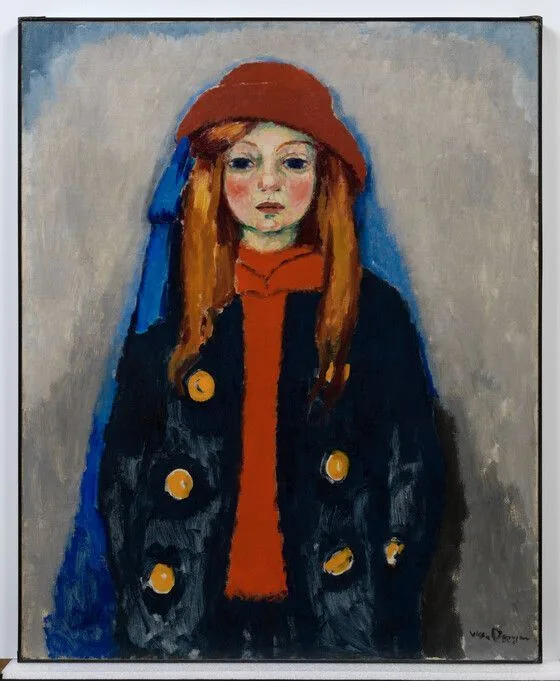
[Galerie Bernheim-Jeune, Paris, from 9 February 1914].(1) [Paul Vallotton (1864–1936), Lausanne, c. 1914]. [Galerie Le Centaure, Brussels].(2) Mme Madeleine Ittner, Brussels, by 1937, still in 1951.(3) Henri Belien, Brussels, from at least 9 July 1959.(4) [Walter Feilchenfeldt Gallery, Zurich, probably 1960s]. Sydney R. (1906–1994) and Rose Barlow, Los Angeles, from at least July 1969 (sale, London, Sotheby Park Bernet, 2 April 1979, lot 14).(5) Marion O. Hoffman Trust (sale, New York, Sotheby Parke Bernet, 15 May 1984, lot 50, to);(6) A. J. Perenchio (1930–2017), Los Angeles, gifted 2025 to; Los Angeles County Museum of Art
Footnotes
(1) According to Bernheim-Jeune & Cie, under stock number 20193, the title of the work is given as “Gusie.” While the date of the purchase is clear (the same day they sold cat. 15), the date of the sale is unfortunately illegible (letter from Guy-Patrice Dauberville to Leah Lehmbeck, 2 December 2015).
(2) According to a label now affixed to the backing board, Galerie Le Centaure, Bruxelles, lent this painting to an exhibition at the Palais des Beaux-Arts de Bruxelles. According to Wildenstein & Co., who are now supporting the catalogue raisonné for van Dongen under the authorship of M. Jacques Chalom des Cordes, it is possible that the painting was with the Gallery Centaure before it was with Ittner. The Gallery held two important van Dongen exhibitions, in 1927 and 1931, but the catalogues do not give enough detail to verify that this
painting was actually in their possession (emails from Christine Tolo to Leah Lehmbeck, 29 October and 16 November 2015).
(3) Madeleine Ittner’s letter to E. L. T. Mesens, dated 29 May 1951, describes the painting as “portrait de fillette de Van Dongen,” and she mentions that the painting was exhibited in the 1937 Palais des Beaux-Arts exhibition at the request of van Dongen, and again in 1949 in the Museum Boijmans Van Beuningen’s Dongen exhibition. The letters appear in the E. L. T. Mesens papers, 1917–1976 (bulk 1920–1971), The Getty Research Institute, Los Angeles, Accession no. 920094, Box 11, Folder 9, “75 Oeuvres de Demi-Siècle” (1951).
(4) Belien was a major collector of other works of Impressionist and modern painting, and he also owned van Dongen’s Woman with a Cigarette, cat. 14.
(5) Sydney R. Barlow, founder of the Gibraltar Savings and Loan in Beverly Hills, helped found the Los Angeles County Museum of Art, the Music Center of Los Angeles, and the American Film Institute. According to the LACMA Registrar files, the painting was in storage at the museum along with thirty-two other paintings from Barlow’s collection at least twice, from 11 February–13 June 1974 and from 2 July–1 October 1975. LACMA was given permission to display any of the paintings, as long as records were kept of the exhibition dates. There is no paper record suggesting the van Dongen was on view.
(6) Marion O. Hoffman’s husband was Maximilian E. Hoffman (1904–1981), the Austrian-born automobile dealer known by his colleagues as the “Duveen of the motor business,” for his introduction of the European car market to Americans. After he retired in 1975, he turned his attention to building an art collection.