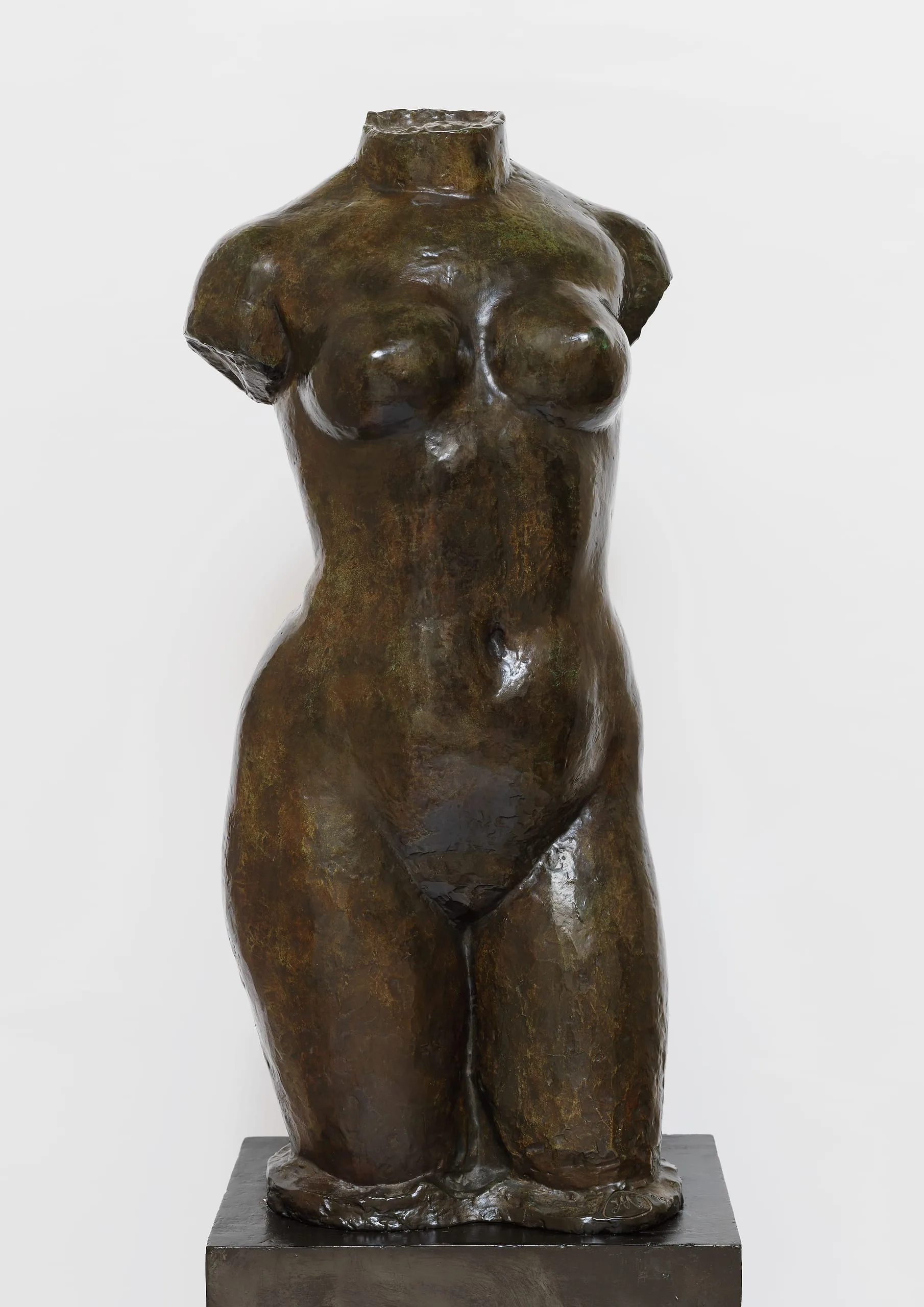
Aristide Maillol’s unwavering dedication to the figural within the realm of the contemporary defined his work over three decades. He was born, raised, and lived as an adult in the same pink house located on a cliff above the Mediterranean Sea in Banyuls, a French-Catalonian town near the Spanish border. While he studied art in Paris in the studios of two titans of academic painting, Jean-Léon Gérôme and Alexandre Cabanel, his work was equally informed by his life in the southwest corner of France, the region’s tangible link to Greco-Roman history, and its own artisanal past.
Around 1900, after forays into painting and tapestry design, Maillol turned his focus almost exclusively to sculpture, and it was at this time that Auguste Rodin’s work activated a modern dialogue on the medium. In this milieu, while Maillol’s fostering of craft and classicism may have seemed regressive against Rodin’s dynamism and fluidity, it should nevertheless be considered a modern approach. Maillol was not a sculptor of movement, to be sure, and he drew on archaic and classical Western sources as well as Indian and Chinese sculpture to which he was exposed during the 1900 International Exposition. But his deployment of these forms was not derivative. Rather, he simplified the body into idealized geometric volumes, eliminating grandiose gesture and sentiment in favor of a profoundly reserved composition.
So dedicated was he to the reduction of the female body that he viewed even arms as a distraction from his aspirational contour. This is evidenced in the great number of torsos he modeled over the course of his career. For this life-size bronze of a young woman, Maillol focused on the sinuous curves of her midsection, from neck to mid-thigh. The figure’s solidity is reinforced by the slight contrapposto, spherical breasts, vertical spine, and flawless half-moon buttocks. Of this geometricization, and the consequent barrier to sentiment but not sensuousness that it maintained, Maillol once remarked that “modeling a vase, a simple pot, or a humble ewer is just the same as modeling a torso, a breast, a young belly, the rounded female thigh. . . . What is the difference? What is a vase if it is not just that—the breast, torso, rump, the beautiful fruit?”
2024