LACMA

ShopMembershipMyLACMATickets
LACMA
Los Angeles County Museum of Art
5905 Wilshire Blvd.
Los Angeles, CA 90036
info@lacma.org
(323) 857-6000
Sign up to receive emails
Subscribe
© Museum Associates 2026
  • About LACMA
  • Jobs
  • Building LACMA
  • Host An Event
  • Unframed
  • Press
  • FAQs
  • Log in to MyLACMA
  • Privacy Policy
© Museum Associates 2026
Collections

Fernand Léger
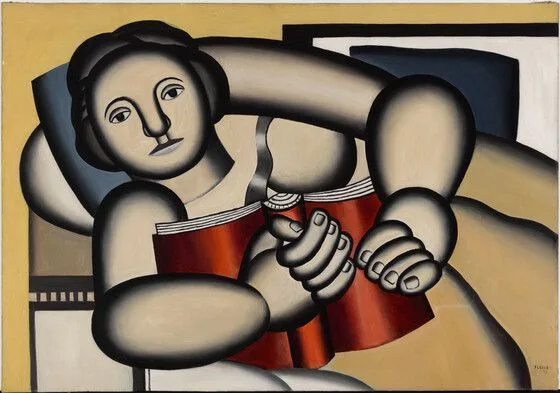
Study for Reading1924

On view:
Geffen Galleries
Oil painting of a reclining woman reading a red book, rendered in bold black outlines with cylindrical, sculptural forms and flat areas of pearl gray, sandy yellow, and steel blue
Artist or Maker
Fernand Léger
France, 1881-1955
Title
Study for Reading
Culture
French
Date Made
1924
Medium
Oil on canvas
Dimensions
Canvas: 31 7/8 × 45 11/16 in. (81 × 116 cm)
Credit Line
Gift of A. Jerrold Perenchio
Accession Number
M.2025.64.24
Classification
Paintings
Collecting Area
European Painting and Sculpture
Curatorial Notes

“I will take you to Baron Gourgaud’s to view my most beautiful painting, Reading,” Fernand Léger said not long after the 1924 masterpiece was sold by his dealer Léonce Rosenberg. The monumental painting, now in the Centre Pompidou, Paris, marks a zenith as a well as a transition for Léger, as it was created at the height of his involvement with Purism. Study for Reading and its companion Woman with a Bouquet (PG.2014.24.33) are two of five oil studies that form the imagery of the final picture. Since their creation, LACMA’s canvases have been bought and sold as a pair. Their link is confirmed by Léger’s inscriptions on the verso of each: on the present work, “study for the readers / left fragment,” and on Woman with a Bouquet, “study for the Readers / right fragment.”

From 1907 to 1914, when he was drafted into World War I, Léger immersed himself in the Cubist experiments of the day. But the experience of war, where he participated in some of the most violent fighting at the front, shifted his perspective. He was struck by the camaraderie among his fellow soldiers and also drawn to the aesthetics of the machine embodied in military materiel. The machine-made object’s plasticity and rational form resonated with the artist and primed him for the philosophy and aesthetics of Purism, expounded in 1918 by the painter Amédée Ozenfant and the architect Le Corbusier in their book After Cubism. In the profound social and political upheaval that followed the war, factions of the avant-garde rejected prewar abstraction in favor of a return to classical principles of order, clarity, and balance. “Now order and purity illuminate life from that of yesterday,” Ozenfant and Le Corbusier declared in their manifesto. “The latter was troubled, uncertain of its path, but the one that is beginning sees it crisp and clear.”

These ideas are articulated in Study for Reading and Woman with a Bouquet—each impressive on its own, but together a statement of Léger’s ideals at the time. “I had broken down the human body, so I was putting it together again and rediscovering the human face. . . . I felt a need for the staticity of large figures.” Both readers indeed appear frozen, delineated by stout, tubular forms; volume is suggested with subtle shading and palette. The women do not actually read but gaze directly at the viewer. Each holds an open book—one red, one blue—against her chest. Horizontal and vertical elements—the picture frame behind the reclining woman, the flower stems sprouting from the standing woman’s fingertips—mimic the figures’ orientation and provide counterpoint in the final painting. These elements appear in Léger’s other works of the period.

The height of the Purist phase would also be its conclusion. Ozenfant and Le Corbusier abruptly parted company in 1925. Léger was already experimenting with cinema and taking note of another shift in visual experience as expressed in the First Surrealist Manifesto, published in 1924. He, too, had moved on.

2024

Provenance

Fernand Léger (1881–1955), sold 6 March 1924 to; [Léonce Rosenberg (1879–1947) Galerie L’Effort Moderne, Paris, sold by December 1928 to];(1) Josef Oskar Müller (1887–1977), Solothurn, Switzerland, still owned in 1957.(2) [Galerie Beyeler, Basel, sold May 1978 to]; Leonard A. Lauder (1933–2025), sold 2 June 1999 to;(3) [Acquavella Galleries, New York, for];(3,4) A. J. Perenchio (1930–2017), Los Angeles, gifted 2025 to; Los Angeles County Museum of Art

Footnotes

(1) While cats. 21 and 22 ultimately were sold to Josef Müller, the exact transaction dates are unclear. See Léger, Rosenberg, and Derouet, Correspondances, Fernand Léger, Léonce Rosenberg, p. 213, letter no. 193, pp. 145–46, letters no. 214, 215, pp. 150, 152, letter no. 223.

(2) Josef Oskar Müller began acquiring art in 1907, and in addition to his collecting activities, he was also a painter and curator. Müller owned both cats. 21 and 22.

(3) According to Anna Jozefacka, associate curator of the Leonard A. Lauder Collections, Lauder purchased cats. 21 and 22 in May 1978 from Galerie Beyeler (email to Casie Kesterson, 3 September 2015). Another Léger with Galerie Beyeler ownership was sold by Sotheby’s in their New York sale Impressionist and Modern Art Day Sale, 8 May 2013, lot 408, and this painting was owned by Josef Müller, then passed by descent to his daughter Monique Barbier, then acquired by Galerie Beyeler, Basel, in 1979.

(4) Acquavella handled both Légers in this collection (cats. 21 and 22), which were acquired from Leonard A. Lauder (email to Casie Kesterson, 27 August 2015). Lauder is the former Chief Executive of Estée Lauder Co. and a major collector of Cubist painting. His collection was promised to the Metropolitan Museum of Art in 2013.
Selected Bibliography
  • Lehmbeck, Leah, ed. Impressionist and Modern Art: The A. Jerrold Perenchio Collection. Los Angeles: Los Angeles County Museum of Art; Munich: DelMonico Books/Prestel, 2016.
Copyright
© Artists Rights Society (ARS), New York / ADAGP, Paris, photo © Fredrik Nilsen