LACMA

ShopMembershipMyLACMATickets
LACMA
Los Angeles County Museum of Art
5905 Wilshire Blvd.
Los Angeles, CA 90036
info@lacma.org
(323) 857-6000
Sign up to receive emails
Subscribe
© Museum Associates 2025

Museum Hours

Monday

11 am–6 pm

Tuesday

11 am–6 pm

Wednesday

Closed

Thursday

11 am–6 pm

Friday

11 am–8 pm

Saturday

10 am–7 pm

Sunday

10 am–7 pm


  • About LACMA
  • Jobs
  • Building LACMA
  • Host An Event
  • Unframed
  • Press
  • FAQs
  • Log in to MyLACMA
  • Privacy Policy
© Museum Associates 2025
Collections

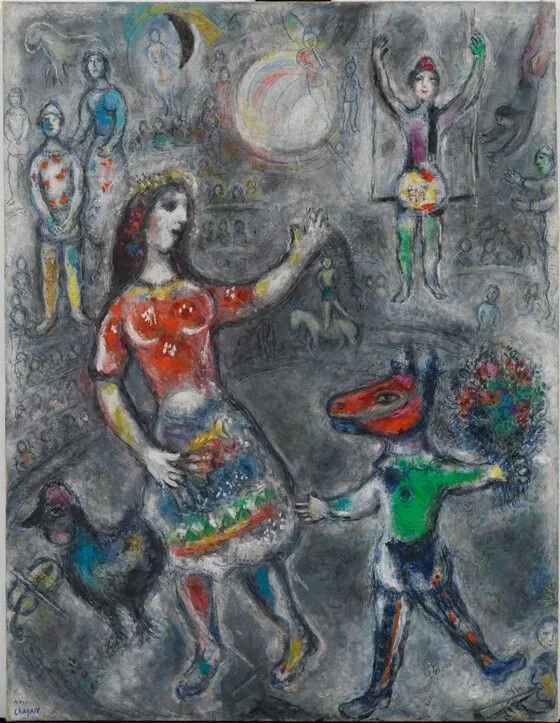
Marc Chagall
Queen of the Circus1974

On view:
Geffen Galleries, The A. Jerrold Perenchio Collection of Impressionist and Modern Art
Oil painting with crowded dreamlike scene: central woman in red top and ruffled skirt, figure with horse head offering flowers, ghostly figures and glowing orb in gray background
Artist or Maker
Marc Chagall
Belarus, active France, 1887-1985
Title
Queen of the Circus
Culture
French
Date Made
1974
Medium
Oil on canvas
Dimensions
Canvas: 45 5/8 × 37 in. (115.89 × 93.98 cm) Frame: 46 1/2 × 45 5/8 × 4 3/4 in. (118.11 × 115.89 × 12.07 cm)
Credit Line
Gift of A. Jerrold Perenchio
Accession Number
M.2025.64.22
Classification
Paintings
Collecting Area
European Painting and Sculpture
Curatorial Notes

Chagall’s approach to painting emerged from a strain of artistic fascination with mysticism and the supernatural that nourished Romanticism and Symbolism and reached its apogee in Dada and Surrealism around the time of World War I. What set him apart was his incorporation of folkloric and biblical themes into his vibrantly colored canvases. Born a Russian Jew into a family of modest means, Chagall’s grounding in the religious and cultural practices of turn-of-the-century western Russia defined his imagery for his entire career.

Moving to Paris in 1910, Chagall became immersed in the Parisian avant-garde and the circle of Guillaume Apollinaire—poet, champion of Cubism, and forefather of Surrealism. Though completed half a century later, The Queen of the Circus embodies the intellectual and formal concerns that had been incubating in Chagall’s work since the 1920s. Figures, animals, and musical instruments materialize in a spray of color across the picture plane. The sophisticated palette comprises vivid greens, deep magentas, and cobalt blues that work harmoniously alongside bursts of yellow and acidic orange. The interior of a circus is roughly defined by the ring and audience in the background, but direct references to an actual event, as well as perspective and narrative, end there. Rather, elements both large and small are deployed without a consistent perspectival strategy, resulting in a playful, fantastical artistic performance. As Chagall said of his semi-referential worlds: “Judge me by form and color, by my philosophy, not by the separate symbols. One can see all the questions and answers in the pictures themselves. Everyone can see them in his own way, interpret what he sees and how he sees.”

2024

Selected Bibliography
  • Lehmbeck, Leah, ed. Impressionist and Modern Art: The A. Jerrold Perenchio Collection. Los Angeles: Los Angeles County Museum of Art; Munich: DelMonico Books/Prestel, 2016.