LACMA

ShopMembershipMyLACMATickets
LACMA
Los Angeles County Museum of Art
5905 Wilshire Blvd.
Los Angeles, CA 90036
info@lacma.org
(323) 857-6000
Sign up to receive emails
Subscribe
© Museum Associates 2026
  • About LACMA
  • Jobs
  • Building LACMA
  • Host An Event
  • Unframed
  • Press
  • FAQs
  • Log in to MyLACMA
  • Privacy Policy
© Museum Associates 2026
Collections

Claude Monet
Water Liliescirca 1908

On view:
Geffen Galleries
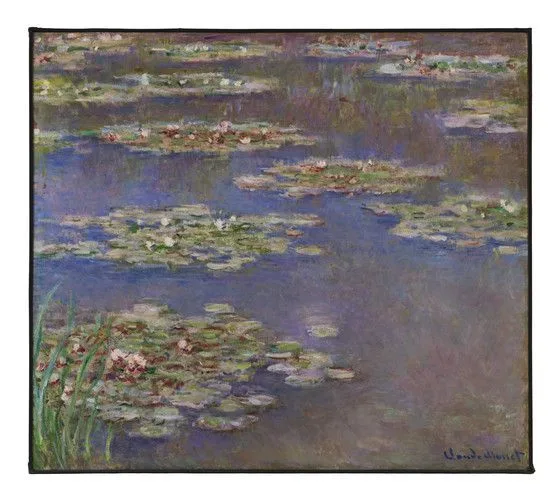
Oil painting of a water lily pond, lily pads and pink blossoms covering a periwinkle-blue surface, with reeds in the lower left corner and loose, impressionistic brushwork
Artist or Maker
Claude Monet
France, Paris, 1840-1926
Title
Water Lilies
Culture
French
Date Made
circa 1908
Medium
Oil on canvas
Dimensions
Canvas: 35 1/8 × 39 3/4 in. (89.22 × 100.97 cm) Framed: 39 9/16 × 34 1/8 × 2 1/8 in. (100.49 × 86.68 × 5.4 cm)
Credit Line
Gift of A. Jerrold Perenchio
Accession Number
M.2025.64.21
Classification
Paintings
Collecting Area
European Painting and Sculpture
Curatorial Notes

During the last three decades of his life, Monet focused almost exclusively on capturing views of his garden at Giverny, a suburb 45 miles northwest of Paris. By this time, his success was so well established that in 1890 he was able to purchase the house, build a studio there (hugely expanded during World War I), and renovate the garden. He spent years revamping the garden’s physical layout and cultivating a great variety of vegetation. In 1901–2, he dramatically enlarged the pond, as encroaching trees, grasses, and flowers had begun to block the light. In 1908, about a decade into his cycle of water lilies, he wrote, “These landscapes of water and reflections have become an obsession.” The zenith of this series was the panoramic frieze created for the French state and installed in the Orangerie.

LACMA’s Water Lilies was made toward the beginning of Monet’s exploration of the subject, but certainly after he was well along in his dedication to the project. While it likely served as a point along the way to realizing his magnum opus, it nevertheless stands convincingly on its own as an experiment in color, perception, and depth. The perspective changes from the bottom to the top of the canvas. The reeds at lower left—an exceptional detail among Monet’s water lilies—ground the picture along with the more aggressively illustrated group of leaves and flowers just behind. As the floating plants continue up the canvas, however, they begin to flatten—the viewpoint has seemingly changed from top down to sideways, making it appear as though the pond is curving away from the viewer from bottom to top. The fluctuating viewpoint accords with Monet’s visual experimentation, and yet the paint’s tactility undermines the perception of depth, creating a beautiful tension between near and far.

Monet chose this painting along with four other water lilies to be sold to two dealers, Durand-Ruel and Bernheim-Jeune, in an effort to stave off their interest in the giant murals and provide their clients—now living as far away as America and Japan—with his latest output.

2024

Provenance

The artist, sold December 1920 to; [Galerie Durand-Ruel, Paris, and Galerie Bernheim-Jeune, Paris, sold before March 1921 or in 1922 to]; [Galerie Durand-Ruel, Paris, sold 17 January 1923 to]; [Durand-Ruel Galleries, New York, sold 13 March 1925 to];(1) Franklin Felix Nicola (1860–1938), Pittsburgh. Mrs. K. D. Murdock, c. 1932. Mrs. George Blumenthal, New York. Lucius D. Humphrey (1881–1957), Paris and New York. [Wildenstein & Co., Inc., New York, sold 15 August 1952 to];(2) Charles W. Engelhard (1917–1971), bequeathed to;(3) Jane Engelhard (née Marie Antoinette Jeanne Reiss, 1917–2004) (sale, New York, Christie’s, 13 November 1996, lot 15, to); A. J. Perenchio (1930–2017), Los Angeles, gifted 2025 to; Los Angeles County Museum of Art

Footnotes

(1) Durand-Ruel verified the half-share arrangement between Durand-Ruel and Bernheim-Jeune, as well as their dates of purchase on 14 December 1920 (document prepared by Flavie and Paul-Louis Durand-Ruel for Leah Lehmbeck, 8 December 2015). Bernheim-Jeune records show the painting as being bought from the artist 1 December 1920 and sold to Durand-Ruel in 1922 (letter from Guy-Patrice Dauberville to Leah Lehmbeck, 15 April 2016).

(2) The Sterling and Francine Clark Art Institute’s Monet Rouen Cathedral, the Façade in Sunlight (1967.1) lists a similar early-to-mid- twentieth-century ownership history: “. . . [Durand-Ruel, Paris and New York, possibly from 1911–at least 1914]; Frank F. Nicola, Pittsburgh (in 1925); Murdock (c. 1932); Lucius D. Humphrey, New York; [Wildenstein, New York, until at least 1952]. . . .”

(3) In addition to this Monet, Engelhard owned The Artist’s Garden, Vétheuil, cat. 33.
Selected Bibliography
  • Lehmbeck, Leah, ed. Impressionist and Modern Art: The A. Jerrold Perenchio Collection. Los Angeles: Los Angeles County Museum of Art; Munich: DelMonico Books/Prestel, 2016.
Copyright
photo © Fredrik Nilsen

Related Unframed

Related Unframed

Diffuse Control by Beeple Iteration: Blurred Edges
  • December 4, 2025
  • Deliasofia Zacarias
The 2024 LACMA Holiday Gift Guide
  • November 20, 2024
  • Alexander Schneider
Flower Power: Andell Family Sundays
  • August 10, 2017
  • Alicia Vogl Saenz
Pierre Huyghe at LACMA: Arts Reporting as Embedded Journalism
  • February 18, 2015
  • Brian Sonia-Wallace
A. Jerrold Perenchio Announces Bequest of His Impressionist and Modern Art Collection to LACMA
  • November 6, 2014
  • Linda Theung