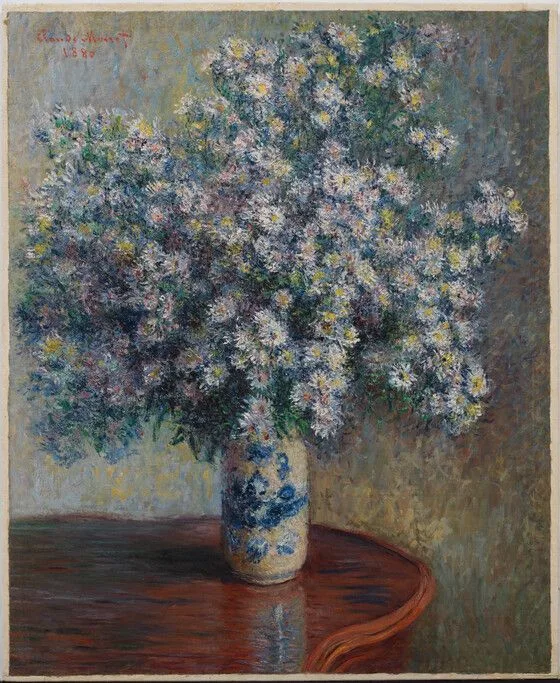
Throughout his seven-decade career, Claude Monet focused his artistic efforts on the urban and rural settings in which he lived. Nevertheless, while still-life painting was in many ways antithetical to his approach to capturing the flickering environments of the outdoors, he occasionally turned to the arrangement of flowers, fruits, or game. These periods reflect moments of professional crisis or growth. When Monet took up the very saleable genre of still life, he was not just responding to inclement weather—as he adamantly insisted. Rather, he hoped to improve the marketability of his work and establish name recognition. His most significant and sustained period of still-life painting came between 1880 and 1882, during which time he produced a group of large canvases each featuring a single species of flower, as in this magnificent picture of asters. Paint explodes across the surface, petals and leaves bursting like firecrackers. The fall blooms, also called autumn daisies, fill more than half of the composition. The vase, which appears in at least two other paintings in the series, may have been inspired by the works of Japanese ceramist Makuzu Kōzan, who won a gold medal at the 1878 Paris Exposition Universelle.
The boldness of these still lifes, at least one of which, Bouquet of Sunflowers (Metropolitan Museum of Art, New York), was showcased in the Seventh Impressionist Exhibition in 1882, made a big impact on Monet’s younger colleagues. In November 1888, Vincent van Gogh wrote to his brother Theo: “Gauguin was telling me the other day—that he’d seen a painting by Claude Monet of sunflowers in a large Japanese vase, very fine. But—he likes mine better. I’m not of that opinion. . . . If at the age of forty I do a painting of figures like the flowers Gauguin was talking about I’ll have a position as an artist alongside anything.”
2024