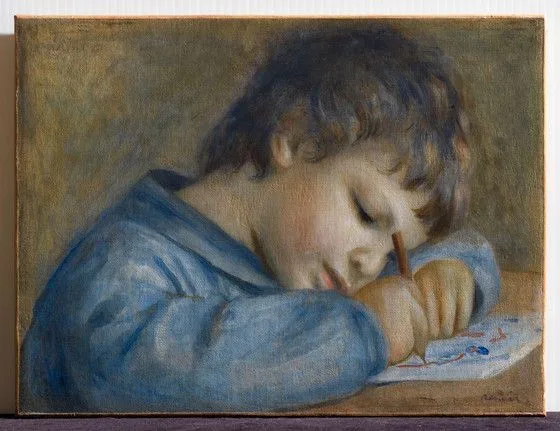
The artist, to 9 June 1891; [Galerie Durand-Ruel, Paris, sold before 1922 to];(1) Paul Durand-Ruel (1831–1922), Paris. [Galerie Durand-Ruel, Paris and New York, sold 24 February 1932 to]; Stephen C. Clark (1882–1960), New York, sold 21 November 1945 to;(2) [Durand-Ruel Galleries, New York and Rosenberg, New York]. [Galerie Durand-Ruel, New York sold 27 February 1948 to]; A. B. Knop City Bank Farmers (Astor), New York. Lord and Lady Astor, New York, by 1964;(3) Mr. And Mrs. James Astor, London. [Coe Kerr Gallery Inc., New York, sold 26 March 1982 to]; A. J. Perenchio (1930–2017), Los Angeles, gifted 2025 to; Los Angeles County Museum of Art
Footnotes
(1) According to Durand-Ruel the painting was purchased by the gallery from the artist on 9 June 1891 (stock no. 1004). The picture was later part of Paul Durand-Ruel’s private collection, but the gallery is unable to identify exactly when, although certainly before his death in 1922. The gallery sold it to Clark, and it was purchased back by the New York gallery, in half shares with Rosenberg (Durand-Ruel, New York, stock no. 5525). In their stockbook, the final sale by Durand-Ruel was to “A.B. Knop City Bank Farmers (Astor)” on 27 February 1948 (document prepared by Flavie and Paul-Louis Durand-Ruel for Leah Lehmbeck, 8 December 2015). Lord Astor’s name and dates of ownership are given by François Daulte in his catalogue raisonné.
(2) Labels on the reverse of the painting identify Clark as owner of the painting during this period. Known for his philanthropy and art collecting, Stephen C. Clark was one of the heirs to the Singer Sewing Machine Company fortune. In addition to establishing the National Baseball Hall of Fame in Cooperstown, NY, he was actively involved in New York’s art museums, including the Metropolitan Museum of Art and the Museum of Modern Art, where he was a trustee. His brother, also an art collector, founded the Sterling and Francine Clark Art Institute in Williamstown, MA.
(3) This is possibly John Jacob Astor (1886–1971), 1st Baron Astor of Hever, New York and London. According to François Daulte this was in the collection of Lord and Lady Astor, London, by 1964.