LACMA

ShopMembershipMyLACMATickets
LACMA
Los Angeles County Museum of Art
5905 Wilshire Blvd.
Los Angeles, CA 90036
info@lacma.org
(323) 857-6000
Sign up to receive emails
Subscribe
© Museum Associates 2026
  • About LACMA
  • Jobs
  • Building LACMA
  • Host An Event
  • Unframed
  • Press
  • FAQs
  • Log in to MyLACMA
  • Privacy Policy
© Museum Associates 2026
Collections

Camille Pissarro
The Market at Gisors1889

On view:
Geffen Galleries
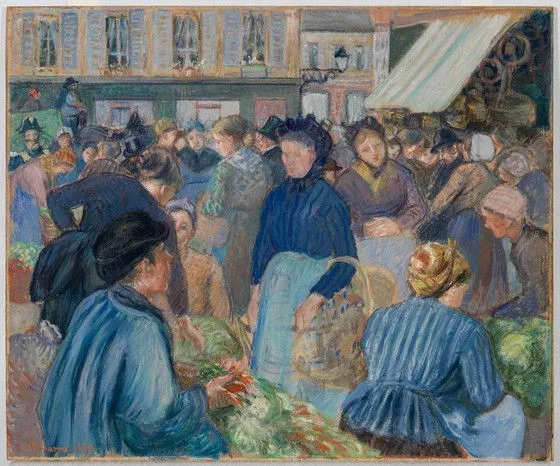
Pastel or oil painting of a crowded outdoor market scene, dozens of figures in dark coats and hats filling the composition in front of pale building facades, rendered in loose broken brushwork
Artist or Maker
Camille Pissarro
Title
The Market at Gisors
Culture
French
Date Made
1889
Medium
Tempera and pastel on canvas
Dimensions
Canvas: 20 1/4 × 25 5/8 in. (51.44 × 65.09 cm) Frame: 30 15/16 × 35 3/16 × 2 1/4 in. (78.58 × 89.38 × 5.72 cm)
Credit Line
Gift of A. Jerrold Perenchio
Accession Number
M.2025.64.12
Classification
Paintings
Collecting Area
European Painting and Sculpture
Curatorial Notes

While Camille Pissarro’s distinguished career is primarily associated with the landscape genre, he explored figure painting at regular intervals throughout his life, beginning in the early 1850s during his study trip to Caracas, where he produced images of rural laborers. He also depicted several market scenes, a natural next step from his paintings of fieldworkers as those same figures are shown selling the fruits of their labor in the local markets. It is this later phase in the cycle of production and consumption that is on view in The Market at Gisors, a busy image expressive of Pissarro’s attentive vision of humanity, as well as a digestible (read: saleable) version of his political ideology.

Much has been written about the impact of progressive anarchism on Pissarro’s artwork. As he himself stated, “I firmly believe that our ideas, impregnated with anarchist philosophy, rub off on our work.” Pissarro rejected the sentimental notion of the noble peasant humbly laboring in a romantic rural setting, à la Jean-François Millet. Grounded in his recognition that goods are the product of human capital, his market scenes are honest depictions of the realities of farmwork and its place in a cyclical economy. The marketplace is the point of contact between rural and urban dwellers, a liminal space where both are needed to sustain each other’s way of life.

But there is no blatant dogma in Market at Gisors. Rather, we are placed directly in the action, from a slightly elevated view, behind two vegetable vendors. Top hats can be spotted here and there among the crowds of mainly women buying and selling, and the caricatured features of a gendarme are visible in the distant left. The canvas quivers with movement. The majority of the composition is defined by bodies going about their business, as Pissarro devotes three-quarters of the canvas to a sea of focused human activity, with only hints of the setting—an awning, a few architectural details, a street lamp. He harnessed the qualities of tempera and pastel to create tapestry-like effects, producing a remarkable range of colors. Subtle hues provide depth, and pops of color lead the eye through the pictorial narrative. Details such as the woman’s kerchief at lower right and the spring radishes at lower center reveal Pissarro’s incredible facility with both paint and chalk.

2024

Provenance

Marc François, Paris (sale, Paris, Hôtel Drouot, 20 March 1935, lot 11, to); Salomon Flavian, Paris.(1) [Paul Rosenberg (1881–1959), Paris, after July 1937, still in 1939]. [Sam Salz (1894–1981), Inc., New York, by 8 January 1941, still by 28 February 1941].(2) Mrs. Doris Warner Vidor (1912–1978), USA, by 25 March 1965.(3) Private Collection, United States.(4) [Coe Kerr Gallery Inc., New York, sold 26 March 1982 to]; A. J. Perenchio (1930–2017), Los Angeles, gifted 2025 to; Los Angeles County Museum of Art

Footnotes

(1) Hôtel Drouot auction, Tableaux Modernes, Gouaches, Pastels . . .Oeuvres Importantes de Claude Monet . . . appartenant à Marc François, 20 March 1935, lot 11, illus. in catalogue. The Getty Research Institute’s c.2 (Dieterle) sale catalogue is hand-annotated with price and buyer: “12.000 Flavian.” At least some of the property belonging to Salomon Flavian (identified as a Romanian citizen) was seized by the Devisenschutzkommando at the Westminster Bank, 24 rue de la Faisanderie, Paris, in 1941. However, it appears this was already part of Paul Rosenberg’s gallery stock sometime after July 1937, bearing the stock number 3825, according to Ilda François at The Paul Rosenberg Archives (email to Casie Kesterson, 5 October 2015). The Paul Rosenberg Archives have no records for the period of 1929 to 1939, and they are unable to confirm from whom the painting was purchased or to whom it was sold.

(2) The painting appears in Knoedler & Co. records as owned by Sam Salz indicating these dates, and there is a Sam Salz label on the reverse of the painting indicating his ownership.

(3) Vidor was the daughter of Harry Warner and the fourth (and final) wife of Charles Vidor (1900–1959), Hollywood director.

(4) Provenance given by Coe Kerr Gallery Inc., in the owner’s object file.
Selected Bibliography
  • Lehmbeck, Leah, ed. Impressionist and Modern Art: The A. Jerrold Perenchio Collection. Los Angeles: Los Angeles County Museum of Art; Munich: DelMonico Books/Prestel, 2016.
Copyright
photo © Fredrik Nilsen