LACMA

ShopMembershipMyLACMATickets
LACMA
Los Angeles County Museum of Art
5905 Wilshire Blvd.
Los Angeles, CA 90036
info@lacma.org
(323) 857-6000
Sign up to receive emails
Subscribe
© Museum Associates 2026
  • About LACMA
  • Jobs
  • Building LACMA
  • Host An Event
  • Unframed
  • Press
  • FAQs
  • Log in to MyLACMA
  • Privacy Policy
© Museum Associates 2026
Collections

Camille Pissarro
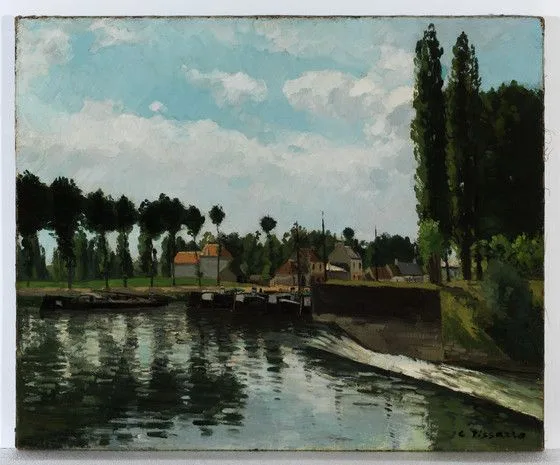
The Weir at Pontoisecirca 1868

On view:
Geffen Galleries
Impressionist oil painting landscape of a calm canal with moored barges, low buildings, poplar trees, and a cloudy sky reflected in the water
Artist or Maker
Camille Pissarro
West Indies, active France, 1830-1903
Title
The Weir at Pontoise
Culture
French
Date Made
circa 1868
Medium
Oil on canvas
Dimensions
Canvas: 18 1/4 × 21 1/2 in. (46.36 × 54.61 cm) Frame: 28 5/16 × 33 5/16 × 2 1/4 in. (71.91 × 84.61 × 5.72 cm)
Credit Line
Gift of A. Jerrold Perenchio
Accession Number
M.2025.64.11
Classification
Paintings
Collecting Area
European Painting and Sculpture
Curatorial Notes

The town of Pontoise, northwest of Paris, was a touchstone for Camille Pissarro, a symbol of both the picturesque and the effects of rapid industrial development along the waterways and in the countryside of rural France. He captured the dichotomies of this historical shift time and again in paintings such as The Weir at Pontoise, and his brushwork, palette, and interest in the constantly fluctuating atmosphere mirror that changing ground. This view was painted from the Pontoise side of the river Oise, with the village of Saint-Ouen-l’Aumône in the background. The weir, or dam, was intended to regulate the dramatic variations in water level in that section of the river. The barges moored in the center of the picture were thus forced to travel along the river on the far side of the small island, depicted here with tall poplars on its northern tip. The luminous light blue sky and gauzy clouds are reflected in the dark green water, which turns to white foam as it passes over the weir.

Pissarro was revered by a generation of painters as a nurturing mentor and friend. Mary Cassatt observed, “He was so much a teacher, that he could have taught stones how to draw correctly.” Cézanne, Gauguin, Seurat, Signac, and Matisse all acknowledged their debt to the gentle, thoughtful man who was born in Saint Thomas (at the time, a French colony) to French-Jewish merchants. In 1855, he settled in Paris, then moved with his wife and two young children to Pontoise around 1866. Monet, Renoir, and Cézanne soon followed, and would paint alongside Pissarro. He was the only member of the Impressionists to participate in all eight of their exhibitions, and his pictorial approach continued to evolve throughout his career.

2024

Provenance

Jean-Baptiste Faure (1830–1914), Paris, by at least 1902, by descent to;(1) Maurice-Louis-Émile Faure (1850–1919), Paris, by descent to; Mme Maurice-Louis Faure, Paris, sold 1 February 1919 to; [Durand-Ruel Galleries, New York, and Galerie Georges Petit, Paris]; [Galerie Georges Petit, Paris, sold 18 February 1919 to];(2) [M. Knoedler & Co., New York, sold December 1925 to]; [Galerie Georges Petit, Paris, sold 24 April 1929 to]; Antonio Santamarina (1880–1974), Buenos Aires (sale, New York, Sotheby’s, 2 April 1974, lot 8, to);(3) [Galerie Bellarte possibly on behalf of Private Collector, Italy].4 Possibly Private Collector, Italy. [Galerie Bellarte (sale, New York, Sotheby’s, 15 May 1984, lot 28, to)]; A. J. Perenchio (1930–2017), Los Angeles, gifted 2025 to; Los Angeles County Museum of Art

Footnotes

(1) “Faure” is inscribed on the stretcher on the reverse of the painting. Jean-Baptiste Faure was a celebrated French operatic baritone, and a number of works from his collection of Impressionist paintings appear in museums today, including the Pissarro Cowherd Valhermeil, Auvers sur-Oise at the Metropolitan Museum (Inv. 56.182), which also has the same provenance from the Faure family to Durand-Ruel and Galerie Georges Petit.

(2) According to Durand-Ruel, the two galleries owned the painting jointly (half shares) (document prepared by Flavie and Paul-Louis Durand-Ruel for Leah Lehmbeck, 8 December 2015), however Knoedler’s records note the purchase was from Georges Petit only. See M.Knoedler & Co., Painting Stock Books 6: 12653-15139, 1911 December–1920 July, p. 188, no. 14626 “New York March 1919” in a group of paintings coming from Georges Petit, Paris, dated 18 February 1919. Georges Petit sold it to Santamarina on 24 April 1929. The number “14626” is inscribed on the stretcher on the reverse of the painting.

(3) Antonio Santamarina was an Argentine cattle rancher and politician whose collection of Impressionist and modern paintings was considered one of the best in South America. See Michel Strauss, Pictures, Passions and Eye: A Life at Sotheby’s (London: Halban, 2011), pp. 220–24. In addition to this Pissarro, Santamarina owned Toulouse-Lautrec’s Paul Viaud, Taussat, Arcachon, cat. 47.
Selected Bibliography
  • Lehmbeck, Leah, ed. Impressionist and Modern Art: The A. Jerrold Perenchio Collection. Los Angeles: Los Angeles County Museum of Art; Munich: DelMonico Books/Prestel, 2016.