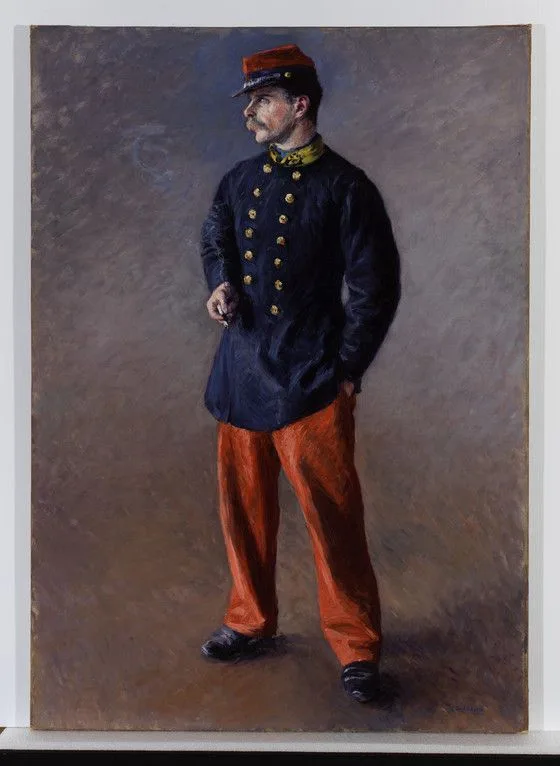
This portrait is a superb example of Gustave Caillebotte’s unique verism. Unlike the shimmering worlds of his friends Monet and Renoir, Caillebotte’s take on modern life was rendered with a sharp, controlled touch in an often severely constructed composition, and the execution of his subject matter embeds gentle, naturalistic observation in an artificial, presentational offering. Here, the soldier is clad in the bright red pants characteristic of the French uniform; gold embellishments on the hat, collar, and jacket reflect the artist’s keen attention to detail. The soldier’s gaze, directed off the canvas and away from the viewer, is difficult to read. But his casual stance, one hand in pocket, the other holding a cigarette, subverts the traditional heroicizing portrait of a military figure. This man appears as if on stage, and the blank background—beautifully executed in a wash of violet and rose—promotes the impression of a studio picture.
A pivotal figure in the history of Impressionism, Caillebotte received a largely positive critical reception during his short window of exhibiting between 1876 and 1882. Émile Zola, a champion of many Impressionists, declared Caillebotte “the most noble of the group,” and his work was often described as courageous and truthful. However, his extraordinary wealth, which allowed him to support the Impressionists in exceptional ways, from promoting exhibitions to assuming the role of organizational leader and, most particularly, the financial support of individual artists, seems to have upstaged his artistic endeavors. Above all, Caillebotte’s bequest of sixty-eight Impressionist works to the French nation at a time when these artists were still largely underappreciated by the public may have distracted historians from dealing with his own painterly accomplishments.
2024