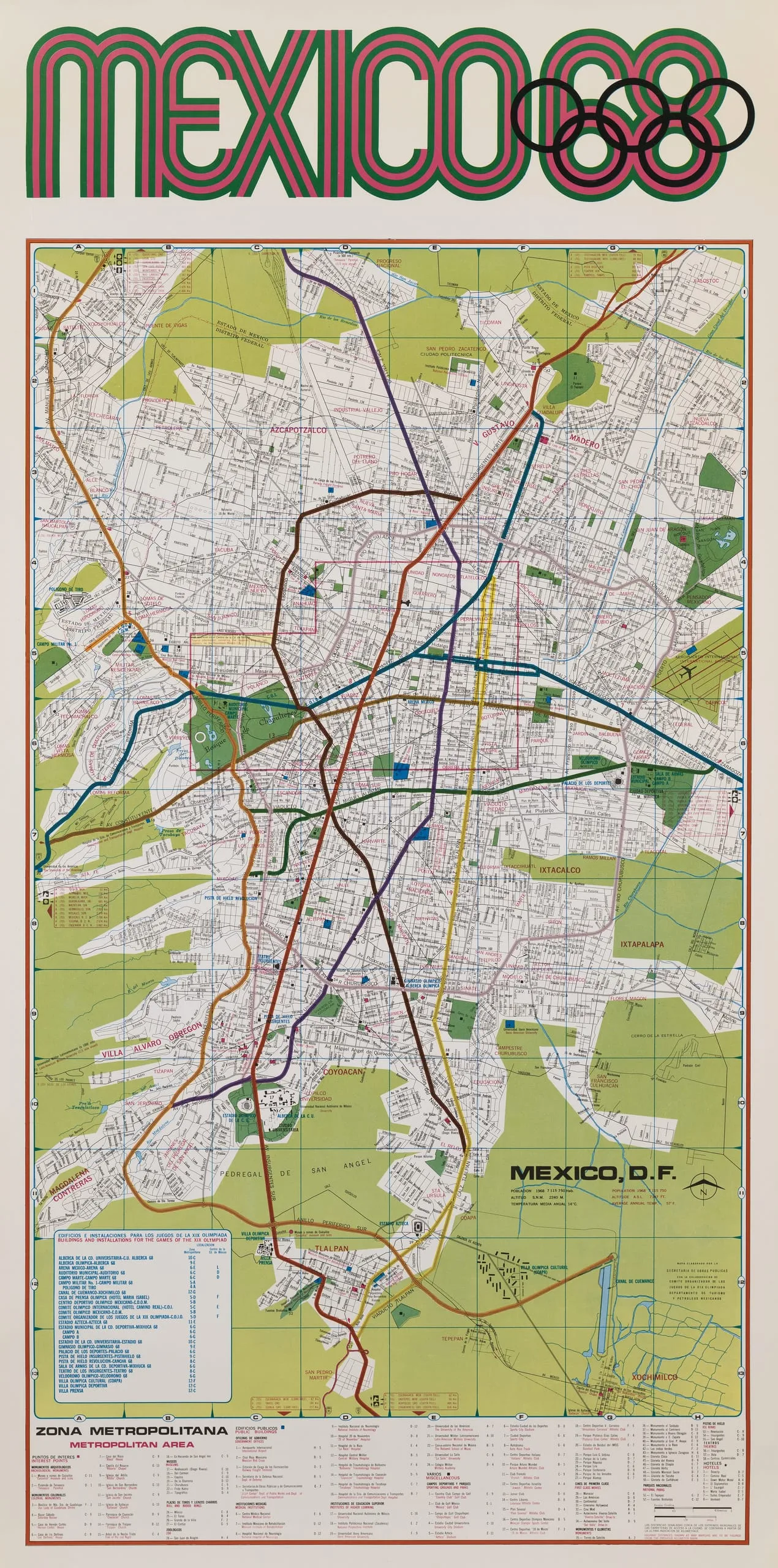
A transformative moment in Mexican history, the 1968 Olympics in Mexico City is remembered both for its brilliant design scheme and for the horrifying massacre of student protestors only days before the opening ceremonies. For Mexican politicians, the games provided an unprecedented opportunity to present the rapidly modernizing nation to a global audience. Design played a crucial role; as Mexican architect Pedro Ramirez Vasquez, director of the Organizing Committee for the Games of the XIX Olympiad, observed in a 2005 interview, "Of least importance was the Olympic competition: the records fade away but the image of a country does not."
Ramirez Vasquez oversaw the large international design team, who developed a sophisticated branding program to unify the sprawling metropolis. Mexican architect Eduardo Terrazas created a color-coding system that helped visitors navigate the many event sites, even going so far as to paint light posts among the city’s main thoroughfares to match maps posted across the city. The games’ iconic logo was attributed at the time to American designer Lance Wyman, though conflicting accounts assign some credit to Ramirez Vasquez and Terrazas. The logo’s hypnotic, radiating lines reference both the international fashion for Op Art and the celebrated textile techniques of Mexico’s Huichol people.
Staci Steinberger, Associate Curator, Decorative Arts and Design, 2021