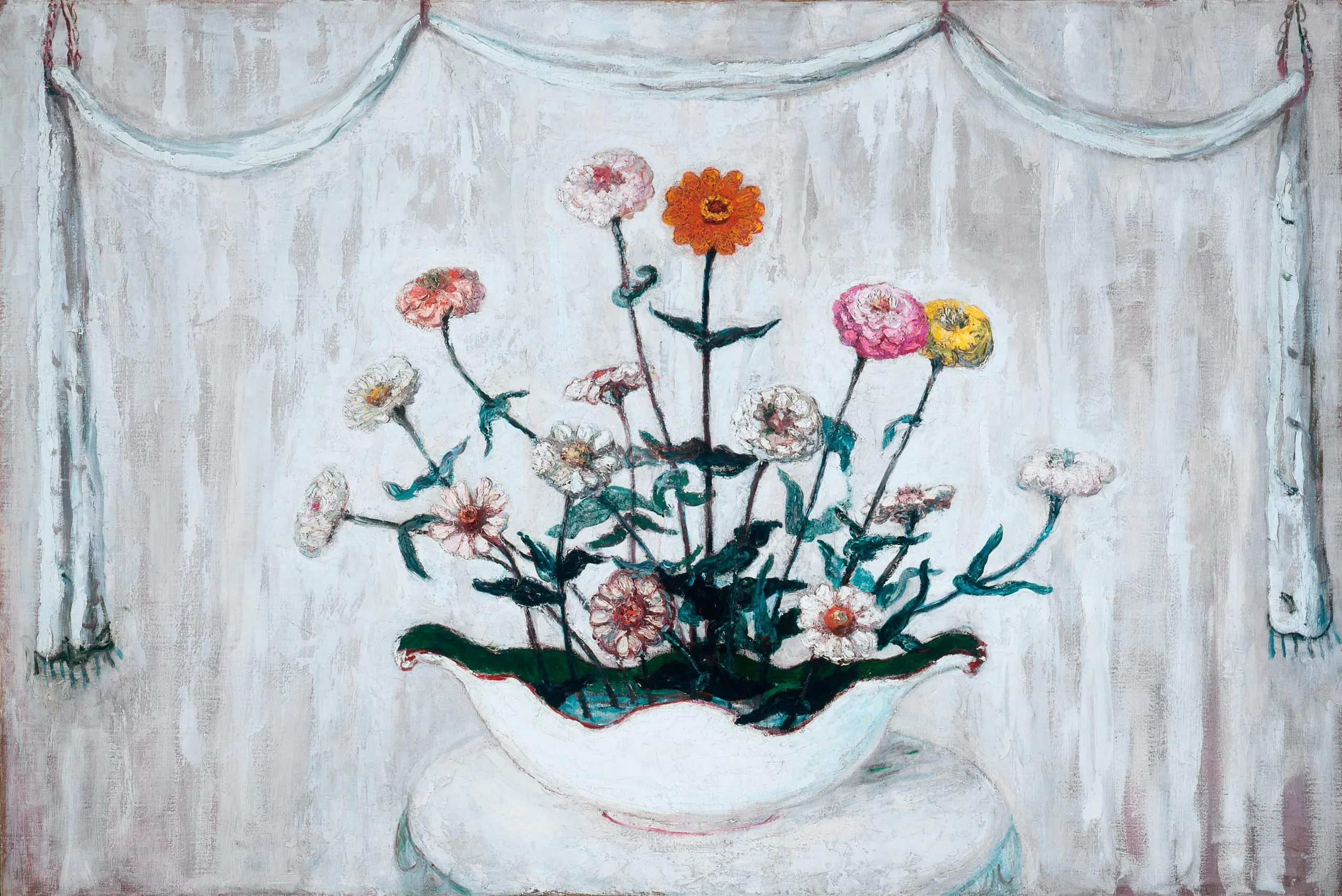
Stettheimer painted flowers throughout her life, incorporating them into her figurative compositions or using them as the focal point of her still-life paintings.
Zinnias exhibits all the typical elements of a mature Stettheimer still life. A bouquet of flowers is placed beneath a festoon on a table in the center of the composition. In the 1920s Stettheimer became fascinated with the design theories of Adolfo Best-Maugard (1891-1964), whose principles of composition were based on simplicity and conventionalized, childlike images. Stettheimer’s repeated use of a frontal view of a vase of flowers and drapery swag may have been related to Best-Maugard’s emphasis on such motifs.
Stettheimer painted the vase, background, and festoon in white with tints of pink and gray underpaint. White was her color, for she not only used it extensively in her painting as a color and to key up her palette, she also surrounded herself with white, often wearing a fringed white dress and decorating her studio in white lace and fringed drapery. The garland draped above the vase in the museum’s painting alludes to her canopied bed. The vase of flowers appears to exist in a sheltered, private niche, safe from the outside world, just as Stettheimer lived in an exclusive, refined world that she created. Even the thickly impastoed surface, characteristic of Stettheimer’s mature art, suggests the pure sensuosity of her maidenly, but artistically rich, life.