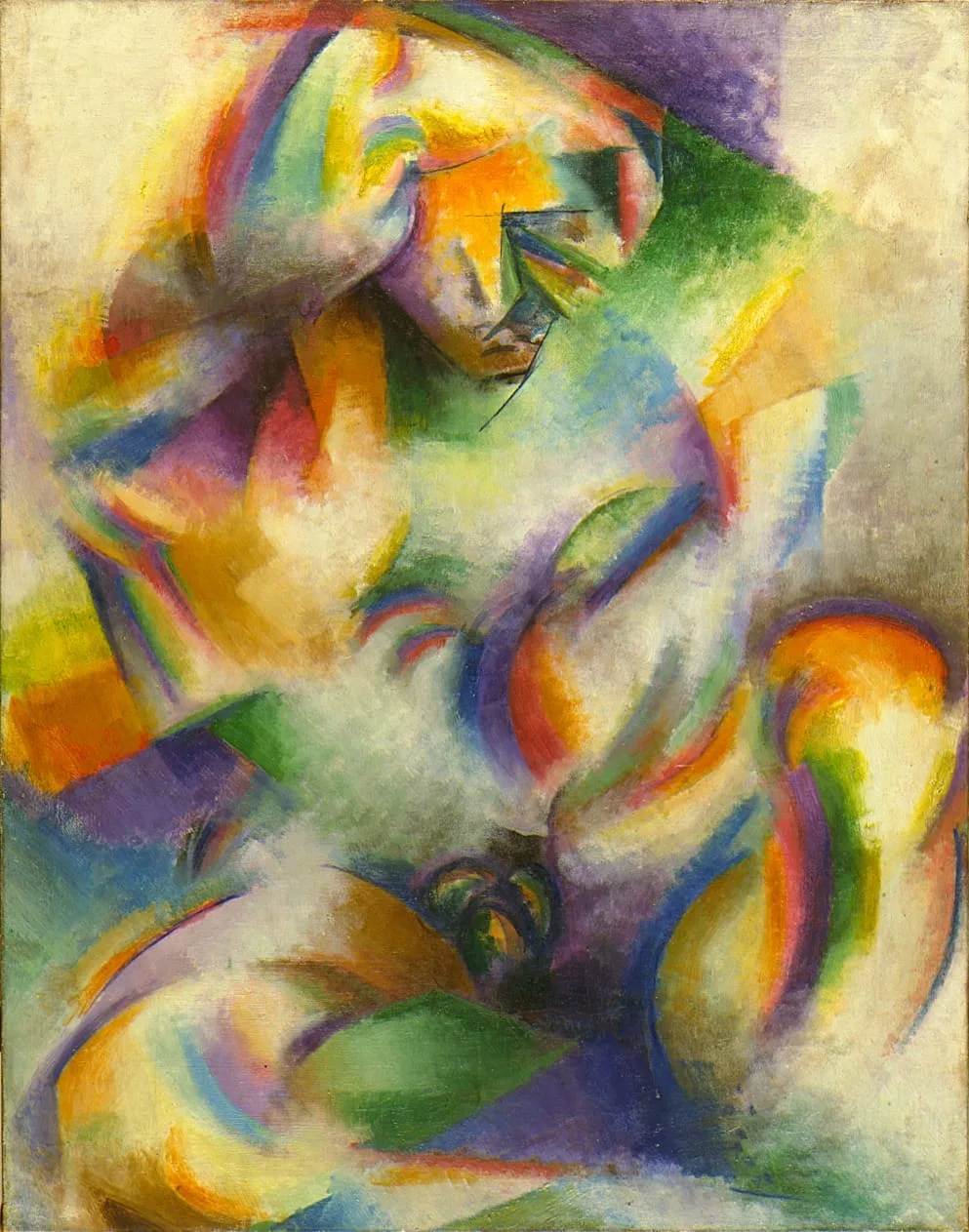
Macdonald-Wright created relatively few completely nonobjective synchromies, fearing that such work could deteriorate into "aimless ‘free’ decoration" ("The Artist Speaks: Stanton Macdonald-Wright," Art in America 55 May 19671: 73). He preferred instead to base his color abstractions on the figure. He and Morgan Russell both greatly admired the muscular figures of Michelangelo (1475-1564) and used his powerful human forms in their paintings. Synchromy in Purple is one of many paintings in which the artist based the composition on a heroic figure. In Synchromy in Blue, 1916 (Weyhe Gallery, New York, as of 1978), the figure is presented in almost the same seated pose, its large, muscular body nearly bursting beyond the edges of the canvas.
Synchromy in Purple is typical of the color abstractions Macdonald-Wright painted around 1916 and 1917. The artist purged his palette of blended tertiary colors, relying largely on the primary and secondary hues of the color spectrum-in this case using reds, blues, purples, and yellows-and often presenting them as complementary color chords. While Russell’s palette had been limited to these colors as early as 1913, Macdonald-Wright did not adopt such prismatic hues until later. Unlike Russell, Macdonald-Wright employed white extensively, thereby creating paintings with a softer, more crystalline luminosity. Moreover, he did not present the colors as fractured colored planes; here he sketched in the basic contours and even some of the details of the face with arcing blue lines and applied the brilliant hues in long strokes. The white and color passages function together to suggest light and dark and consequently a modeled human body. Despite Macdonald-Wright’s intentions, the color becomes almost a decorative overlay, and consequently the later synchromies such as this example appear less avant-garde. Macdonald-Wright’s paintings would always retain a certain luminous delicacy, and these qualities accorded well with his later fascination with oriental philosophy and art.