- Title
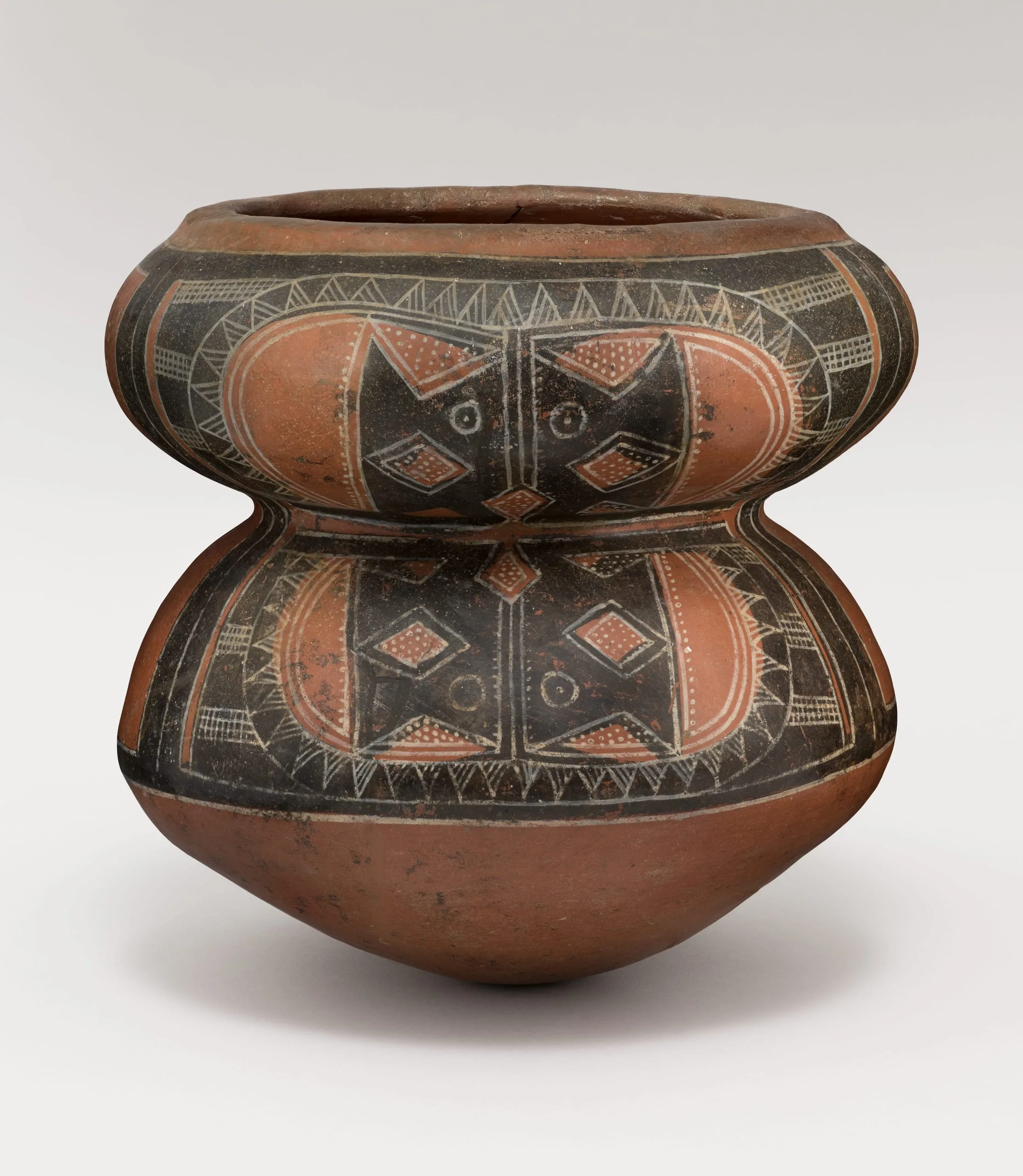
- Double-bodied Jar
- Date Made
- 250–500 CE
- Medium
- Slip-painted ceramic
- Dimensions
- Height: 11 in. (27.94 cm)
Diameter: 11 in. (27.94 cm)
- Accession Number
- M.2015.268.2
- Curatorial Notes
Double-bodied vessels (doble cuerpos) are perhaps the most iconic and showy of Tonosí-style ceramics. This example features a globular lower chamber with a slightly flattened one on top, and its rounded base indicates that it was not designed to stand upright on its own. Vessels of this type have been found in infant burials, but the reason for such a placement is unknown. The decoration, painted in black and white on a deep red ground, is mirrored on the upper and lower chambers. What the artist intended to depict is unclear—possibly frogs viewed from above.
Tonosí-style ceramics are primarily associated with the southern tip of the Azuero Peninsula. As here, designs are typically repeated on the front and back, and often in panels enclosed by circumferential bands at the top and bottom.