LACMA

ShopMembershipMyLACMATickets
LACMA
Los Angeles County Museum of Art
5905 Wilshire Blvd.
Los Angeles, CA 90036
info@lacma.org
(323) 857-6000
Sign up to receive emails
Subscribe
© Museum Associates 2025

Museum Hours

Monday

11 am–6 pm

Tuesday

11 am–6 pm

Wednesday

Closed

Thursday

11 am–6 pm

Friday

11 am–8 pm

Saturday

10 am–7 pm

Sunday

10 am–7 pm


  • About LACMA
  • Jobs
  • Building LACMA
  • Host An Event
  • Unframed
  • Press
  • FAQs
  • Log in to MyLACMA
  • Privacy Policy
© Museum Associates 2025
Collections

Shitao
LandscapesQing dynasty, dated 1694

Not on view
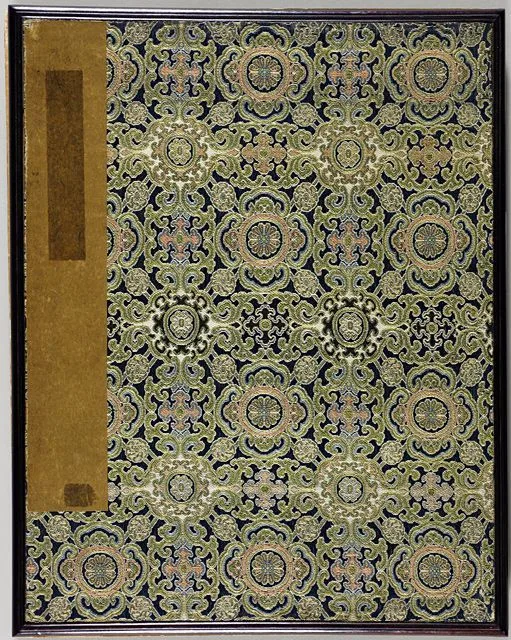
Cover of a bound book or album with an all-over woven textile pattern of gold and sage green medallions on a navy blue ground, with a plain golden-tan panel along the left edge
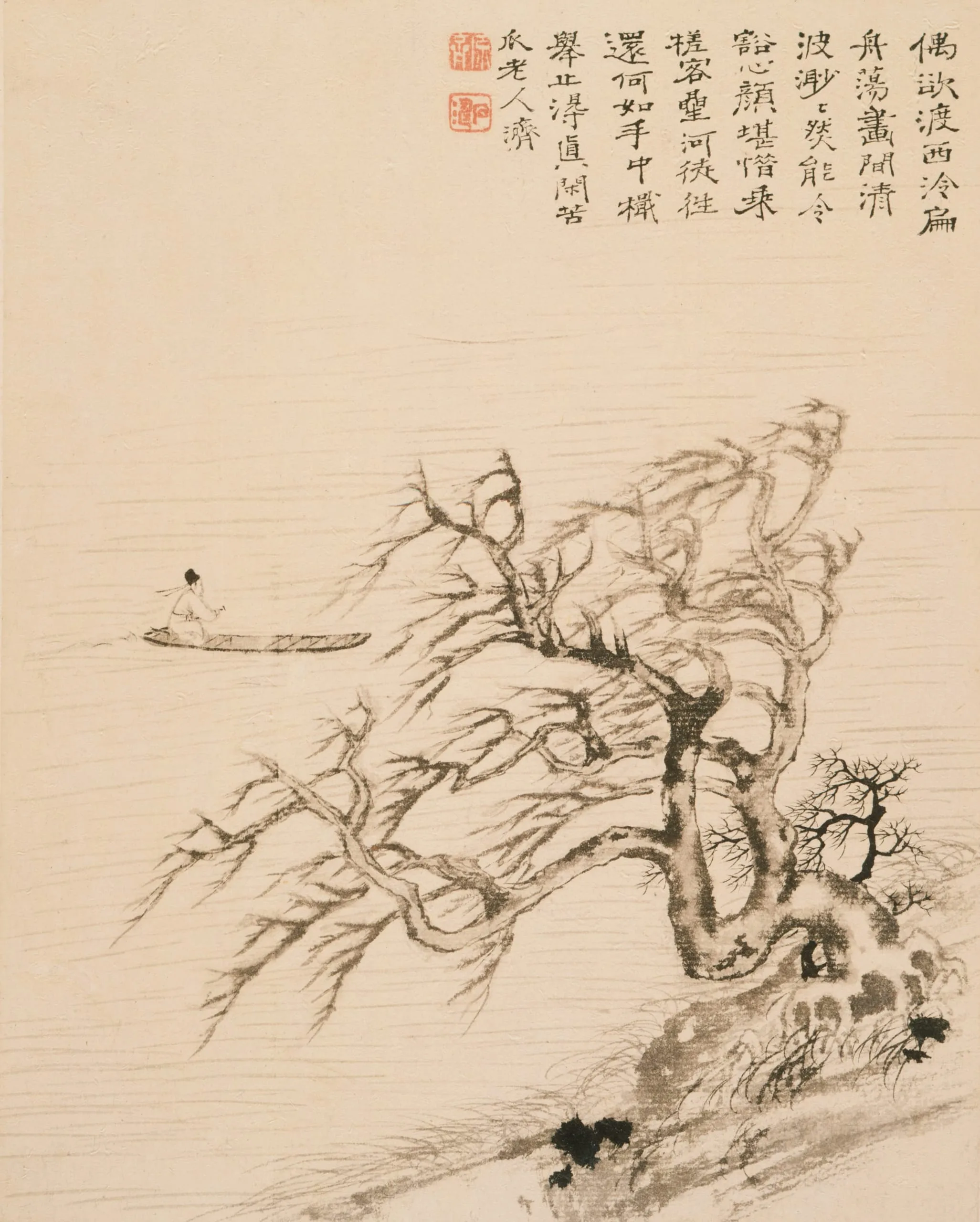
Ink painting on paper; a lone figure poles a small boat across open water at left, beside a gnarled, windswept tree and rocky shore rendered in fluid brushwork; columns of Chinese calligraphy and two red seals at upper right.
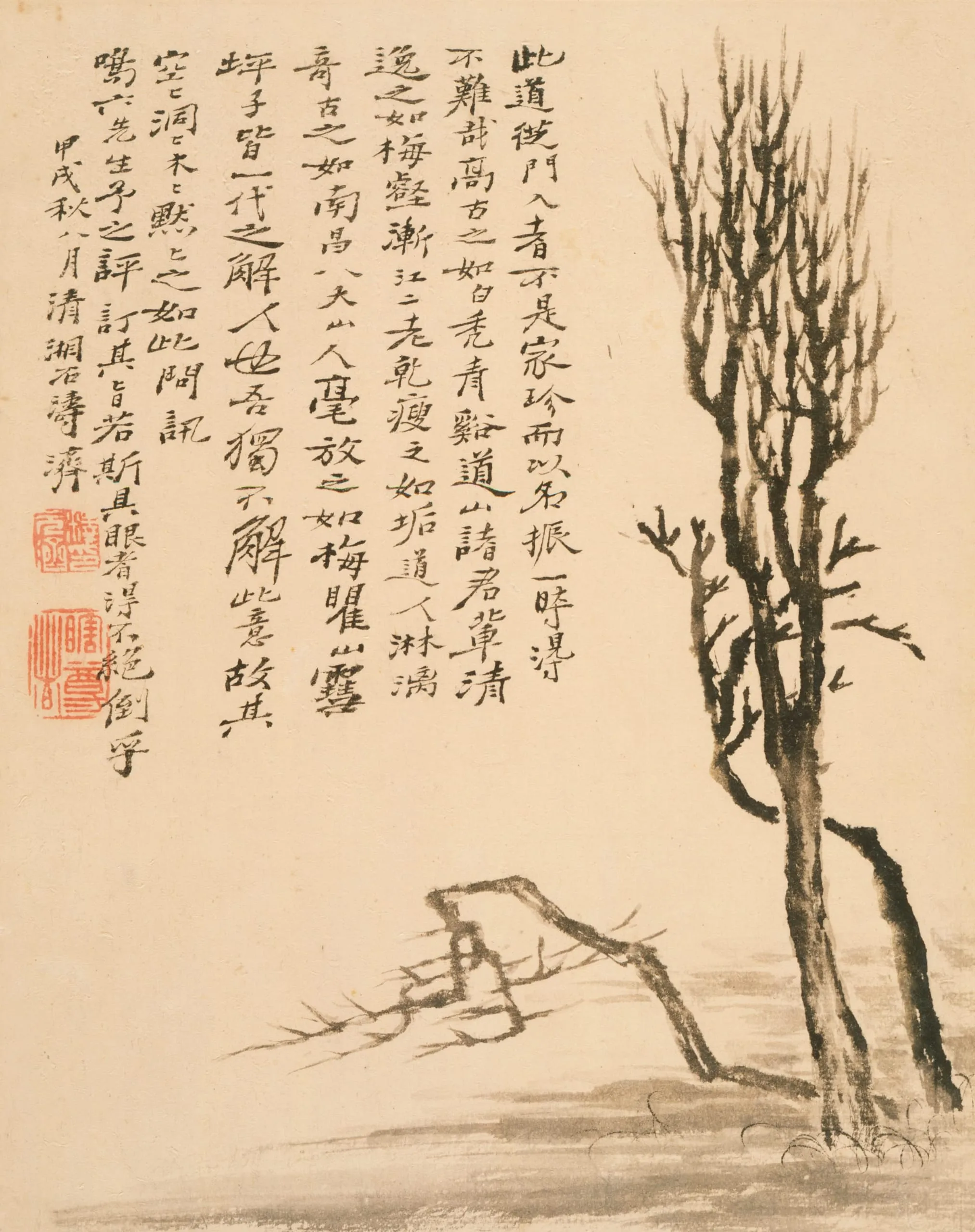
Ink painting on paper depicting a bare, leafless tree beside a weathered rock on a sparse ground plane, rendered in loose, expressive brushwork. Multiple columns of Chinese calligraphy fill the left and upper portions, with two red seal impressions at lower left.
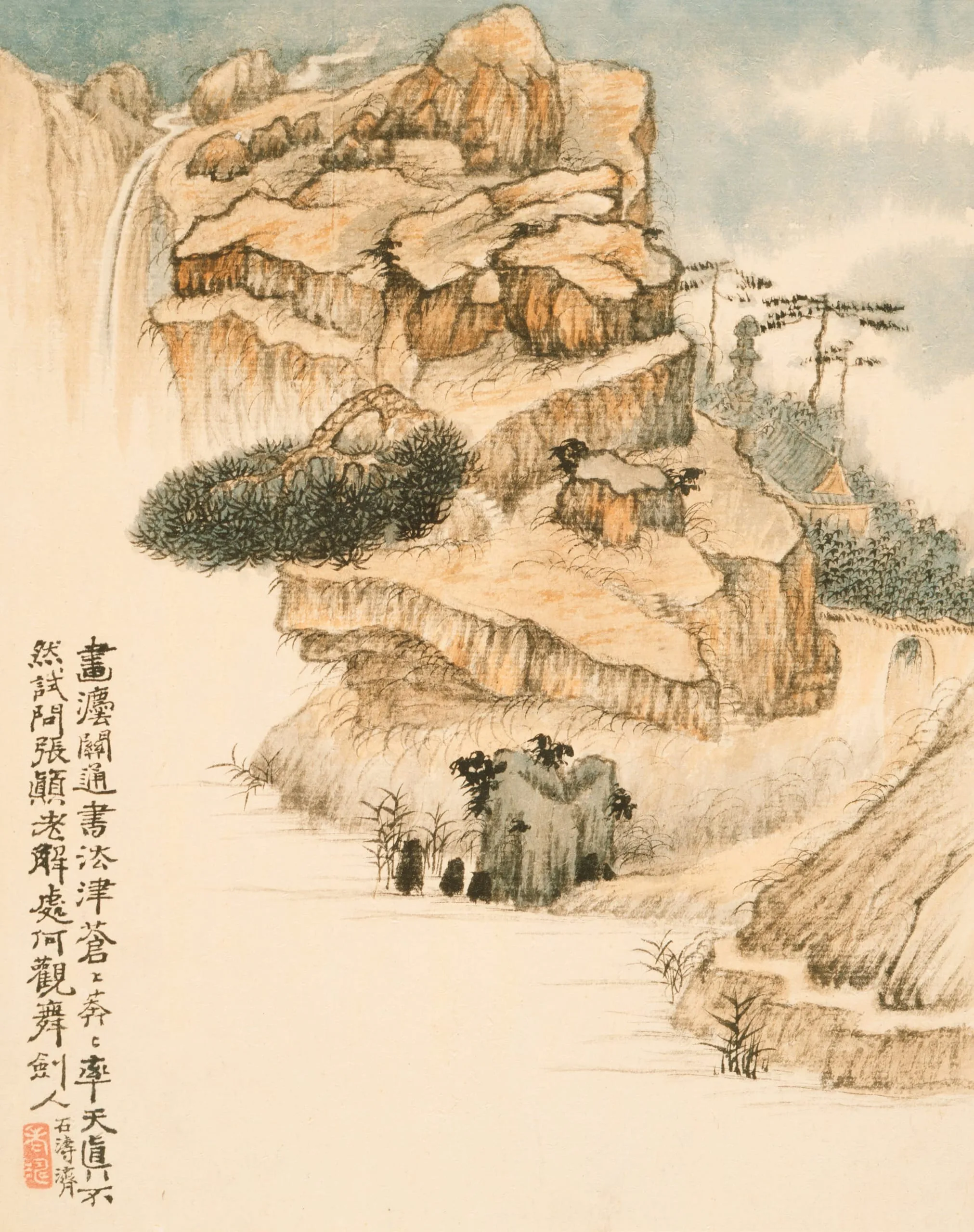
Chinese ink and color landscape painting on paper, depicting a towering rocky cliff with a waterfall at upper left, pine trees, and a pavilion at right; two small figures stand near water in the foreground; columns of Chinese calligraphy and a red seal at lower left.
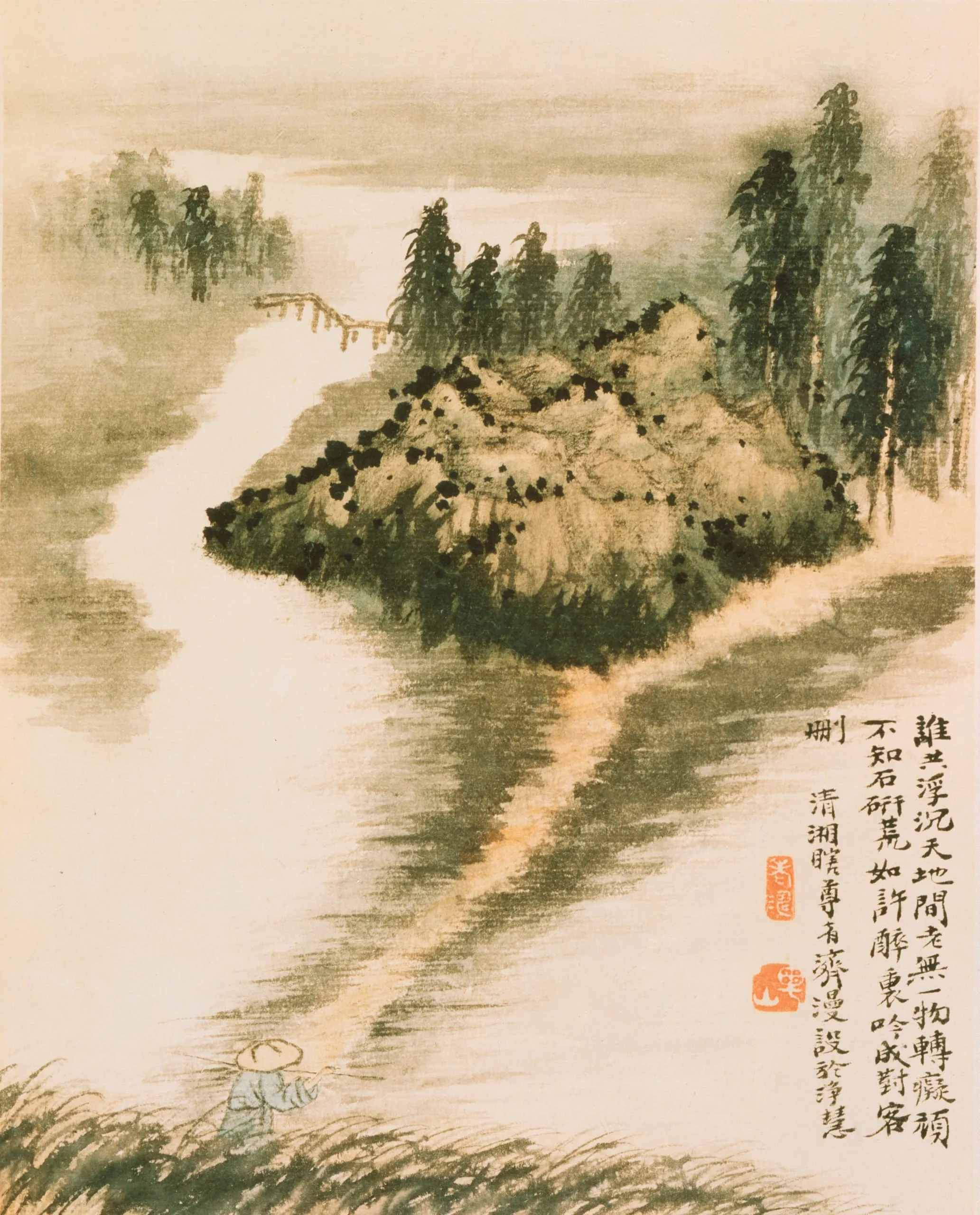
Ink and wash landscape painting of a rocky, tree-covered island surrounded by calm water, with a wooden bridge in the middle distance and mist dissolving into pale sky. A lone figure in a wide-brimmed hat stands among tall grasses in the lower left. Columns of Chinese calligraphy and two red seal stamps at lower right.
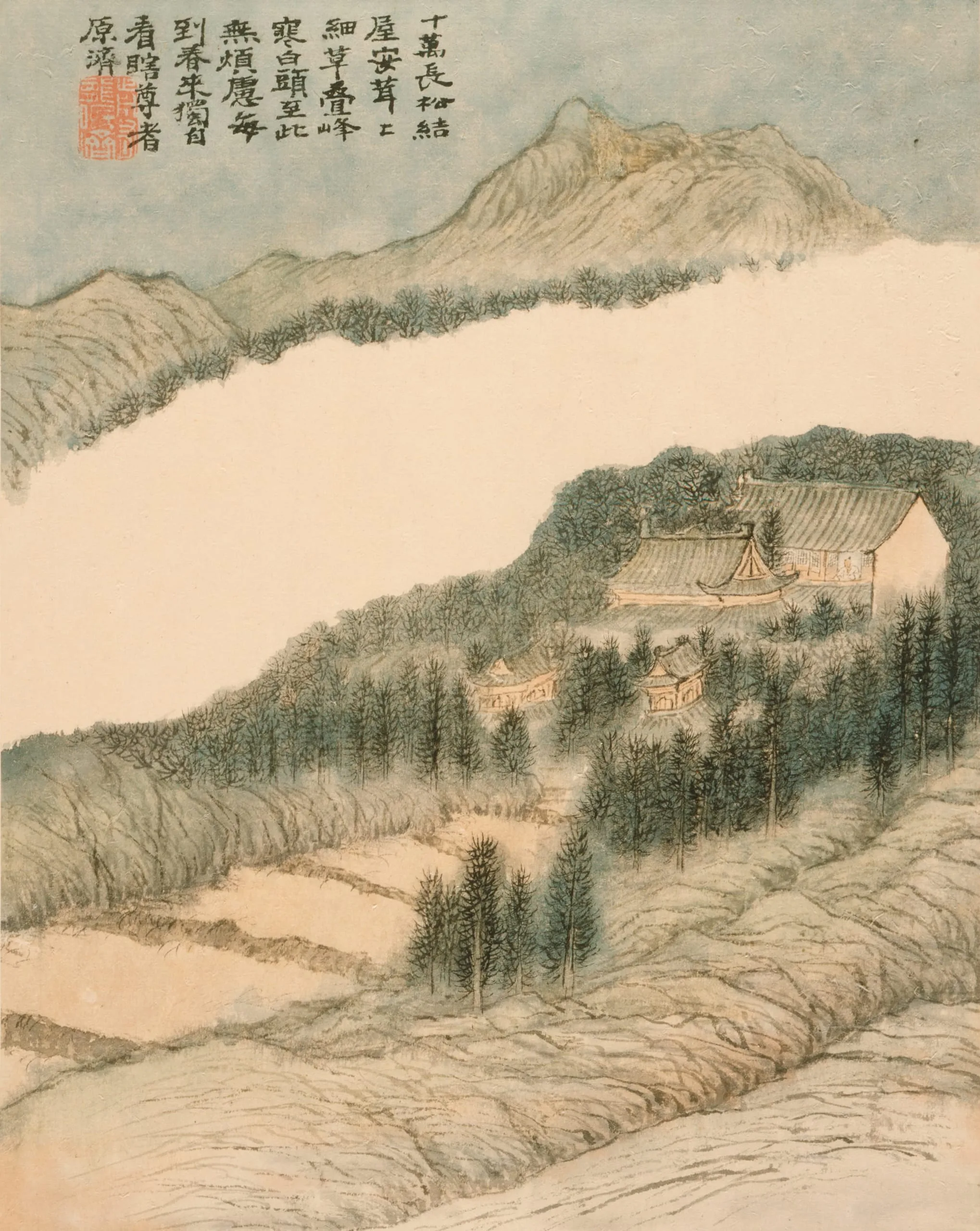
Chinese ink and color landscape painting depicting a mountain valley with traditional roofed buildings nestled among pine trees on a hillside, misty peaks in the background, and columns of Chinese calligraphy with a red seal at upper left.
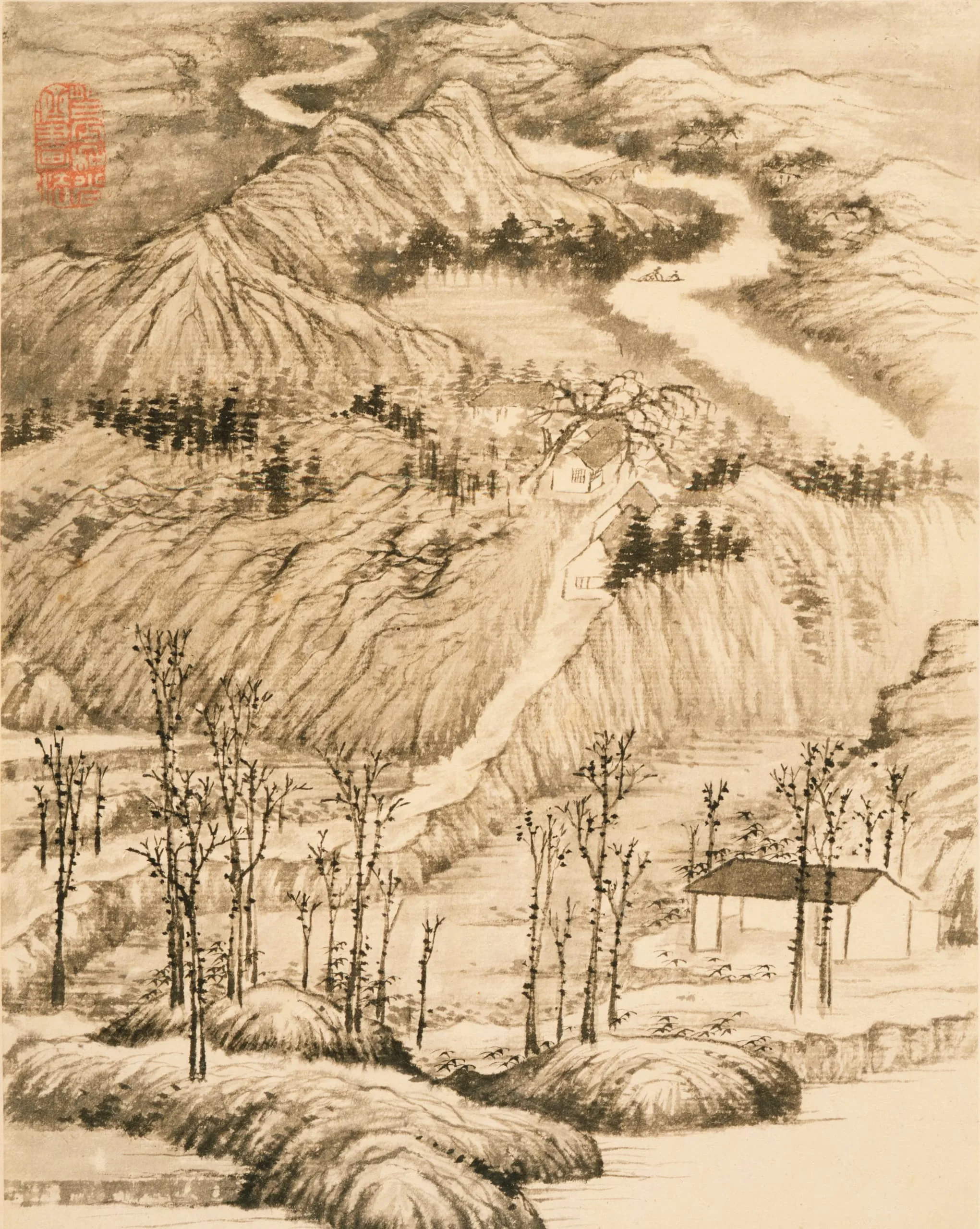
Chinese ink landscape painting with layered mountains receding into mist, a winding river, scattered pines, bare deciduous trees in the foreground, and small pavilions nestled among the hills; red seal impression at upper left.
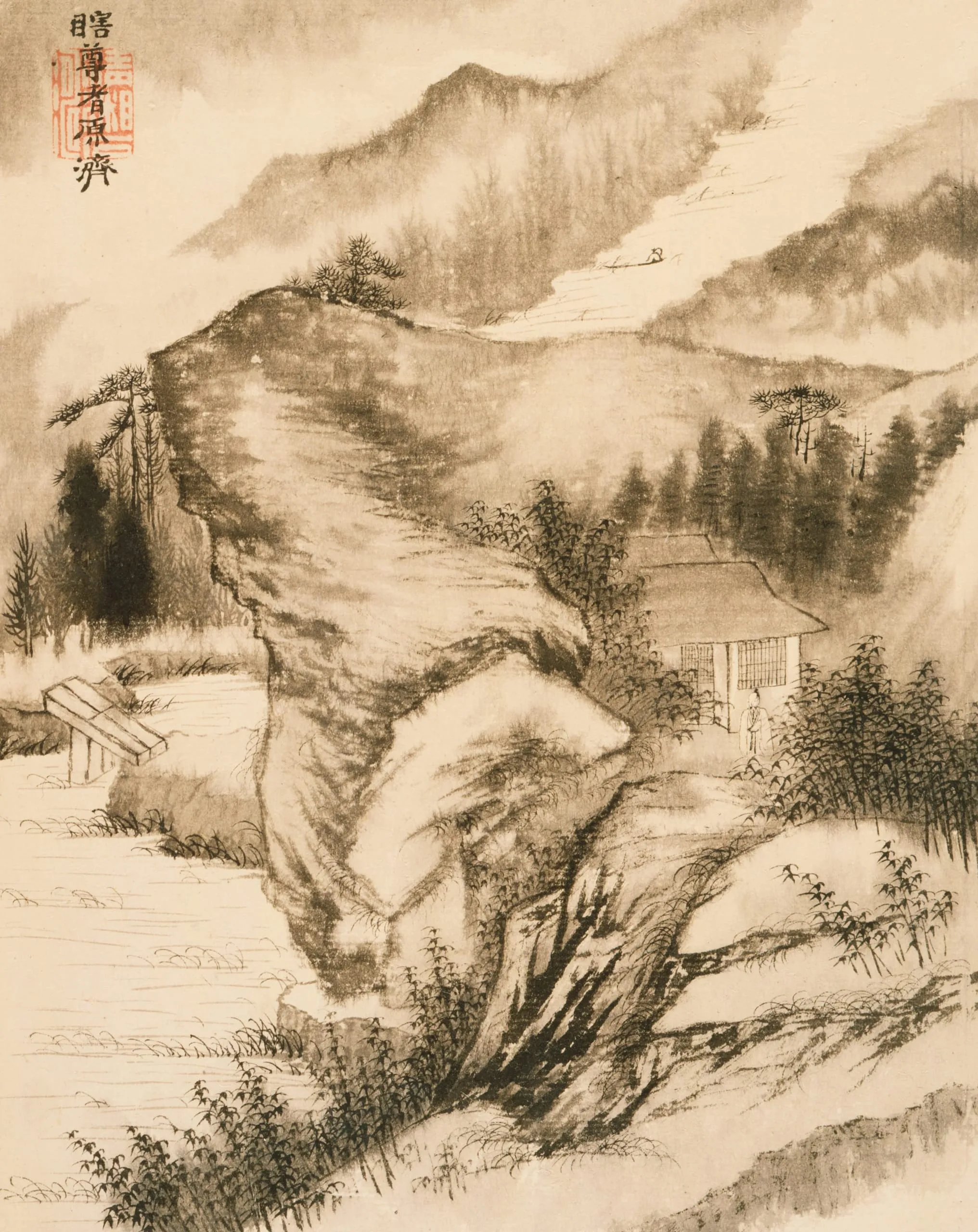
Ink wash landscape with craggy rocks, a thatched structure, and pine trees in the foreground; misty mountains recede into the background with a small boat on water. Vertical columns of Chinese calligraphy and a red seal at upper left.
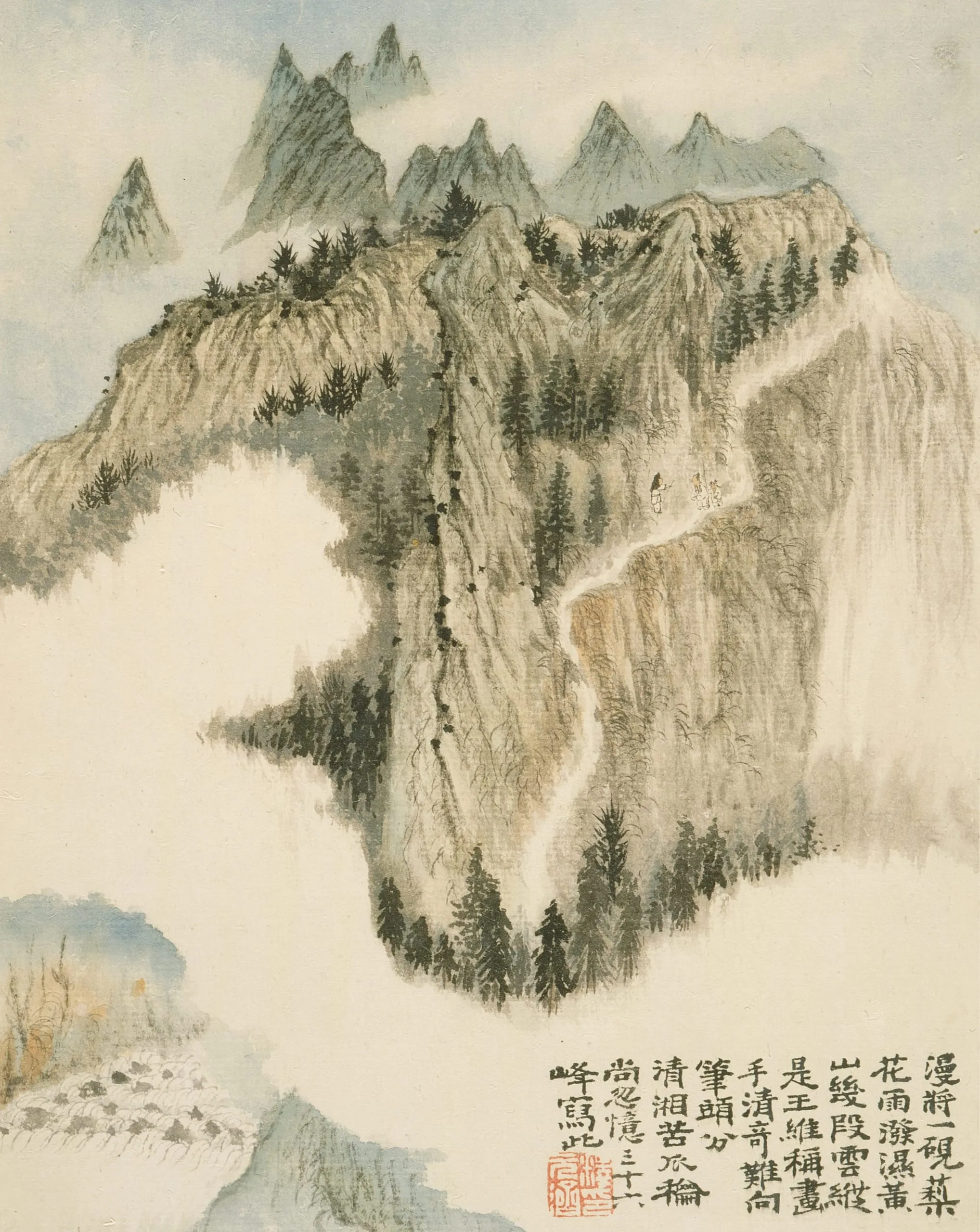
Chinese ink and color landscape painting of jagged mountain peaks rising through mist, with dark conifer trees clinging to rocky cliffs; a winding path with a small figure descends the central massif; columns of Chinese calligraphy and red seals at lower right.
Artist or Maker
Shitao
Title
Landscapes
Culture
Chinese
Place Made
China
Date Made
Qing dynasty, dated 1694
Period
Qing dynasty
Medium
Eight-leaf album, ink and color on paper
Dimensions
Image: 11 x 8 3/4 in. (27.94 x 22.22 cm); Mount: 13 3/8 x 10 1/2 in. (33.97 x 26.67 cm); Mat: 16 x 14 in. (40.6 x 35.6 cm)
Credit Line
Los Angeles County Fund
Accession Number
60.29.1a-h
Classification
Books
Collecting Area
Chinese and Korean Art
Curatorial Notes
The Qing dynasty in China was founded in 1644 by a coup d'etat. Having been asked to come south to Beijing to help quell a rebellion, the Manchus of the north obliged, then occupied the capital and proclaimed their rule. Fortunately they greatly admired Chinese culture, adopting its more conservative institutions and a reactionary Confucianism. Despite this, and despite a period of civil unrest and political realignment, ceramics, architecture, and painting flourished.
This vigor in Qing arts is nowhere better seen than in the work of Shitao, one of the most original and formally creative artists in all Chinese paintings. A descendant of Ming royalty, Shitao was an accomplished calligrapher, poet, painter, and art theorist. Although ordained a Buddhist monk, he chose travel over seclusion and enjoyed intellectual and aesthetic relationships with other artists and poets.
Shitao maintained a determined and articulate independence from the academicism that governed literati painting at the time. His painting of the early 1690s shows him at the height of his powers and engaged in experimental stylistic concerns. This scene of Mount Huang depicts white-water rapids at the lower left, suggesting a possible viewpoint just in front of the picture plane. Shitao then evokes a great and precipitous leap across a mist-filled chasm to a higher view of steeply massed peaks, a mountain ridge, and a trail where three figures meet, their scale and detail seeming to contradict this implied distance. There is an arresting invention in the shifting perspective. Shitao's fluid washes, dark brushstrokes, and voids create solid, naturalistic forms seen in a transient moment.
Selected Bibliography
  • Hay, Jonathan. Shitao: Painting and Modernity in Early Qing China. Cambridge: Cambridge University Press, 2001.