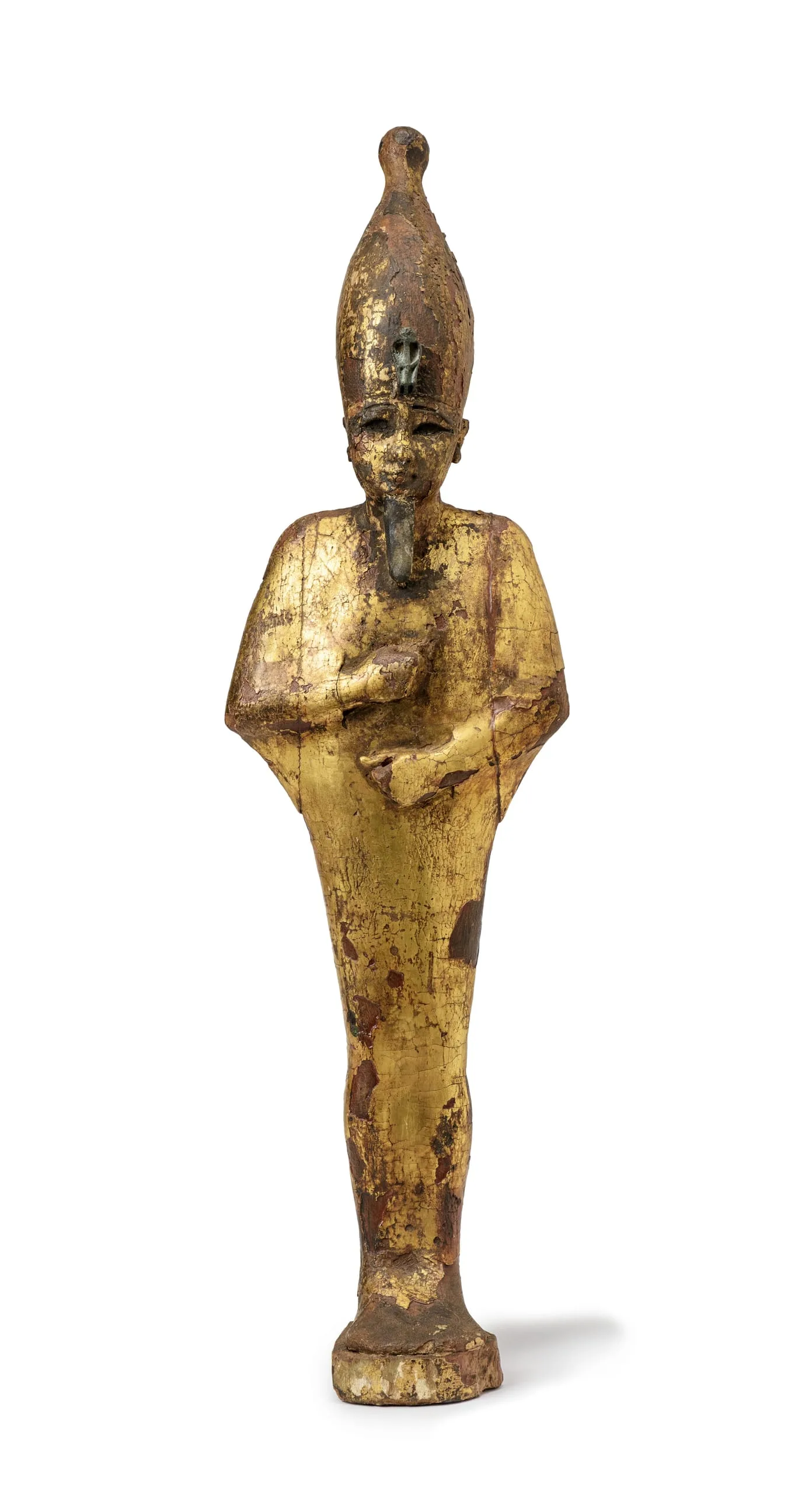
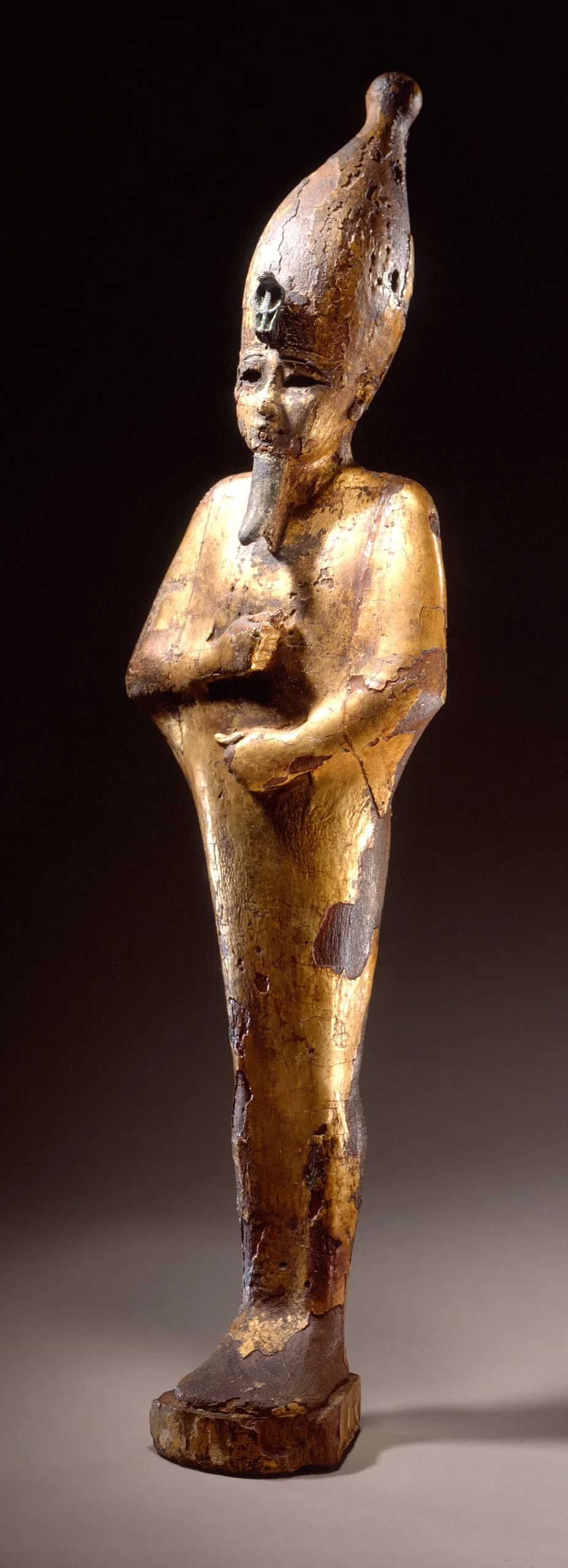
Osiris was the protective funerary god of the ancient Egyptians, the “Foremost of the Westerners,” a title that references the location of many cemeteries on the west side of the Nile River. From the 5th Dynasty (c. 2435−2306 BCE) onward, he is mentioned in texts as part of the Egyptian pantheon, and soon after takes on other attributes to become the embodiment of the dead and divine kingship. Throughout antiquity, Osiris was depicted as a shrouded figure wearing the tall and slightly bulbous atef royal crown of Upper Egypt, and carrying the emblems of kingship, a crook and flail. This elegantly proportioned wood statuette is gilded and originally had inlaid eyes, probably of glass and obsidian. The body’s form is carefully delineated beneath the enveloping shroud. The well-defined hands would originally have held royal implements. The protective royal emblem, the uraeus, is inserted as a bronze element on the figure’s forehead. In addition, he wears a bronze “false-beard,” a distinctive attribute of Osiris that was also depicted in reliefs and believed to have been worn by reigning kings and queens, such as Hatshepsut.
The head, torso, and legs of this Osiride figure were carved from a single piece of wood; each arm was made separately, then pinned with wood dowels to the body. Similar gilded figures with bronze attributes and inlaid eyes, representing a range of deities, were preserved in the royal tomb of Tutankhamun, discovered nearly intact in 1922.