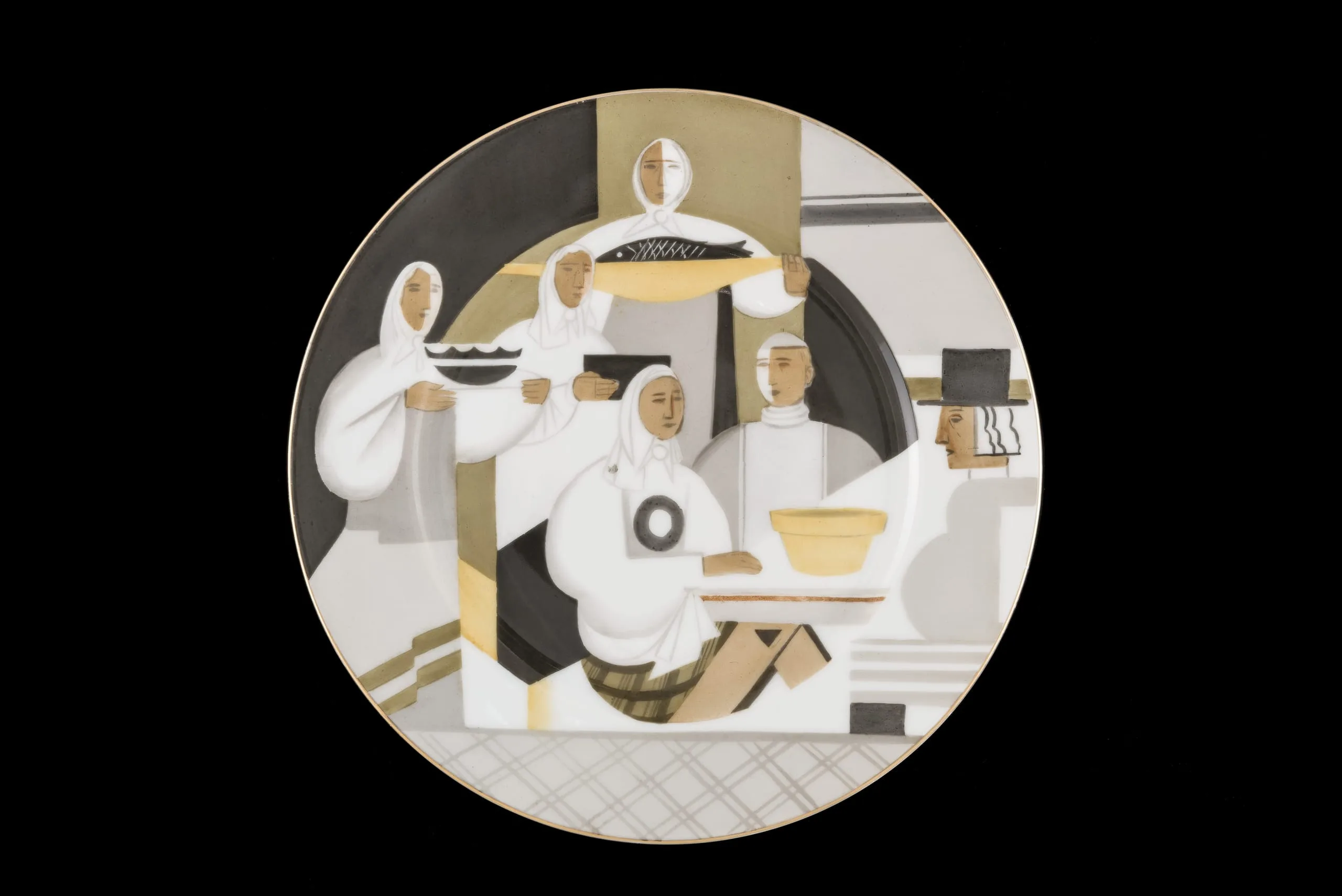
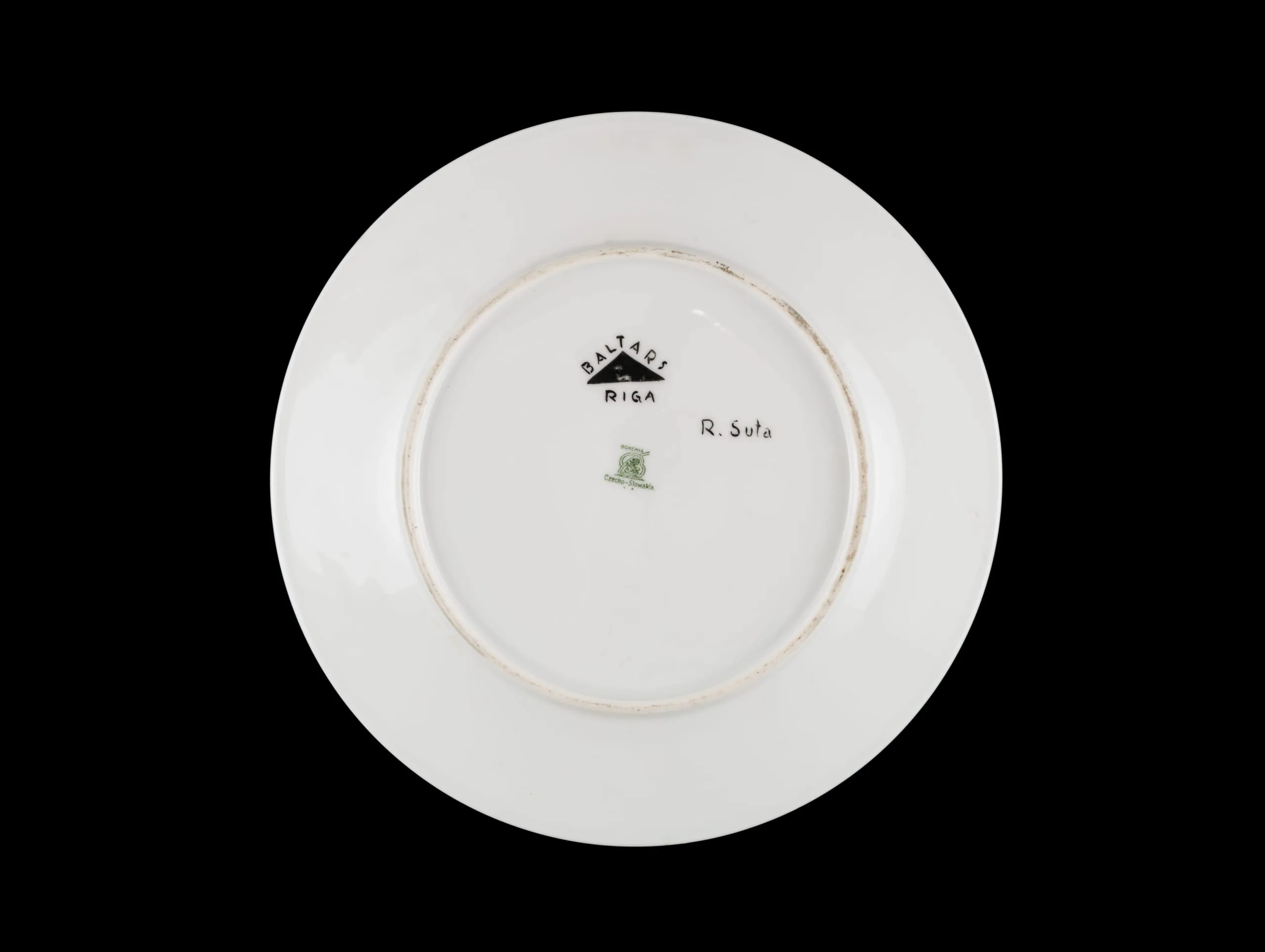
In the second half of the 1920s, less than a decade after Latvia’s independence from Russia, a group of artists operated the Baltars Workshop to disseminate their modernist painted porcelain as broadly as possible. The workshop’s name signified a melding of new art forms in the Baltic region. The choice of medium was inspired by propagandistic Russian Suprematist porcelain, as well as by the Arts and Crafts movement’s promotion of ceramics as a medium for national folk culture. Histories of political domination meant that modernists in Eastern Europe tended to adapt progressive styles to local traditions for the expression of cultural identity, and Baltars porcelain exemplifies this practice. This plate in a vibrant geometric style (one of two in LACMA’s collection; see M.2016.6) depicts a traditional celebratory feast. It bears the marks of the Baltars Workshop, the artist Romans Suta (one of the workshop founders), and the Czech factory that supplied the porcelain blanks.
Painters Suta and his Russian-born wife Aleksandra Beᶅcova met at Penza Art School in Saint Petersburg, and had traveled to Berlin and Paris. They were central figures in the Riga Artists’ Group that included graphic artist Sigismund Vidberg, with whom they started the Baltars Workshop. Although the workshop received two gold medals and one bronze at the 1925 International Exhibition of Modern Decorative and Industrial Arts in Paris, few examples of this porcelain exist in public collections outside Riga.
The two Suta plates in LACMA’s collection came from the collection of Kurzeme-born Eduards Patvaldnieks, who purchased the plates from Suta around the time of Patvaldnieks’s marriage in 1930. He and his wife carefully packed them as they fled the advance of the Soviet military in Latvia, and held onto them even while they had to endure the hardships of refugee camps. In 1949, they brought them to California. His daughter Lelde gifted these heirlooms—rare examples of Suta’s work in an American collection—to LACMA in 2015.
Dr. Rosie Mills-Helterbran
2015/2024