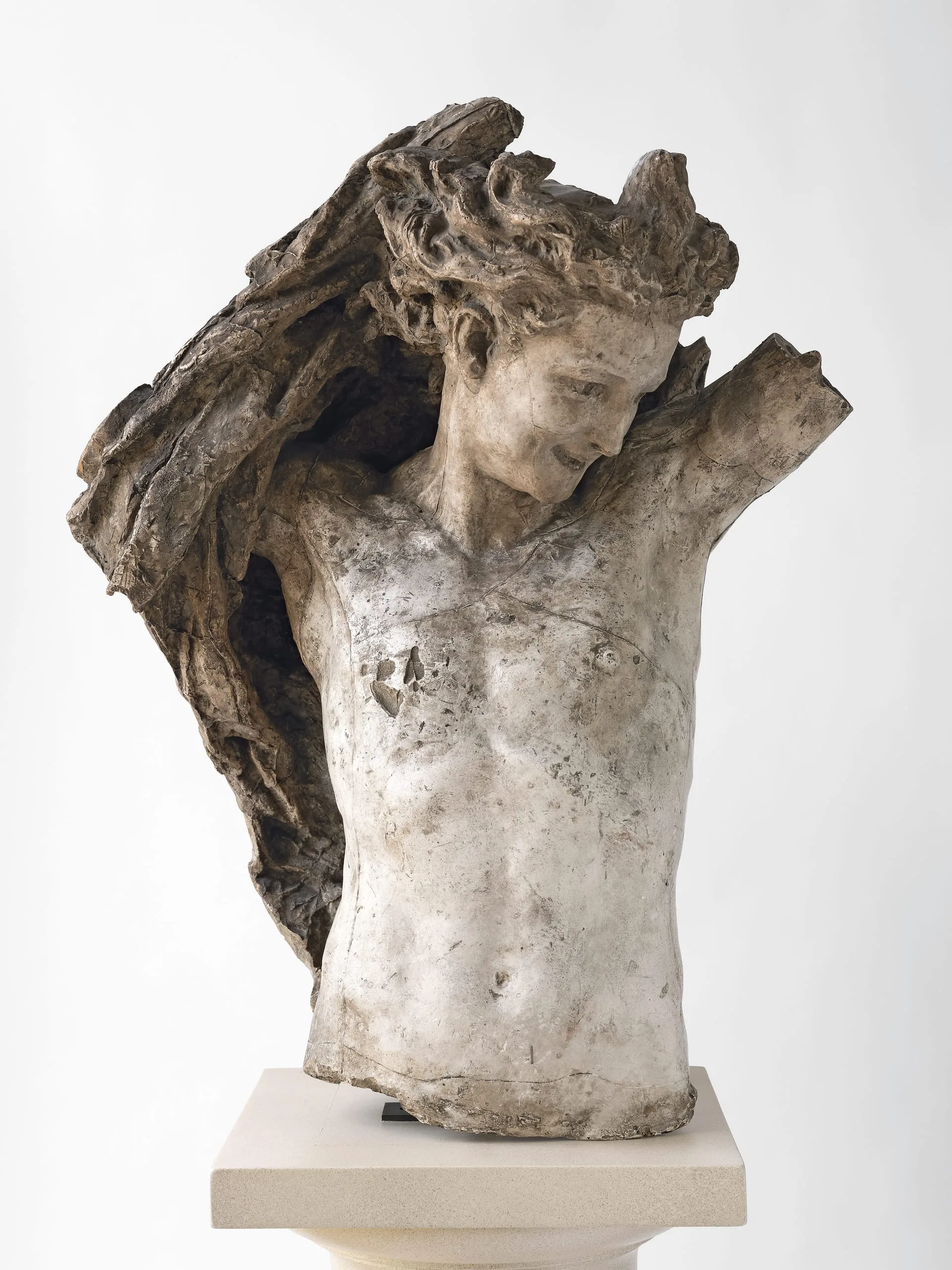
After eight long years of construction, with its facade tantalizingly hidden behind layers of fabric and scaffolding, architect Charles Garnier’s grand Opéra de Paris was slowly being exposed. Bit by bit, small pieces of its covering were peeled away during the summer of 1869. This seductive reveal culminated on July 26, when the final four sculptural groups marking the entrance to the building were dramatically unveiled before an audience of nearly six thousand. Three Neoclassical decorative sculptures, Music, Harmony, and Lyrical Drama, sat soberly on the facade of Garnier’s monument to Napoleon III’s empire. The fourth sculpture, The Dance, imagined and carved by Jean-Baptiste Carpeaux, was unlike any of the others surrounding it. Carpeaux’s figures seemed to explode from the very structure of Garnier’s carefully ordered commission. This study, one of only three known versions in plaster, was created for the swirling central figure.
The public reaction to The Dance was violently negative. From the moment it was unveiled, its unprecedented depiction of whirling movement was declared “too realist, too modern.” Just one month after its unveiling, a bottle of ink was thrown on the sparkling white marble. Carpeaux’s performers would not have been found on the stage of the Opéra, a state-sponsored monument to the official arts for which his sculptural group was created. Instead, these dancers would have been seen nightly in the popular bals and café-concerts flourishing in Paris in the late 1860s. This “of the moment” quality reflected a new visual language developed specifically to capture the contemporary zeitgeist. The Dance is a harbinger of the artistic and cultural future of modern Paris.
2024