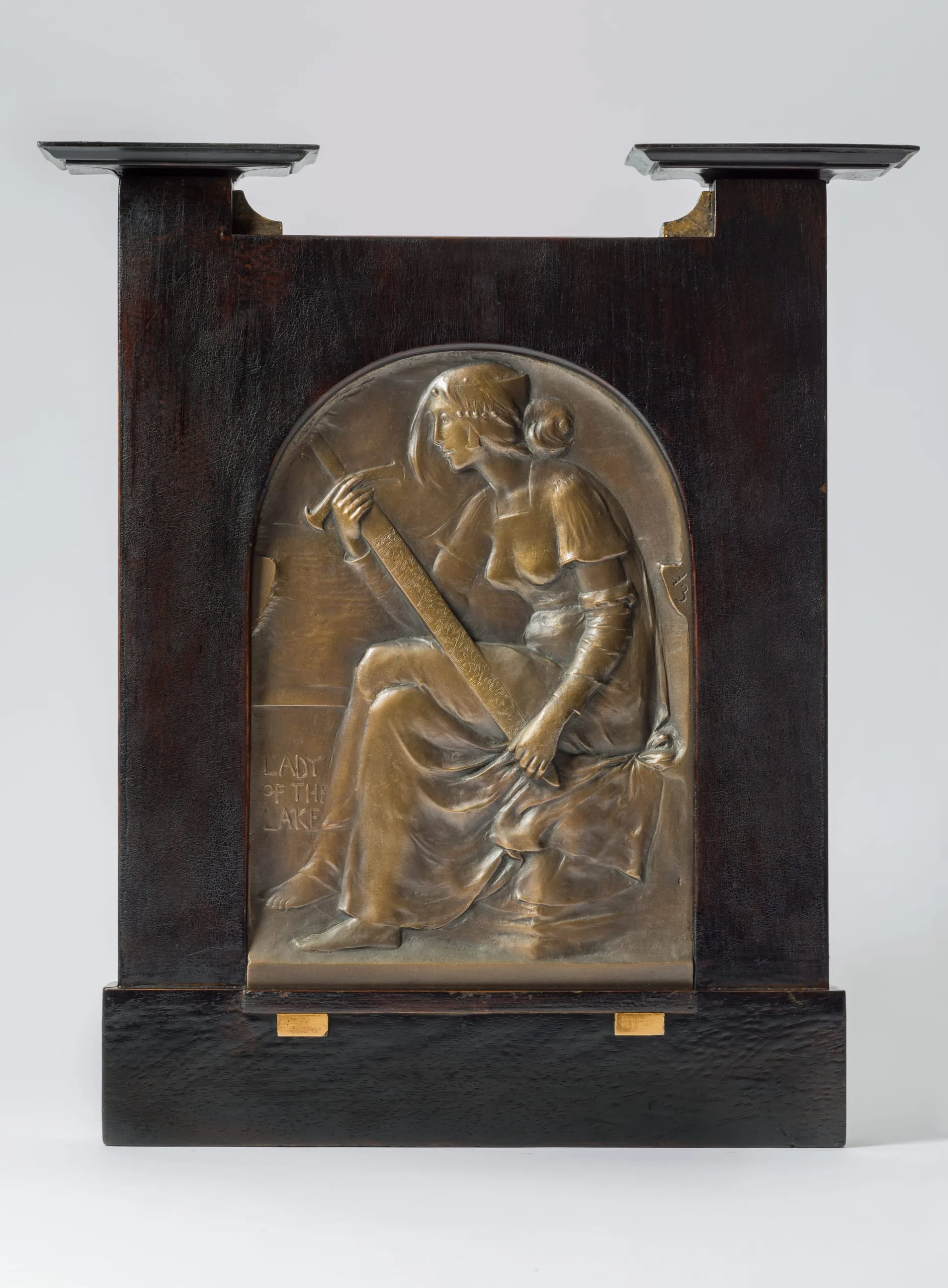
In 1861 critic William Rossetti wrote in Fraser’s Magazine for Town and Country that "Foremost among the causes of depression of the sculptural art may be named the divorce which has taken place of sculpture from architecture." As public enthusiasm for sculpture waned in late-nineteenth-century Britain, a group of artists strove to reinvigorate the discipline. They distinguished themselves from the dominant neo-classicism by creating dynamic compositions with detailed modeling, reviving historic techniques, and elevating the status of applied arts like architectural molding and medal making. Aspects of this movement, named "The New Sculpture" by critic Edmund Gasse in 1894, mirrored the efforts of the Arts and Crafts movement to erase hierarchical distinctions between fine and applied arts. Several of the adherents to "New Sculpture" also joined Arts and Crafts organizations.
The career of sculptor Sir George Frampton exemplifies the relationship between the two movements. The son of a stonemason, Frampton trained in architecture and exterior stone carving before attending the Lambeth School of Art and the Royal Academy School to study sculpture. Over his career, he worked in a range of formats, from figural statues, bas-relief panels, and busts to architectural carving, commemorative medals, and jewelry. A member of the establishment Royal Academy (he was named an associate in 1894 and a full member in 1902), Frampton also joined the Art Workers Guild, an organization that opposed the Academy’s narrow definition of art. A member since 1887, he was named as Master of the Guild in 1902. Although he formed the Central School of Arts and Crafts with W. R. Lethaby in 1893-1894, unlike his co-founder, he does not seem to have taught there. He exhibited regularly with both the Royal Academy and the Arts and Crafts Exhibition Society. Among his most celebrated commissions are the Peter Pan statue in Kensington Park and the architectural sculpture on Lloyd’s Registry of Shipping (1892-1901) in London. Such was his acclaim that he was knighted in 1908.
The Lady of the Lake comes from a series of nine relief panels, each depicting a heroine from Sir Thomas Malory’s Morte d’Arthur, which Frampton originally designed in 1895 for a door in the London home and office of American business magnate William Waldorf Astor. The building’s architect, J. L. Pearson, had commissioned Frampton along with several other prominent craftspeople for the elaborate interior. While the Astor panels were made in gilded silver, Frampton exhibited bronze casts of seven reliefs from the series at the Royal Academy and at the progressive art society La Libre Esthétique in Brussels the following year (1896).
Staci Steinberger, Associate Curator, Decorative Arts and Design, 2021