- Title
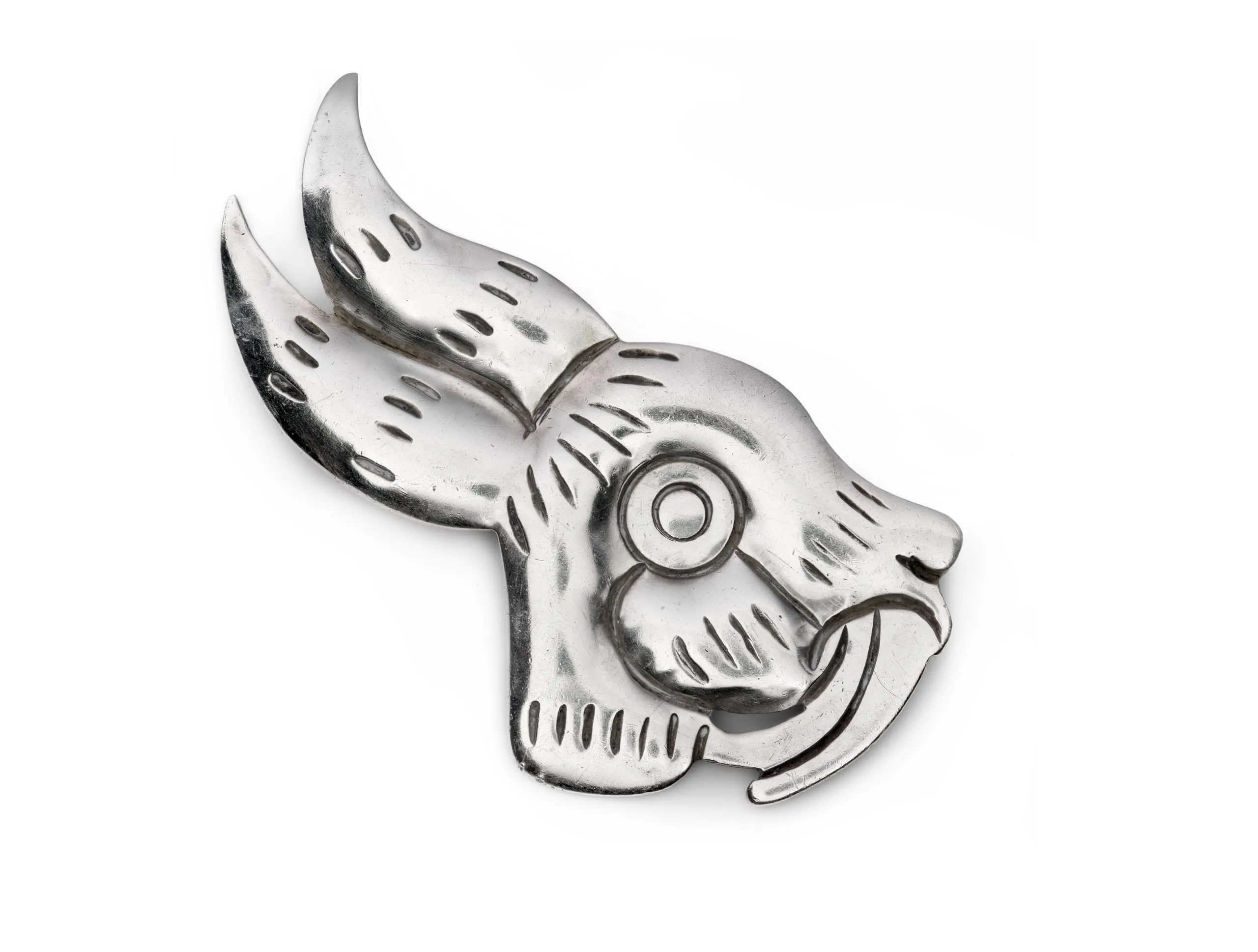
- Rabbit Brooch (Prendedor con conejo)
- Date Made
- 1940s
- Medium
- Silver
- Dimensions
- 2 1/4 × 1 1/4 in. (5.8 × 3.2 cm)
- Accession Number
- M.2015.38
- Curatorial Notes
This rabbit brooch belongs to a set of pins designed by Héctor Aguilar. He was inspired by Mexica and Mixtec symbols, including those found in the tonalpohualli, a 260-day calendar in which each day receives a name—such as tochtli (rabbit)—and is represented by a corresponding hieroglyphic sign. Given Aguilar’s interest in Mesoamerican art, he would have been familiar with these almanacs (known as tonalamatl) and calendric symbols. His rabbit bears a striking resemblance to the glyphs that appear in codices such as the pre-Conquest Codex Fejérváry-Mayer (https://archive.org/details/codexfejeyrvayr00sele/page/20/mode/1up).
Aguilar’s fascination with ancient art and history led to his work as a tour guide, which turned out to be a fateful profession. He met his future wife, Lois Smith Cartwright, while she was traveling in Mexico in 1935; the following year, the newlyweds visited Taxco, a center of the silver industry. Aguilar had previously brought tour groups to William Spratling’s renowned Taller de Las Delicias (established in 1935). Spratling subsequently hired Aguilar to manage the workshop before the latter forged out on his own. Aguilar and Cartwright founded the Taller Borda in 1939, and their workshop became known for the high quality of its elaborate works.
Rachel Kaplan
2025
- Selected Bibliography
- Kaplan, Wendy, ed. Found in Translation: Design in California and Mexico, 1915-1985. Los Angeles: Los Angeles County Museum of Art; Munich: DelMonico Books-Prestel, 2017.
- Copyright
- © artist or artist's estate