LACMA

ShopMembershipMyLACMATickets
LACMA
Los Angeles County Museum of Art
5905 Wilshire Blvd.
Los Angeles, CA 90036
info@lacma.org
(323) 857-6000
Sign up to receive emails
Subscribe
© Museum Associates 2025

Museum Hours

Monday

11 am–6 pm

Tuesday

11 am–6 pm

Wednesday

Closed

Thursday

11 am–6 pm

Friday

11 am–8 pm

Saturday

10 am–7 pm

Sunday

10 am–7 pm


  • About LACMA
  • Jobs
  • Building LACMA
  • Host An Event
  • Unframed
  • Press
  • FAQs
  • Log in to MyLACMA
  • Privacy Policy
© Museum Associates 2025
Collections

Paul Cadmus
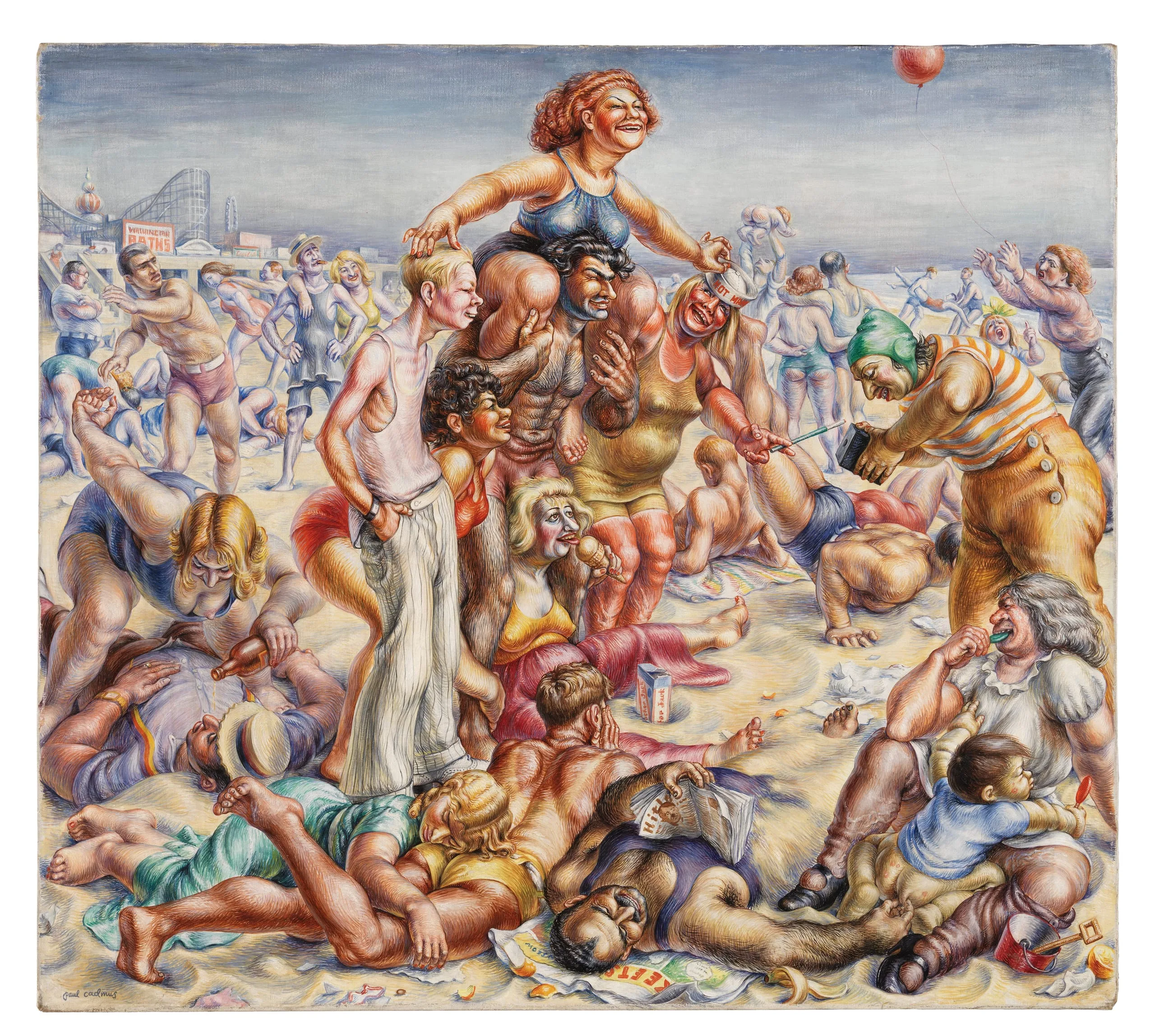
Coney Island1934

On view:
Geffen Galleries, Labor and Leisure in the American Metropolis
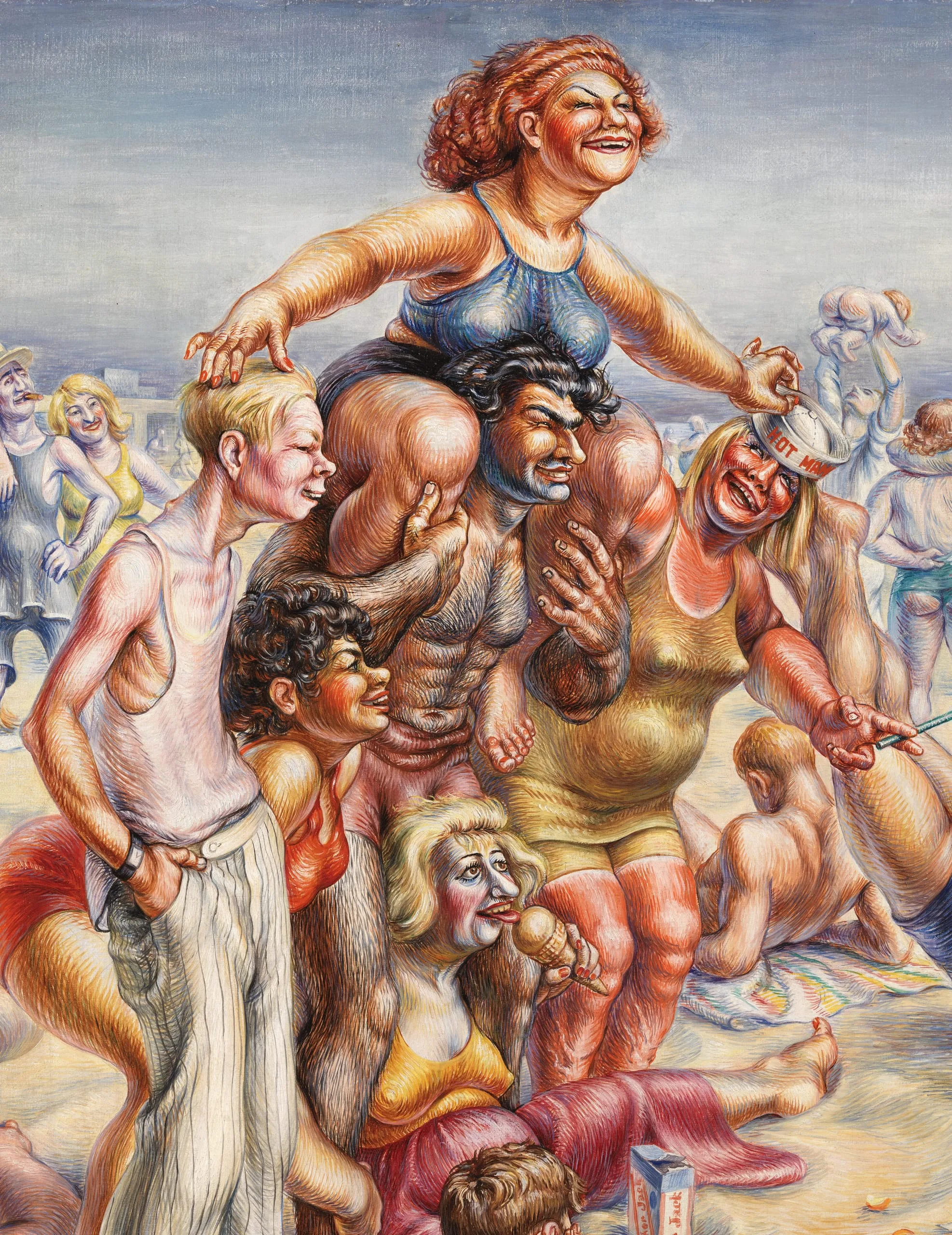
Oil painting of an exaggerated, densely crowded beach scene with figures piled and sprawling across sand, a roller coaster visible in the distance under a gray sky
Oil painting of a crowd of figures in swimwear on a beach, rendered in an exaggerated caricature style with fine hatched brushwork. A central pyramidal grouping shows a muscular man bearing a woman in a blue swimsuit on his shoulders, surrounded by laughing and animated figures in warm reddish-orange tones. Additional figures recede into a pale gray-blue background.
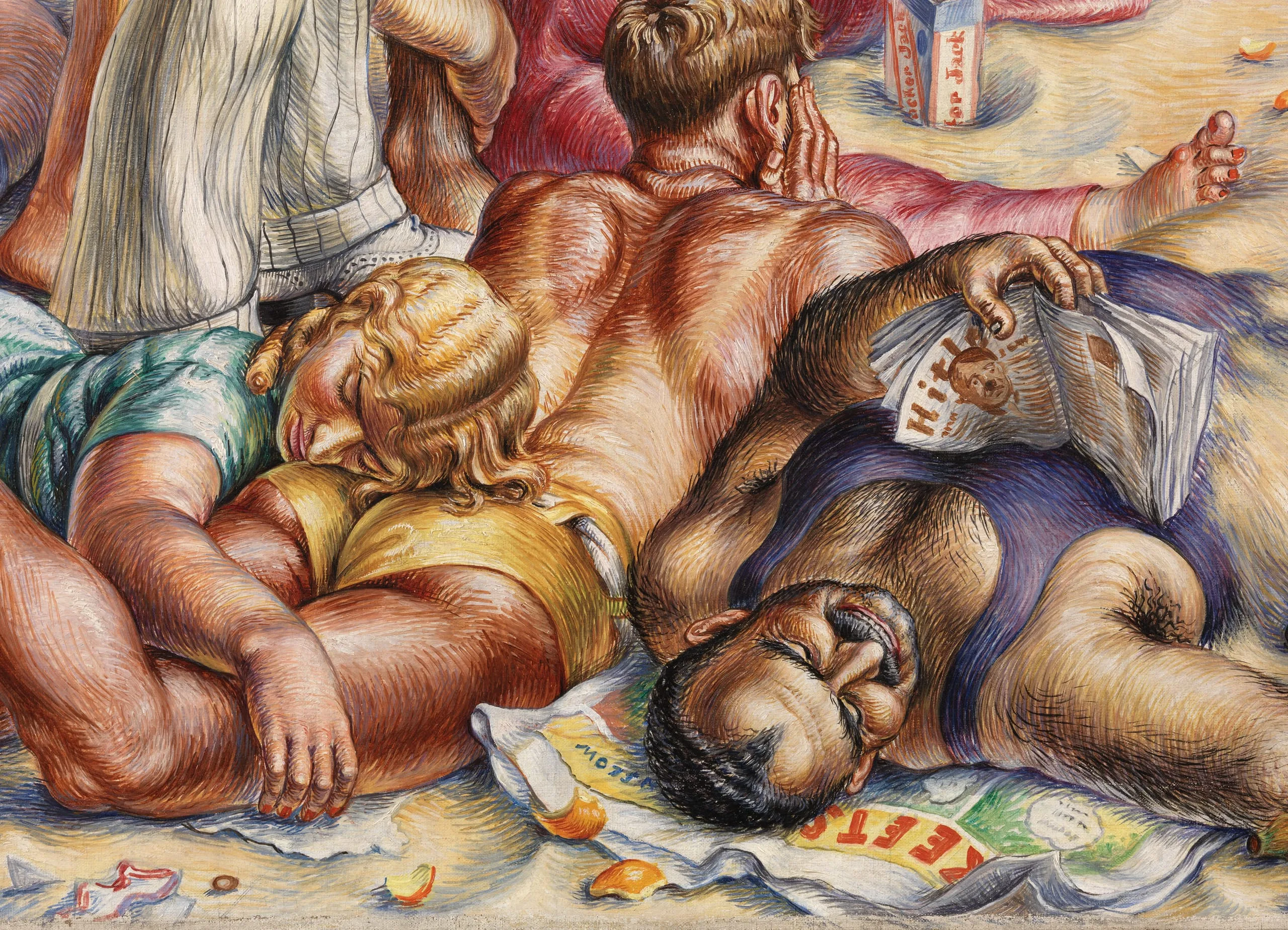
Highly detailed drawing or watercolor of several figures reclining on a sandy beach, rendered with fine hatched linework and warm flesh tones. A shirtless man with reddish sunburned skin lies face-down at center, a young child in a yellow swimsuit resting against him. Nearby, a man in a purple shirt lies face-up holding a folded newspaper. Scattered around them are snack wrappers and food scraps. Standing figures in colorful clothing are partially visible at the edges.
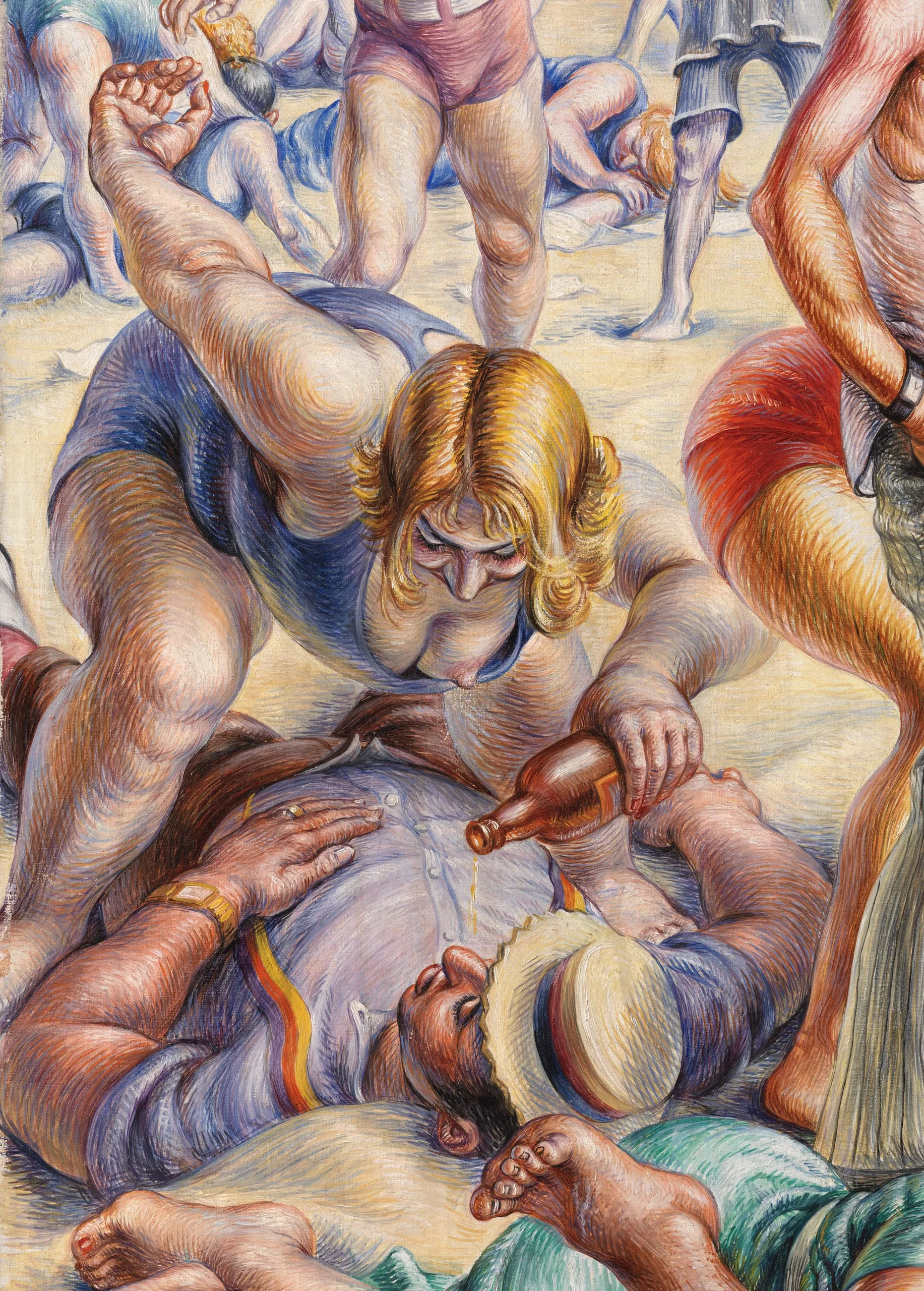
Colored pencil or ink drawing with dense, fine hatching; a crowd of figures on sandy ground, two central figures in the foreground — one crouching over another who lies supine wearing a striped sash and straw hat, holding a brown bottle that drips liquid; additional legs and partial figures crowd the background.
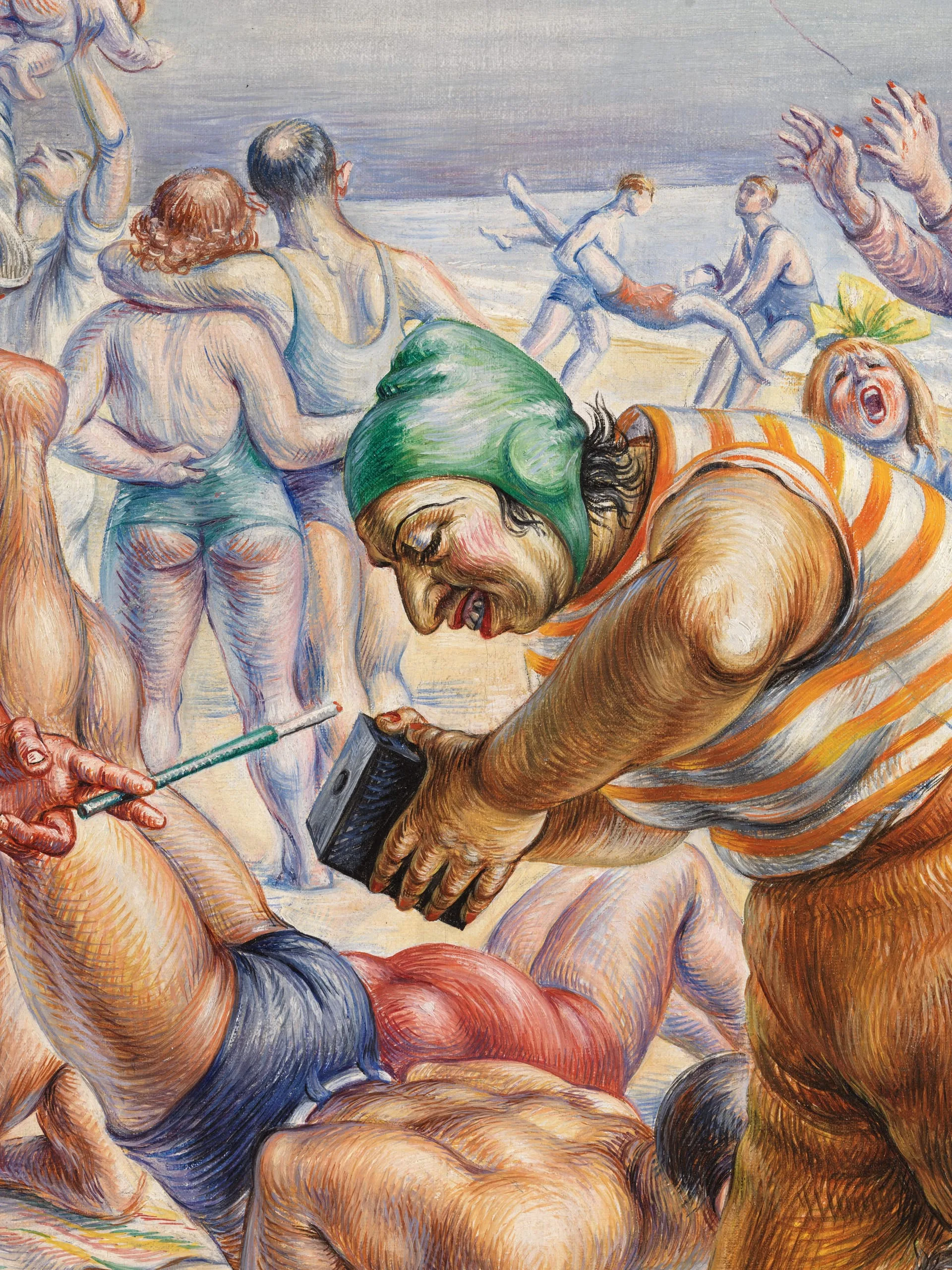
Detailed drawing or tempera work depicting a crowded beach scene with exaggerated, caricatured figures; a heavyset figure in an orange-striped shirt and green cap bends over prone bodies in the foreground, while bathing figures and a distressed figure at right occupy the middle and background, rendered with precise hatched linework and muted flesh tones.
Artist or Maker
Paul Cadmus
United States, New York, New York City, 1904-1999
Title
Coney Island
Place Made
United States
Date Made
1934
Medium
Oil on canvas
Dimensions
Canvas: 32 7/16 × 36 5/16 in. (82.39 × 92.23 cm) Frame: 41 × 45 × 2 in. (104.14 × 114.3 × 5.08 cm)
Credit Line
Gift of Peter A. Paanakker
Accession Number
59.72
Classification
Paintings
Collecting Area
American Art
Curatorial Notes
Coney Island was the first painting Cadmus made after he ceased working for the federally sponsored Public Works of Art Project. It is typical of his paintings of the period in both theme and form.
Cadmus viewed the prosaic activity of bathing on a beach in devastatingly satirical terms. Poking fun at the bathers’ carefree pleasures, Cadmus accumulated an odd assortment of bulging, burnt bodies. The bathers are oblivious to their ridiculous appearance and uncouth behavior. Swarming the beach, their bodies are strangely intertwined, their faces smiling inanely. Everything is exaggerated, the color verging on the garish to intensify their grossness.
In the 1930s Cadmus used oil paint almost as if it were a graphic medium, consequently Coney Island looks more like a tinted drawing than a painting. His small, exacting brushstrokes impart a flickering quality to the surface, which intensifies the impression that the figures are in constant motion.
Cadmus actually began to sketch the scene on Martha’s Vineyard, before he visited Coney Island. He was attracted to the Brooklyn beach because it offered him the opportunity to delineate the human figure with as little clothing as possible. Moreover, he considered the beach scene to be a classical subject. His treatment, however, is rather baroque. As was his friend REGINALD MARSH, Cadmus was attracted to the elaborate compositions of old master paintings. Coney Island, with its seminude figures arranged in complex groupings, their bodies twisted and in constant motion, was for Cadmus the twentieth-century version of a baroque allegorical composition.
Cadmus claimed that his intent was not to be sensational, but when the painting was exhibited in the Whitney Museum of American Art’s second biennial, it suffered the same hostile reception as did his earlier The Fleet’s In!. The Coney Island Showmen’s League, a local trade group, denounced the painting as offensive and inaccurate and threatened a libel suit if the painting was not removed from the exhibition. According to the artist’s incomplete records, it seems that the painting was rejected from several annual exhibitions to which it was submitted soon after it was shown at the Whitney biennial, probably because of the controversy it stirred.
In 1935 Cadmus produced an etching from a photograph of the painting in the hope that it would reach a larger public. In the etching the image is reversed but otherwise differs only in a few minor details (see Related Works).
Selected Bibliography
  • Gioni, Massimiliano and Gary Carrion-Murayari, eds. Peter Saul: Crime and Punishment. London; New York: Phaidon Press, in association with New Museum, 2020.

  • Esguerra, Clarissa, and Michaela Hansen. Lee Alexander McQueen: Mind, Mythos, Muse. Los Angeles: Los Angeles County Museum of Art, 2022.