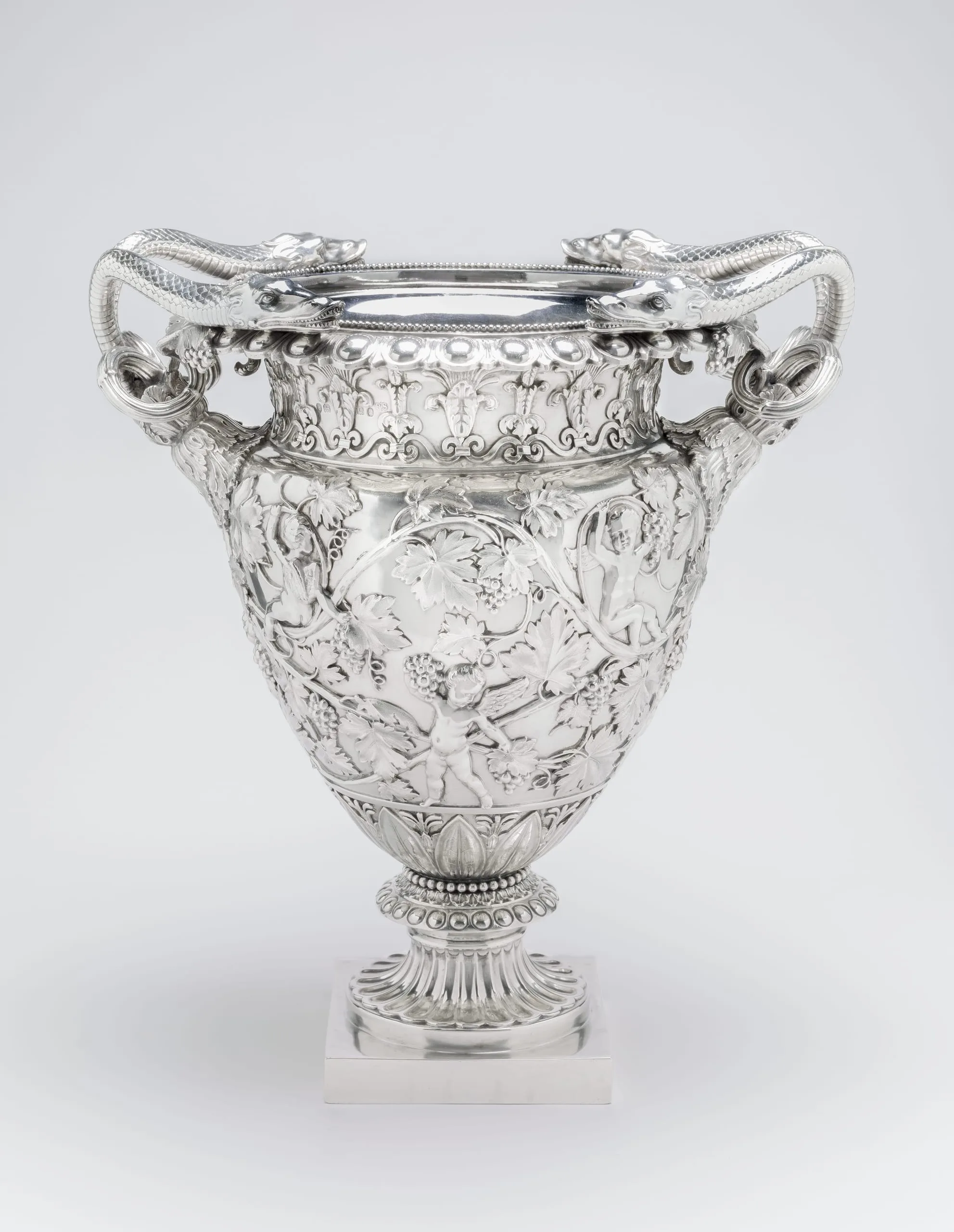
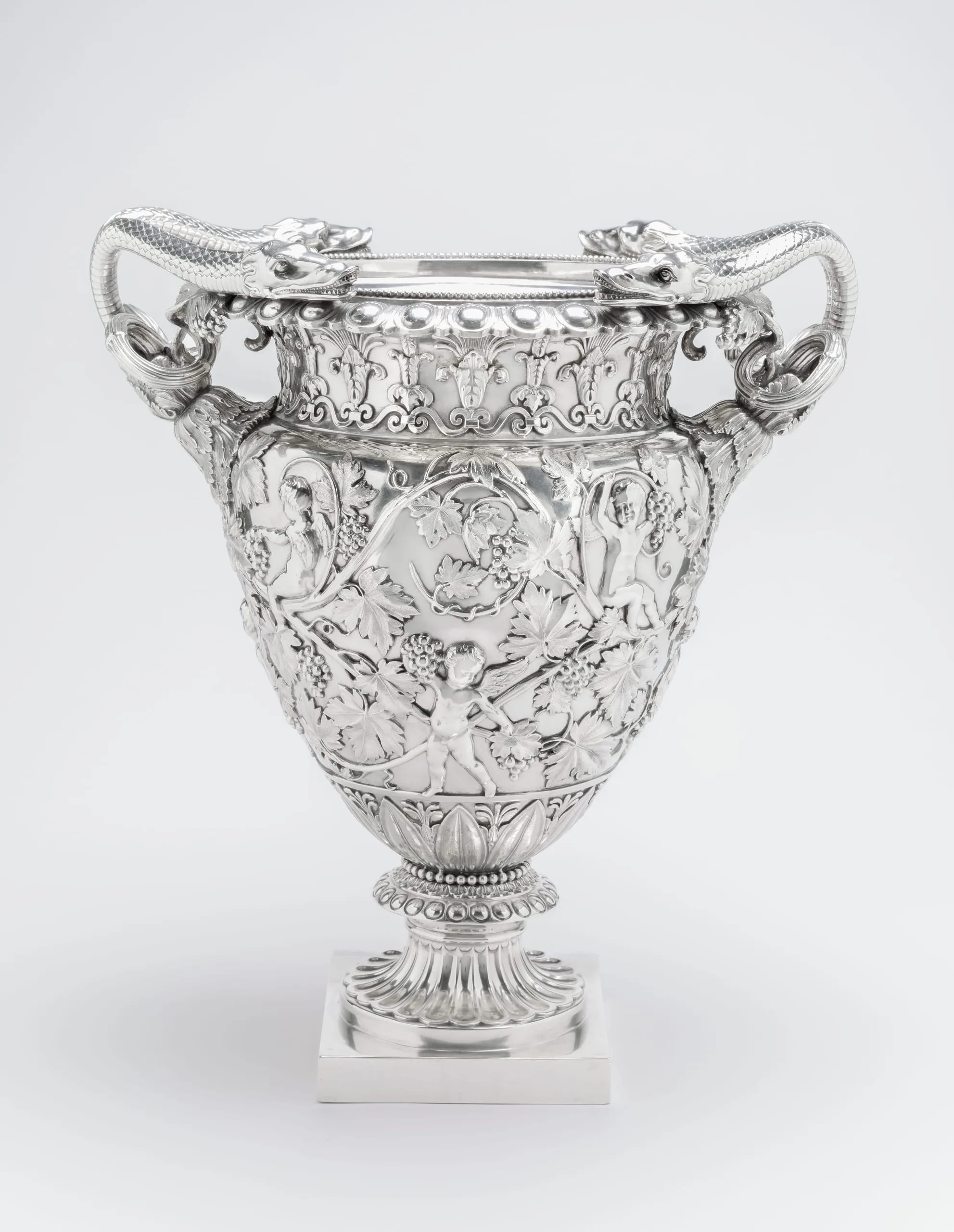
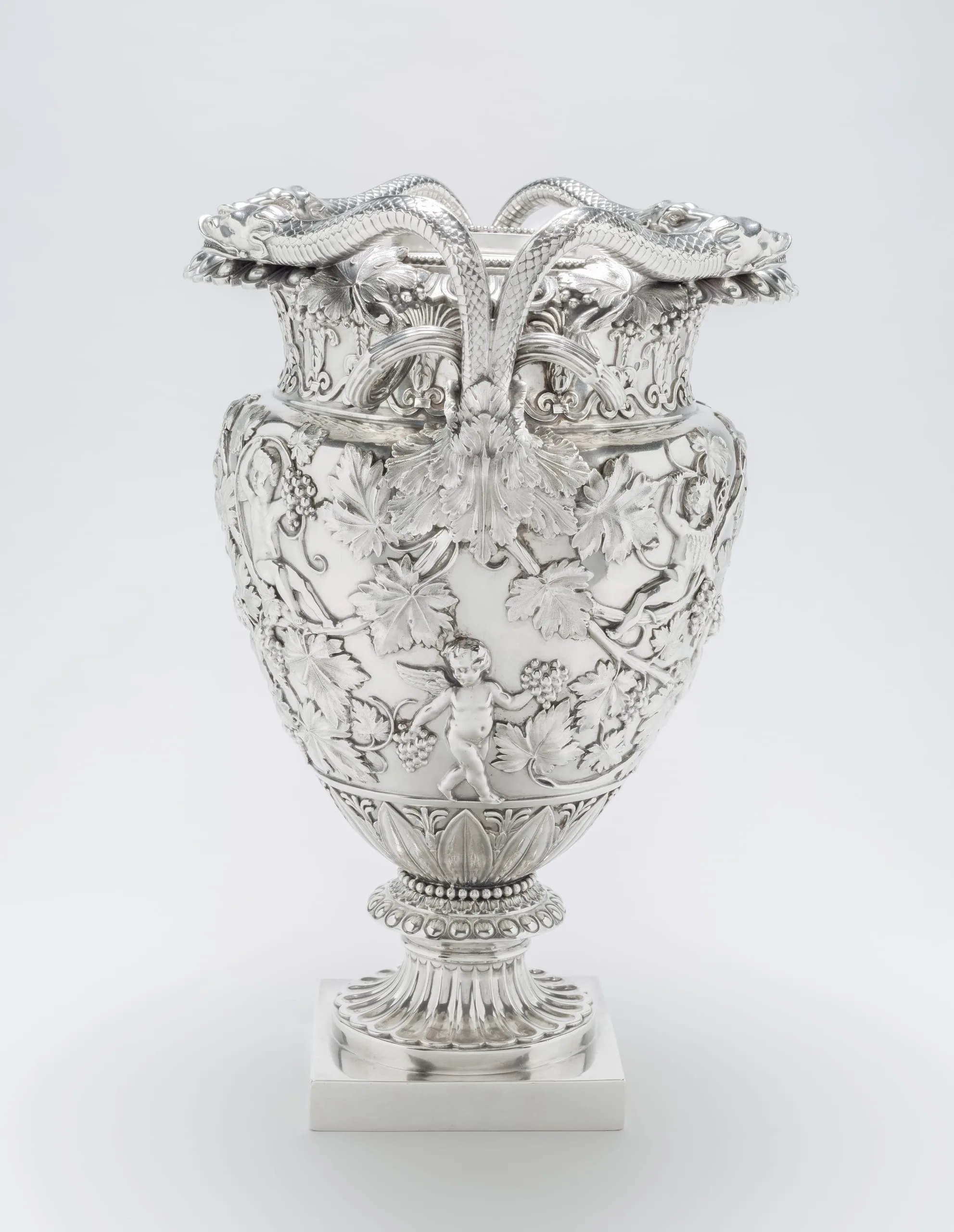
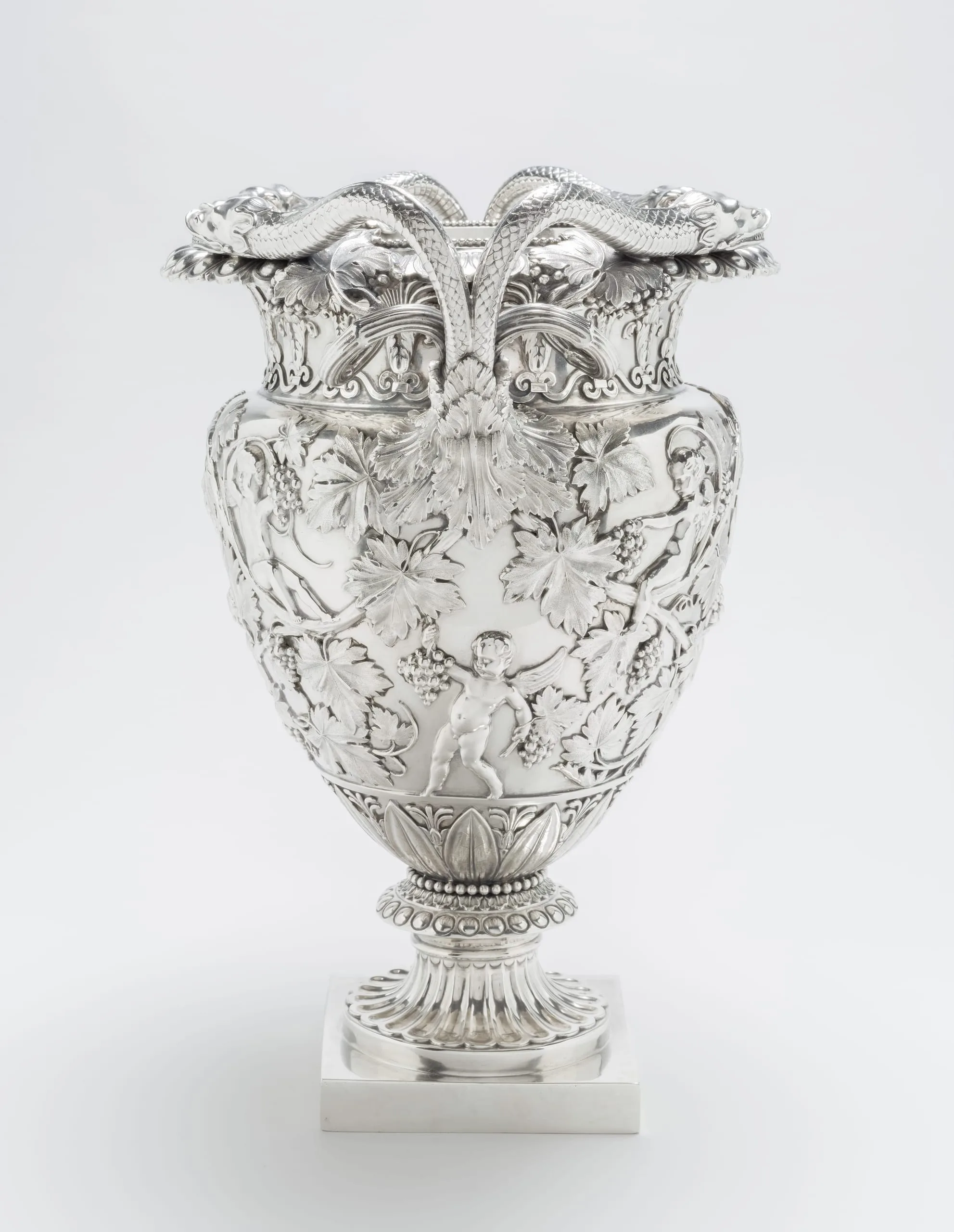
This spectacular showpiece exemplifies British Neoclassicism of the Regency era. Spurred by archaeological discoveries in Italy, especially at Pompeii and Herculaneum, and favored as a counter to the floridity of Rococo designs, the Neoclassical style gained prominence during the 1760s. The new designs combined motifs, forms, and subjects from classical vocabulary; this adoption of Greek and Roman ideas and art brought a sense of balance, linearity, and discipline to British silver. The Storr Vase is the first, the finest, and the most faithful emulation of the Buckingham Vase (also known as the “Stowe Vase,” 51.18.8), a monumental Roman marble that William Randolph Hearst donated to LACMA in 1951. The Buckingham Vase was constructed from fragments excavated in 1769 by Scottish artist and antiquarian Gavin Hamilton (1723−1798) at Hadrian’s Villa near Rome. In 1774, it was purchased by touring English aristocrat George Grenville-Nugent-Temple (later marquess of Buckingham) for his English country house at Stowe. Like another vase from the Roman villa, now in the British Museum, it was probably restored by Venetian polymath Giovanni Battista Piranesi (1720−1778), whose etching of it was widely admired.
Later, in the reign of King George IV (1820−30), the leading silversmith Paul Storr chose Piranesi’s prints as the preeminent models for English silver that looked to Greek and Roman antiquity. A major work from Storr’s early career, this silver vase faithfully replicated a design from a single source (Piranesi’s etching) without modifications or inclusions from other models. Almost all the vases based on Piranesi’s etching were reproduced in silver, but few based on the Buckingham Vase are known to survive. Distinguished by archaeological exactitude, the style of Storr’s vase was informed by the pursuit of classical culture associated with the Enlightenment and the Grand Tour.
Rosie Mills
2015