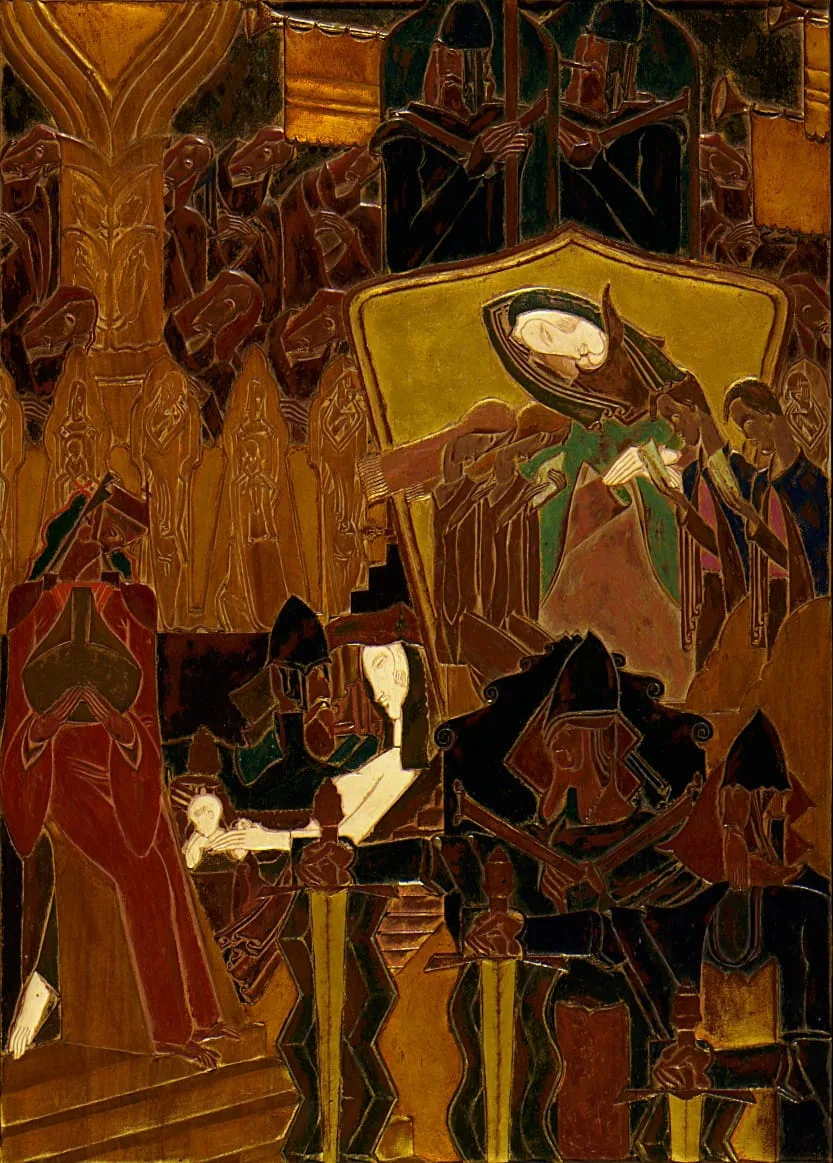
The use of stylized, attenuated figures arranged rhythmically and decoratively was developed in Fulop’s paintings and watercolors by at least 1924. His sources probably include the Byzantine art of the Hungarian church, the decorative characteristics of the country’s folk styles, the art of Gustav Klimt (1862-1918) and the Vienna Secession, and aspects of early twentieth-century French modernism. The fantastic quality, obscure symbolism, and religious nature of his works-meant to be the externalizations of mystical visions-seem to come out of the period before the First World War. Fulop spoke of his designs in terms of music, a concept of synesthesia embodied in his carved panels with their combination of design and sculpture and mixture of materials, bridging the separation between the fine and decorative arts.
The panel is in low relief, with very smooth surfaces. Ivory has been inlaid for the face and hands of the large female figure at the right and for the entire figures of the woman and baby at the lower left. The wood is gilded in places, such as the throne, swords, and trumpet banners, and in other places apparently painted in mostly muted colors over gilding. The effect is rich, but dusky and mysterious.