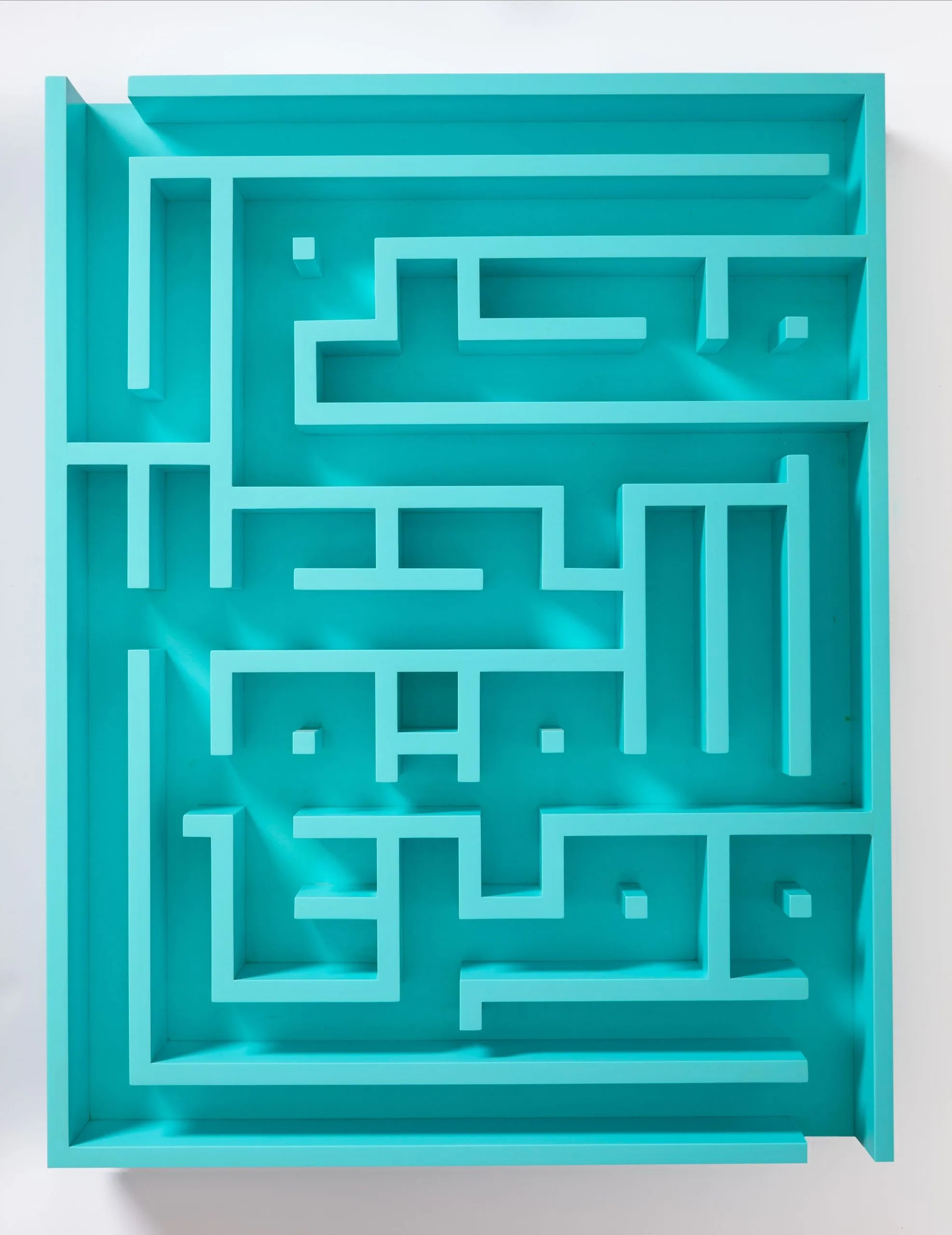
In historical Islamic lands, calligraphy has always been regarded as the noblest form of art because of its association with the Qur’an, the Muslim holy book. On this account, calligraphy became the most important art form regardless of the text. Trained as both a calligrapher and an architect, Nasser Al Salem has developed a unique approach to writing. He focuses on the words and their meaning, medium, and aesthetic, resulting in multivalent, highly nuanced, and engaging works.
In this three-dimensional calligraphy, rendered in a contemporary interpretation of historical square kufic script, Al Salem cleverly transforms the namesake Qur’anic verse, “Whoever obeys Allah, he will make for him a way out,” into a maze; remarkably, his calligraphic composition not only renders the words of the verse but visually re-creates its meaning. While his work is strongly influenced by Muslim faith and tradition, he often employs nontraditional mediums such as neon, video, corian, as here, and even sand for his calligraphy, in addition to the more customary ink on paper (see M.2013.132 and M.2014.181). Al Salem is widely regarded as one of the most innovative calligraphers of his generation.