LACMA

ShopMembershipMyLACMATickets
LACMA
Los Angeles County Museum of Art
5905 Wilshire Blvd.
Los Angeles, CA 90036
info@lacma.org
(323) 857-6000
Sign up to receive emails
Subscribe
© Museum Associates 2025

Museum Hours

Monday

11 am–6 pm

Tuesday

11 am–6 pm

Wednesday

Closed

Thursday

11 am–6 pm

Friday

11 am–8 pm

Saturday

10 am–7 pm

Sunday

10 am–7 pm


  • About LACMA
  • Jobs
  • Building LACMA
  • Host An Event
  • Unframed
  • Press
  • FAQs
  • Log in to MyLACMA
  • Privacy Policy
© Museum Associates 2025
Collections

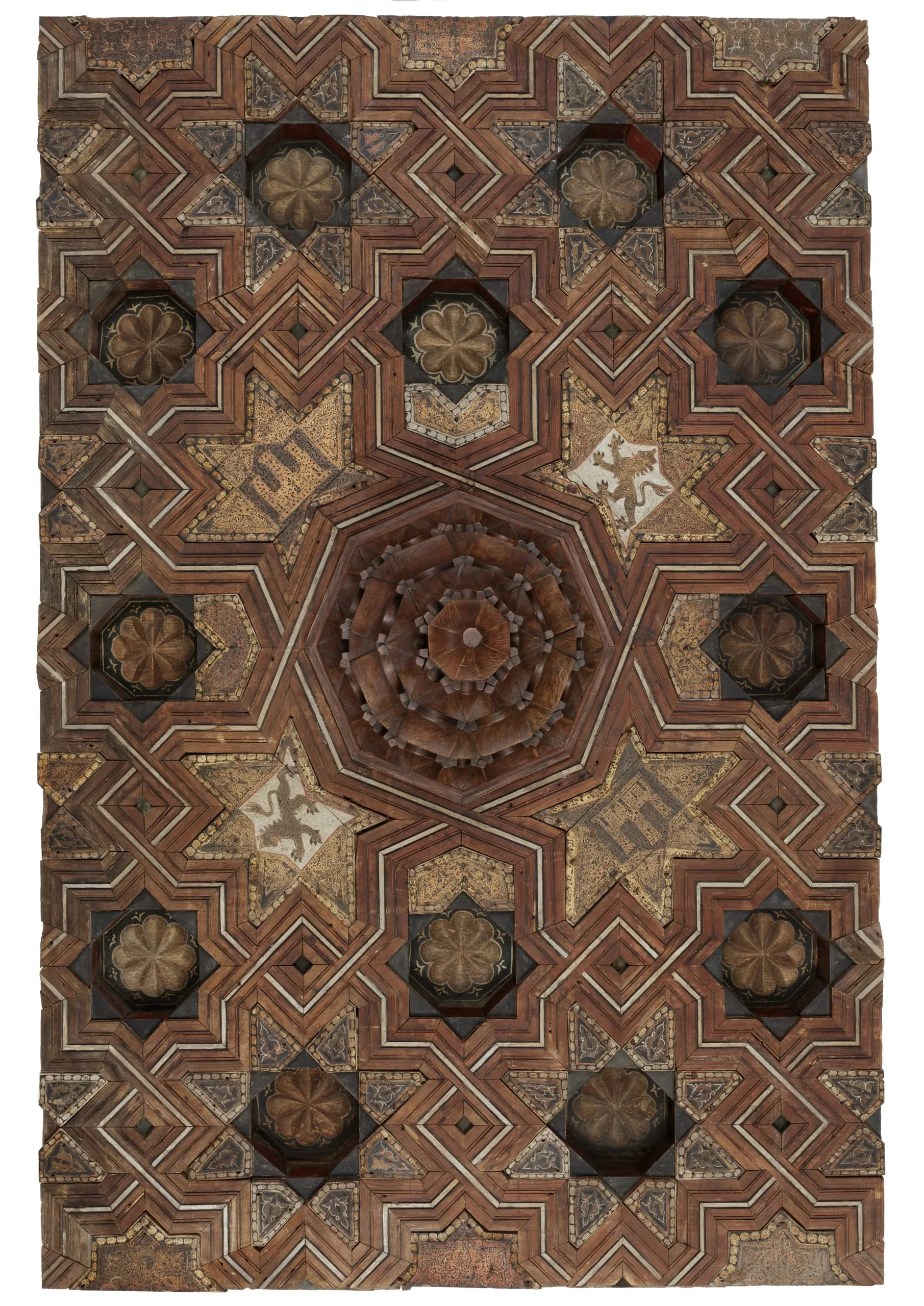
Panel from a Ceilingmid-14th to mid-15th century (panel); 2015 (muqarnas element)

Not on view
Vertical architectural wood panel with geometric star-and-lattice inlay, a central carved muqarnas medallion, carved rosettes, and heraldic lion motifs in mosaic-filled fields
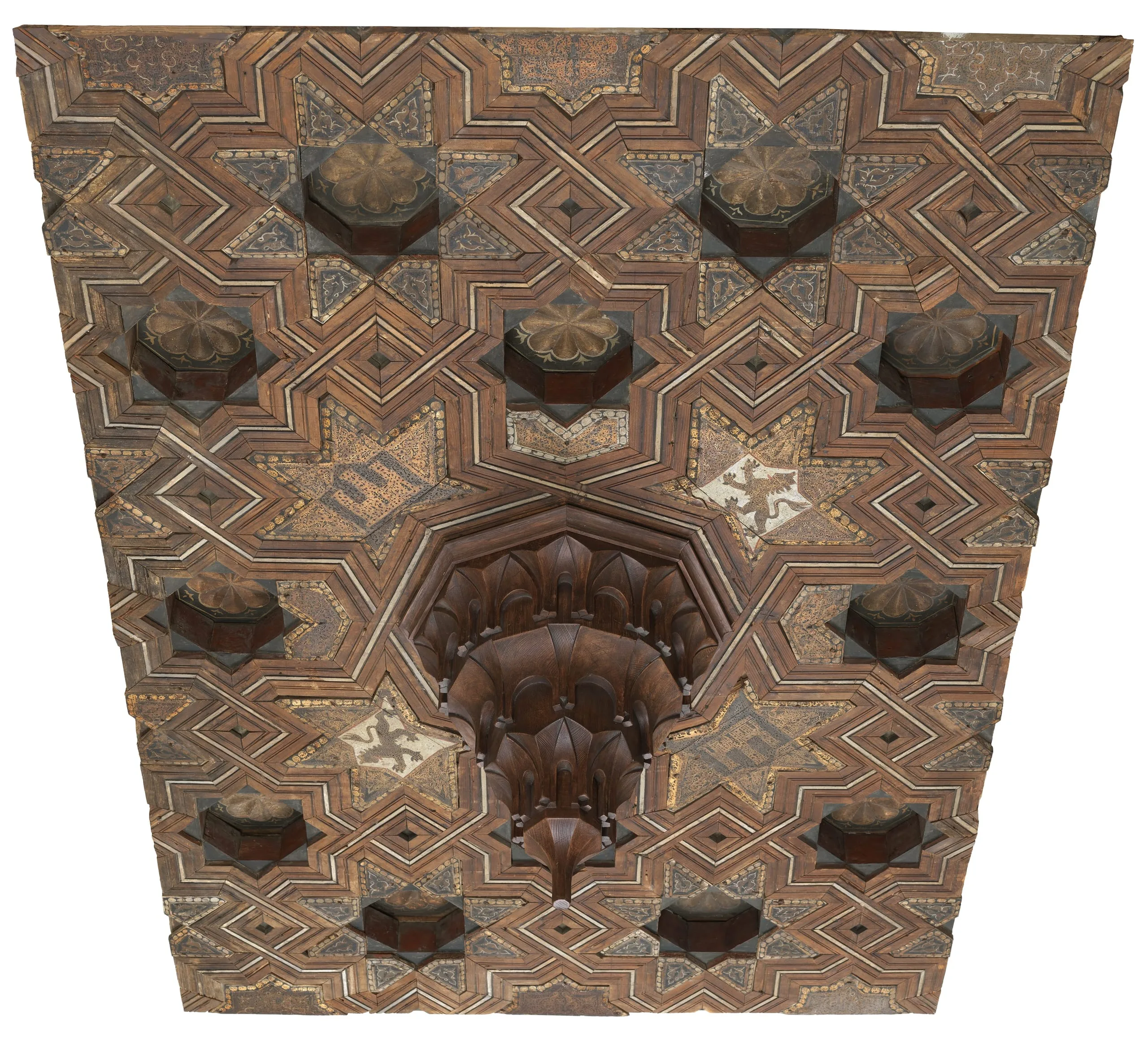
Carved and painted wooden artesonado ceiling panel with interlocking geometric star patterns in dark brown and gold tones, featuring a central octagonal muqarnas pendant and raised hexagonal bosses with rosette motifs throughout; traces of painted heraldic decoration visible in several panels.
Title
Panel from a Ceiling
Place Made
Spain, probably Toledo
Date Made
mid-14th to mid-15th century (panel); 2015 (muqarnas element)
Medium
Wood (pine), with colored pigments and silver
Dimensions
79 × 52 × 30 1/2 in. (200.66 × 132.08 × 77.47 cm)
Credit Line
Gift of The Faculty Club, University of California, Santa Barbara, Inc., in honor of the museum's 50th anniversary
Accession Number
M.2014.179.1
Classification
Architecture
Collecting Area
Art of the Middle East: Islamic
Curatorial Notes

Despite the end of Muslim rule on the Iberian Peninsula in 1492, an Islamic style of art and architecture continued to be popular among the ruling elite, and many Muslim craftsmen remained in Spain to meet the enduring demand for their services. The hybrid style they developed became known by the term mudéjar. Ceiling panels of this type exemplify the mudéjar style in their combination of Islamic and European elements. Strapwork patterns of stars and polygons merge with the heraldic lion and castle, which together help link the ceiling to buildings commissioned by the Toledo or Suárez de Toledo family.

(*Note that the muqarnas element was fabricated by Taujel, S.L., a Spanish company specializing in restoration and construction of historic mudéjar woodwork; it is based on historical methods of construction.)

Built between the late fourteenth to first half of the fifteenth century, the Spanish palace complex in Toledo known as “Casas de Antolín” is among the closest surviving comparisons to the LACMA mudéjar ceiling elements. The panels were previously believed to constitute a single entity, yet subsequent research has revealed they comprise elements of two separate ceilings, currently undergoing restoration: The earlier group dates to the late 14th to early 15th centuries and possibly once adorned a secular setting. The latter dates to the first quarter of the 16th century, and features Passion imagery befitting a Christian place of worship.

The journey of the ceiling panels to Los Angeles further complicates their history of alteration and reception. These elements arrived in California without a precise record of provenance when they were acquired by newspaper publisher and collector William Randolph Hearst sometime in the 1920s. Probably intended to adorn his San Simeon estate (today’s Hearst Castle) they appear to have remained in storage at San Simeon. In 1967, the post-modern architect, Charles Moore, purchased these works for the new faculty club he was building for the University of California, Santa Barbara. During the late-1960s, they were installed in the faculty club, adorning ceilings and walls in the kitchen, service area, dining room, and entranceway. A smaller number of panels were kept separately in the club’s pool house while Moore also installed two panels at his Condominium 1 at Sea Ranch in northern California. 36 panels were gifted to LACMA in 2014, and three more, all belonging to the earlier group, came to the museum in 2019.

After carefully deinstalling these panels from the faculty club, LACMA is currently undertaking the conservation and restoration of the two groups of elements beginning with the earlier ceiling so that it can be viewed as a reconstituted architectural component. The restored panel shown here, from the earlier group, only marks the beginning of the conservation process. As conservation work continues, future research will shed light on the ceiling as an artifact from a transformative period of Iberian history.


Selected Bibliography
  • Williams, Sandra S. "The Itinerant Lives of Two Ceilings from Spain." Postmedieval: A Journal of Medieval Cultural Studies (2025). https://doi.org/10.1057/s41280-024-00354-x.