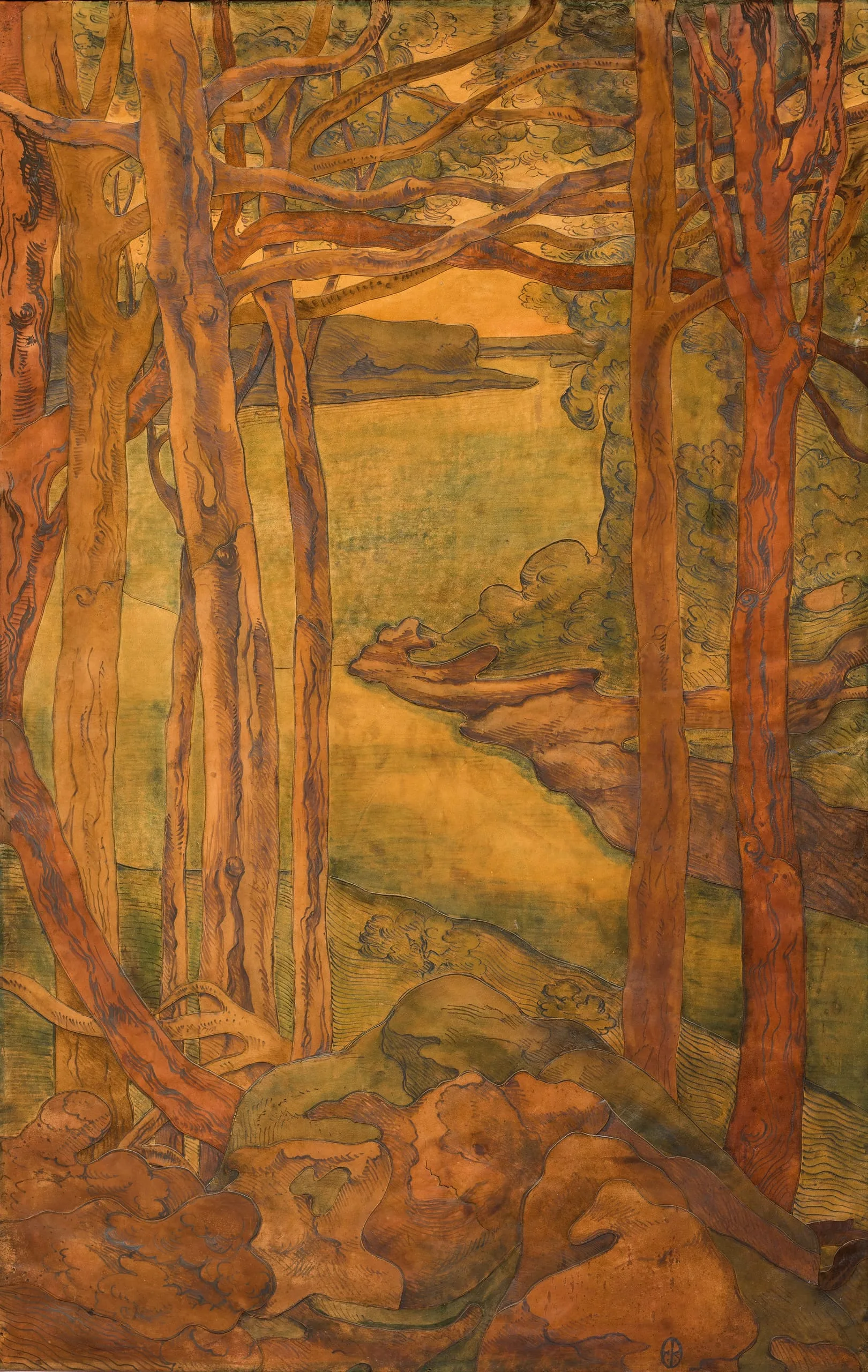
An innovative designer and craftswoman, Elizabeth Eaton Burton applied her talents to metalwork, leather, and wood as well as painting, printmaking, photography, literature, and landscape architecture. As the proprietor of a successful workshop in Santa Barbara, California, Burton marketed her wares to a prominent national client base, illustrating how the Arts and Crafts movement’s embrace of the domestic provided new artistic opportunities for women. Though today she is best known for designing intricate repoussé lamps with shades made from exotic shells, her leather pieces, including cushions, trunks, panels, friezes, and hangings, were equally acclaimed during her lifetime. Burton’s imagery reflected several characteristic motifs of the Arts and Crafts movement, ranging from medieval strapwork to local landscapes. But it was her patented technique—an ever-evolving combination of burning, dyeing, and layered appliqué affixed with machine stitching—that distinguished her work.
Despite the popularity of Burton’s work in leather, little of it has survived, thus adding to the significance of this large panel. The landscape scene (thought to portray the California coast) exemplifies her technique of using delicate shading and strategic layering to portray depth. The piece came from Allenwood, the Vermont lodge of whiskey heir George Marshall Allen. Around 1902, famed Arts and Crafts designer and proselytizer Gustav Stickley provided the furnishings for the home, and it has been suggested that he introduced Allen to Burton’s work. Stickley would later praise Burton in a 1904 article for the prominent design publication The Craftsman, calling her a “mural painter in leather.”
Staci Steinberger
2014/2024