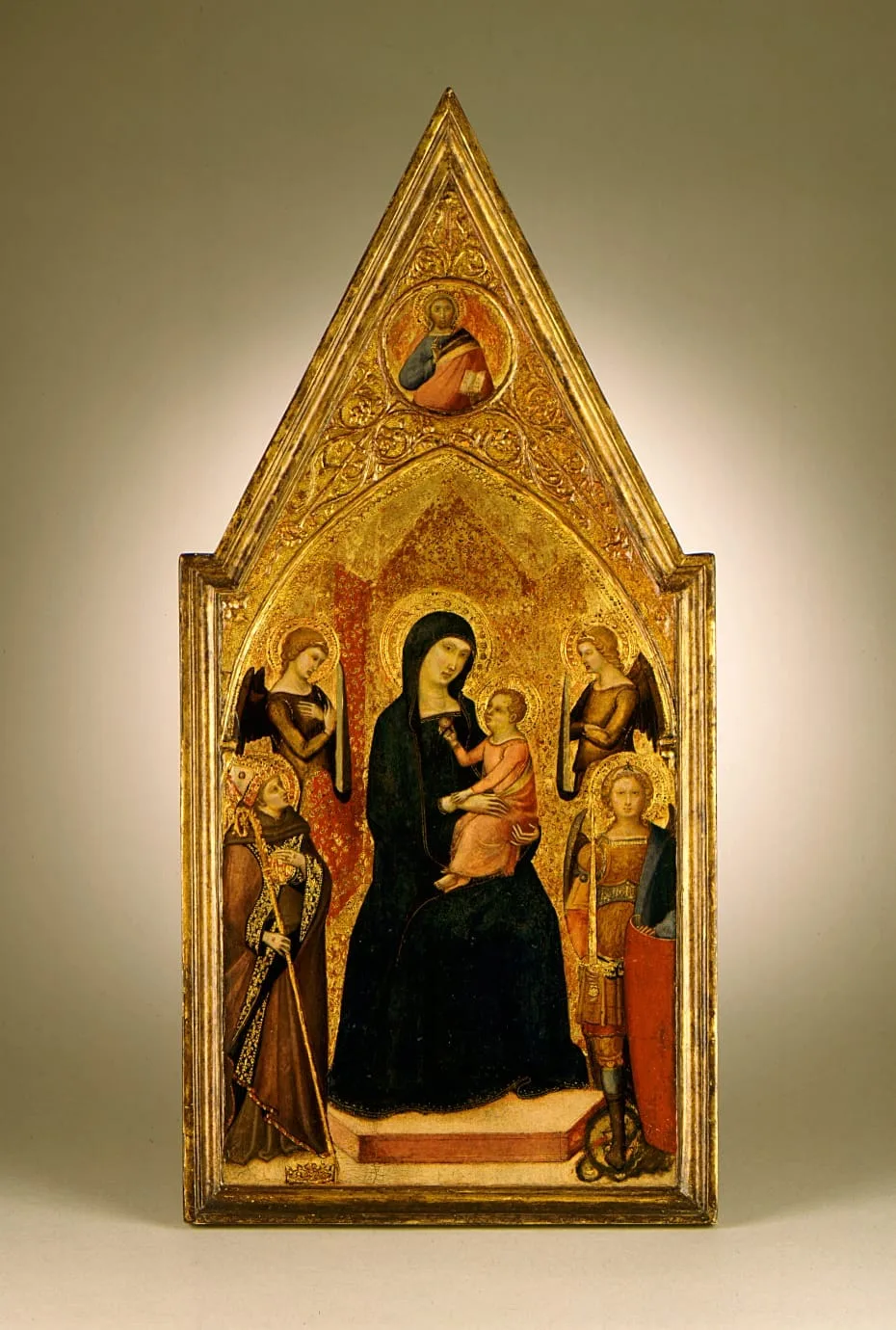
This intricate glided panel was likely once part of a portable altarpiece painted by Luca di Tommè, a prolific artist with a flourishing Sienese workshop who took an active role in local government. Although its companion wings have been lost, the altarpiece, when opened, would have served as an intimate sacred space for personal devotions.
A seemingly straightforward image of the enthroned Virgin and Child with saints, this painting offers a plethora of salvific and eschatological interpretations. At the center of the composition, rendered on a larger scale than the other figures, Mary tenderly holds her son. In a rondel directly above, Christ raises his hand in blessing. At the right, standing on a dragonlike creature, the archangel Michael, the warrior angel, confronts the viewer, sword and shield in hand. Michael’s iconography comes from an episode in Revelations in which he and the other angels wage war against evil, eventually slaying the seven-headed dragon, the embodiment of the seven deadly sins. Yet, for devotees, Michael’s inclusion would also be a reminder of his role in weighing souls in the Last Judgment. On the opposite side of the panel is Saint Louis of Toulouse (1274−1297), the second son of Charles II of Anjou, king of Naples, who renounced his royal inheritance to take up a religious life, joining the Franciscan order and serving as bishop of Toulouse. Although he wears the trappings of his office, his brown robe signals his vows of poverty and humility. At his feet is his discarded royal crown. Saint Louis looks up at the Virgin and Child as a reminder of the ultimate source of power and salvation.
Beneath the gilded surface of this altarpiece lies a history of complex economic, social, and political turmoil that significantly shaped Sienese society during the artist’s lifetime. In the late fourteenth century, wars between the Italian city-states caused a severe economic depression, during which numerous Sienese banking houses and workshops collapsed. The city was further devastated by bubonic plague in 1348, reducing the population by two-thirds. Subsequent epidemics ravaged the region, instilling fear among the populace. These catastrophic events led people to attribute their suffering to divine displeasure, prompting collective prayers and public displays of repentance in an attempt to appease God. The city venerated the Virgin as its special protector. It is within this context that Luca executed the Virgin and Child—with the great reverence, piety, and contrition shared among Sienese citizens.
2024