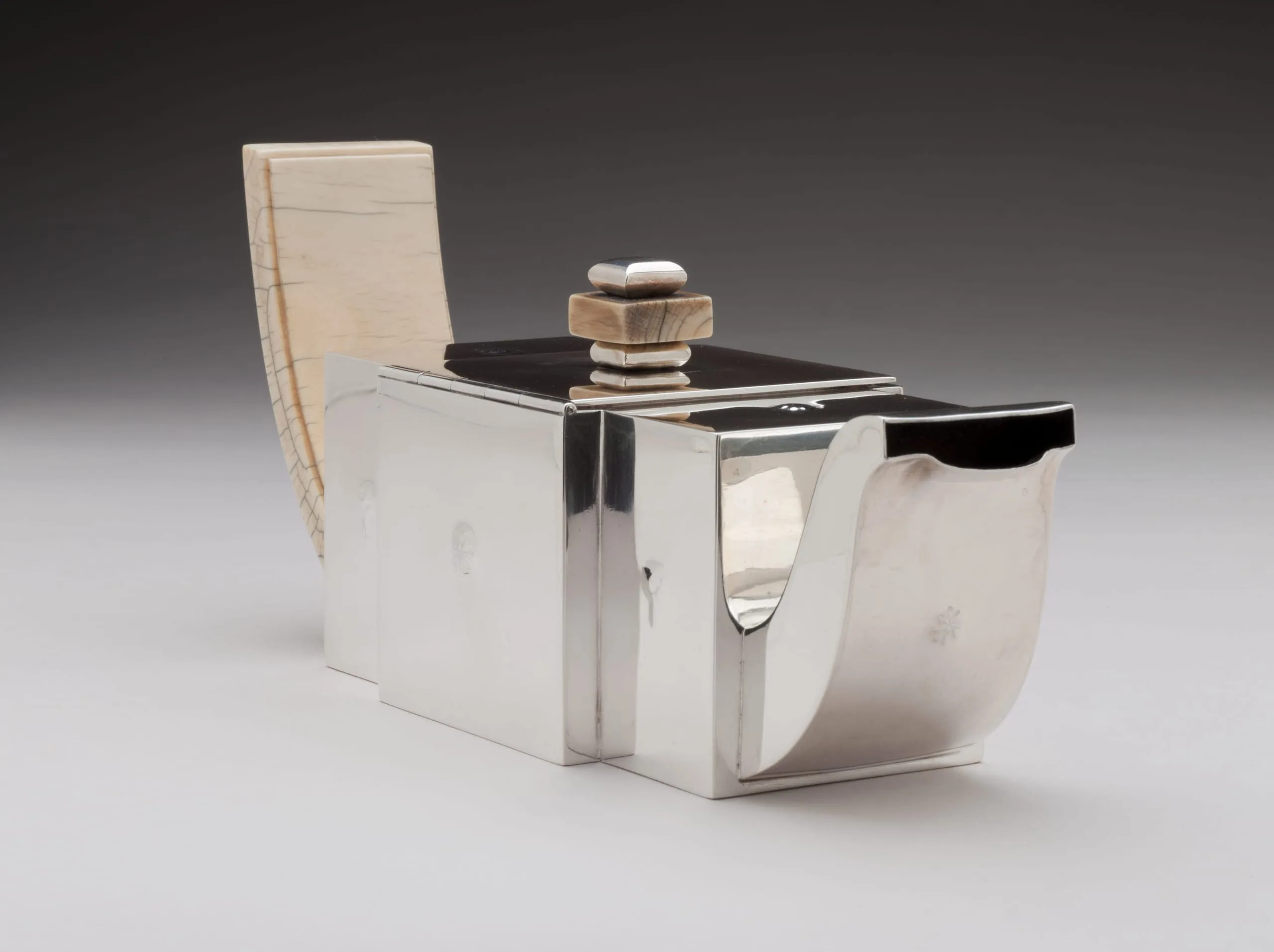
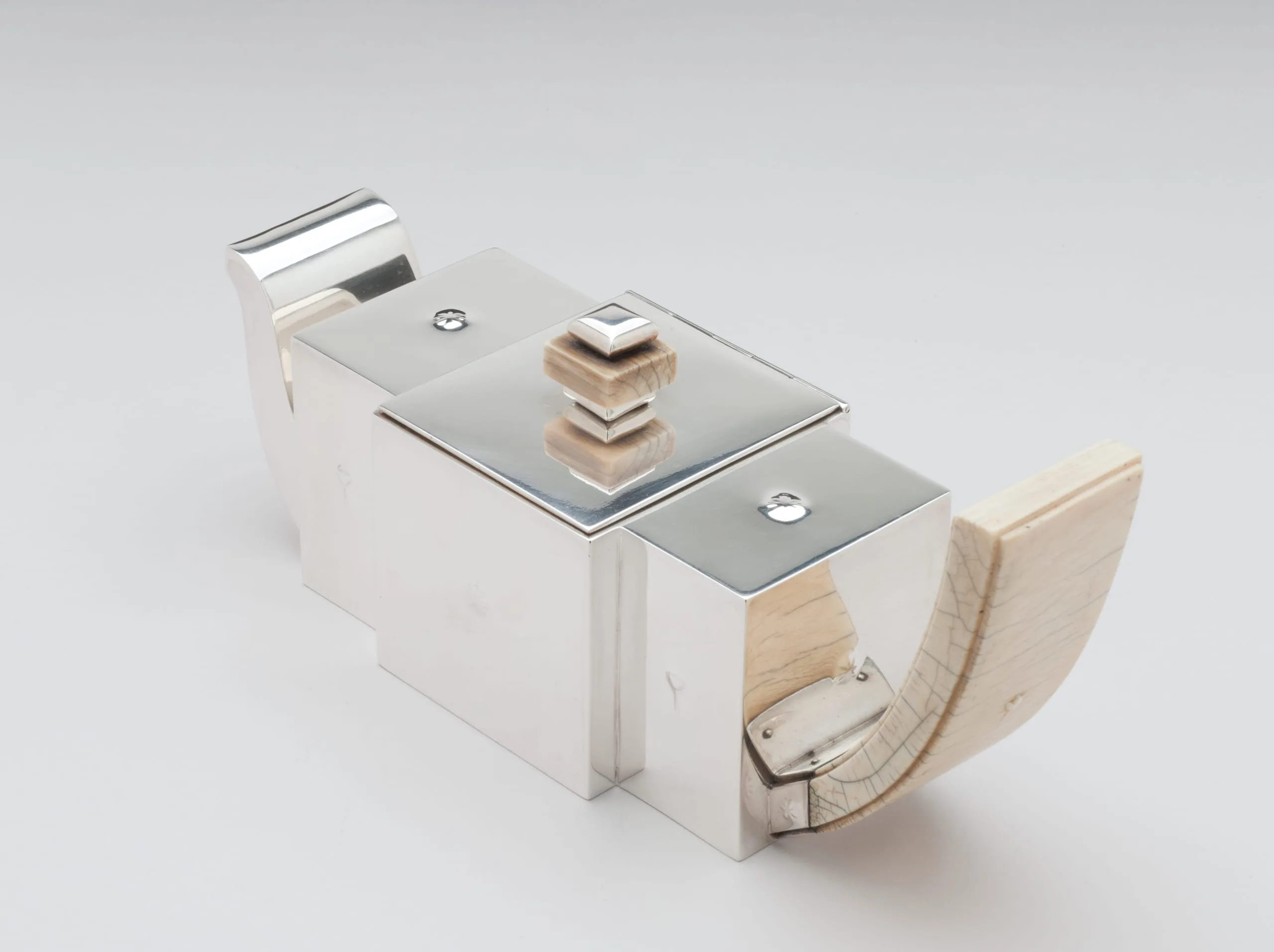
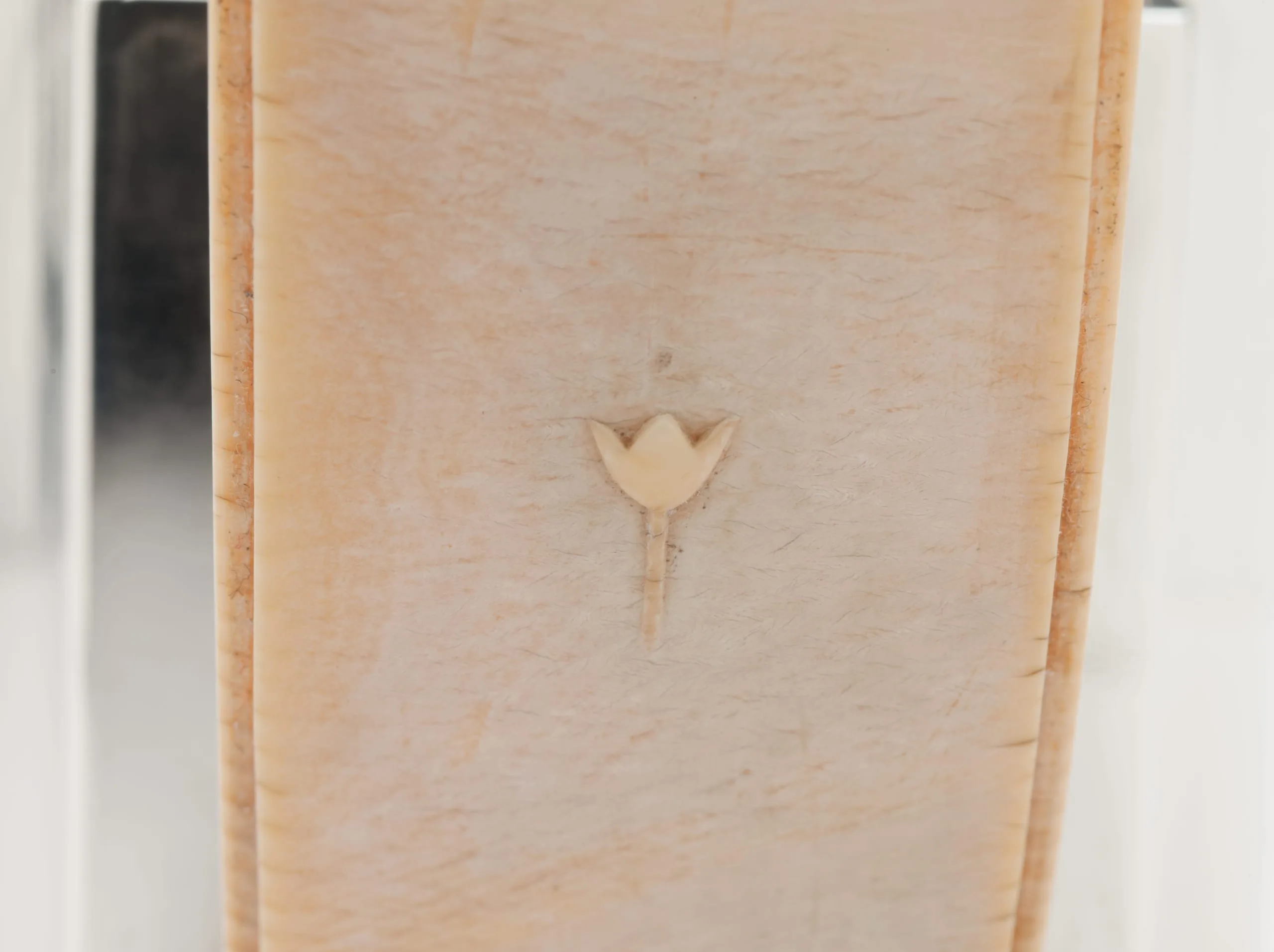
"Josef Hoffmann is the most venerable, stimulating, and fertile figure of the Austrian architects," declared the American Institute of Architects in 1928, a conviction historians still hold today. This four-piece tea service—one of only three in existence—is a masterpiece of Hoffmann's mature style. With its sleek surfaces, subtle repoussé ornament, and delicately carved tulips on ivory handles, the service combines luxury with modernity, a hallmark of Hoffmann's work for decades.
In 1897 Hoffmann was a leader of the progressive Viennese artists who broke away from the city's established exhibiting body to form their own group, known as the Vienna Secession. They brought Austria to the forefront of modern art with their rallying cry, "To the age its art, to art its freedom." Since their definition of modern gave the applied arts a status equal to the fine arts, silver, furniture, and other media were prominently displayed at their exhibitions.
Hoffmann took the dream of uniting all branches of art even further. In 1903 he established the cooperative workshop in Vienna, the Wiener Werkstätte. He and Koloman Moser (who left the firm in 1907) created departments for metalwork, bookbinding, leatherwork, cabinetmaking, glass, and ceramics, as well as an architectural office. A few years later, departments for printing, fashion, and textiles were added. Ambitiously, they aimed to cover all the crafts necessary to create a Gesamtkunstwerk—a total work of art that integrated every aspect of the design.
An immediate artistic success, the Werkstätte designed both homes and their complete furnishings for Vienna's progressive (mostly Jewish) elite and important public buildings such as the Purkersdorf Sanatorium (1904–05). Their aesthetic of rigorous geometry, characterized by the constant repetition and creative interplay of circles and squares, was admired and imitated throughout Europe and the United States.
In June of 1922, Hoffmann's friend, the émigré designer Joseph Urban, opened a branch of the company on Fifth Avenue in New York, where the silver tea service was sold. Trained as an architect, Urban immigrated to the United States in 1912, where he became the chief set designer for the Metropolitan Opera and for the Ziegfeld Follies in New York, and continued practicing as an architect. Urban had gone back to his native Vienna after World War I and was deeply affected by the serious depression that came after Austria's defeat in the war. When he returned to the U.S., he launched the "Artists Fund" to send aid to destitute artists. As another way to help his practically starving countrymen, he raised the money to open a salesroom for the Wiener Werkstätte in New York.
This silver tea service of consummate craftsmanship was illustrated in the company brochure and priced at $650, a staggering figure for the time. We can date the set very precisely, since the Wiener Werkstätte kept detailed records, and the company archives are at the National Museum of Applied Art (the MAK) in Vienna. According to the records, the head of production, Philipp Häusler, signed off on the drawings for the tea set in March of 1922, authorizing it to be made. Three sets were produced, and the work was finished in March, 1923. (Another example is at the Richmond Museum of Art; the location of the third is unknown.)
The Wiener Werkstätte of America closed in December 1923 after only eighteen months, however, as only a small minority of adventurous New Yorkers were patrons of proto–art deco. (The style was popularized at the Paris Exposition of 1925.) Hoffmann himself considered this service of such importance that he included it in the sumptuous catalogue celebrating the company's twenty-fifth anniversary, The Wiener Werkstätte 1903-1928: Modern Decorative Art and its Path.
The teaset was purchased from Joseph Urban by Frances Marion, a renowned screenwriter in Los Angeles, the first woman to win an Academy Award for the best original screenplay. Urban and Frances Marion knew each other well from their close association with William Randolph Hearst. Urban was Hearst's favorite art director and personal friend—during the 1920s, he designed dozens of films for Hearst's company. And since Frances Marion was one of Hearst's favorite writers, she and Joseph Urban worked together on several. In the 1921 feature Enchantment, Urban placed the first modern interior design in an American movie—a Wiener Werkstätte dining room.
The connection between Vienna and New York at that time is a critically important one; far more avant-garde design of the 1920s was transmitted to America by German-speaking artists than French, who have been overly credited. LACMA is fortunate to own several important pieces of early Wiener Werkstätte furniture and is in a unique position to show a different view of the dissemination of Modernism with its holdings in The Robert Gore Rifkind Center for German Expressionist Studies, as well as those of such significant Austrian émigrés as R.M.Schindler and Richard Neutra in Decorative Arts. Both elegant and innovative, the Hoffmann tea service adds a powerful dimension to revising the history of artistic transmission.