- Title
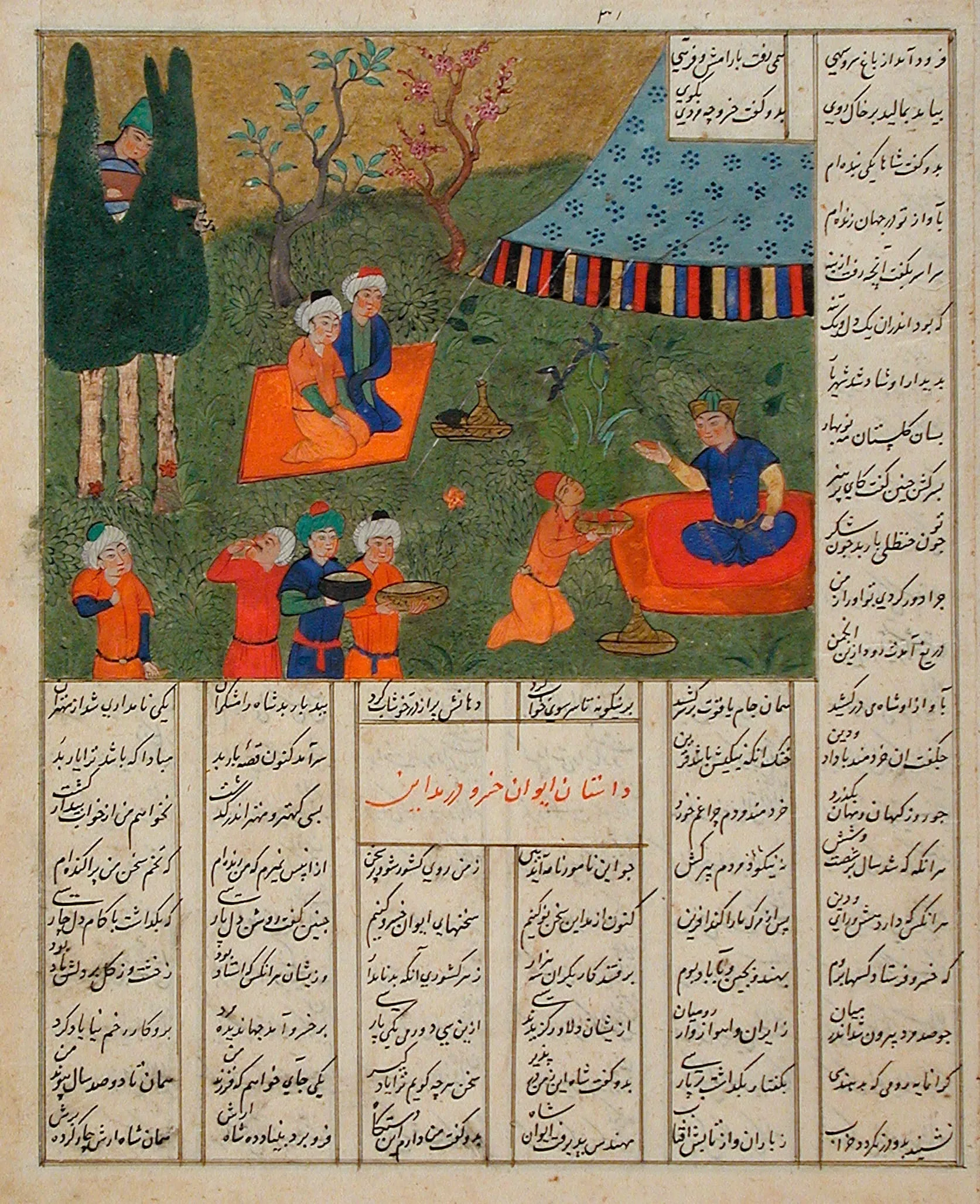
- King Khusraw and the Ministrel Barbad, Folio from a Shahnama (Book of Kings)
- Date Made
- circa 1475-1500
- Medium
- Opaque watercolor, gold, and black and red ink on paper
- Dimensions
- Image: 5 1/16 x 6 1/16 in. (12.86 x 15.4 cm); Sheet: 12 x 9 1/4 in. (30.48 x 23.5 cm)
- Accession Number
- 57.17.4
- Curatorial Notes
The Shahnama (Book of Kings) is an epic Persian poem composed by Firdausi (or Ferdowsi; circa 934-1020) in circa 977-1010. It narrates the legendary and historical past of the Persian Empire until the Arab Muslim conquest in the 7th century. Shahnama manuscripts were frequently produced throughout the Islamic world, including in South Asia. This folio and its set mates (57.17.3, 57.17.4, 57.17.7) are from a dispersed Shahnama that has stylistic antecedents from late 15th-century illustrated manuscripts produced in Herat, Afghanistan and Shiraz, Iran. (For example, see a folio from a Khavaranama (The Book of Eastern Exploits) of circa 1477 in the Aga Khan Museum, Toronto (AKM44.)
In this painting, the Sasanian King Khusraw (or Khosrow II, r. 590-628) is being entertained in a garden. The poet-minstrel Barbad is shown hiding in a cypress tree while playing a lute (barbat). Barbad had resorted to the ruse because he had been prevented from auditioning for Khusraw by the jealous chief court minstrel Sarkash. Khusraw was so impressed by Barbad’s playing that he appointed him chief court minstrel, which fulfilled a prophesy by his grandfather Khusraw I (r. 531-579) that he would make Barbad his chief ministrel.
- Selected Bibliography
- Pal, Pratapaditya. Indian Painting, vol.1. Los Angeles: Los Angeles County Museum of Art, 1993.