- Artist or Maker
- Iman Raad
Iran, Mashad, born 1979 - Title
- #8
- Date Made
- 2011-2014
- Medium
- Mixed media
- Dimensions
- 29 15/16 × 22 1/16 in. (76 × 56 cm)
Frame: 40 3/16 × 32 5/16 × 1 9/16 in. (102 × 82 × 4 cm)
- Accession Number
- M.2014.229
- Curatorial Notes
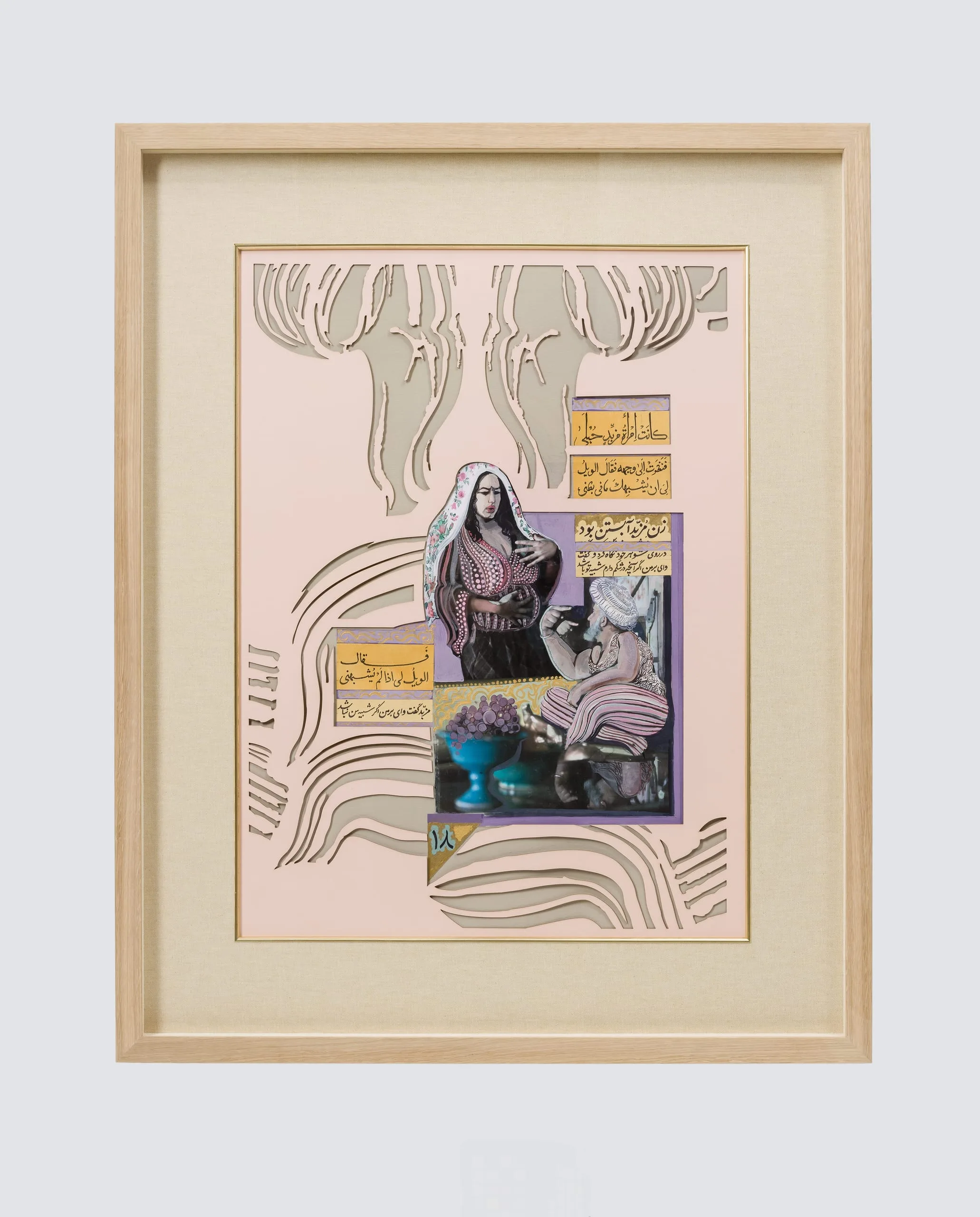
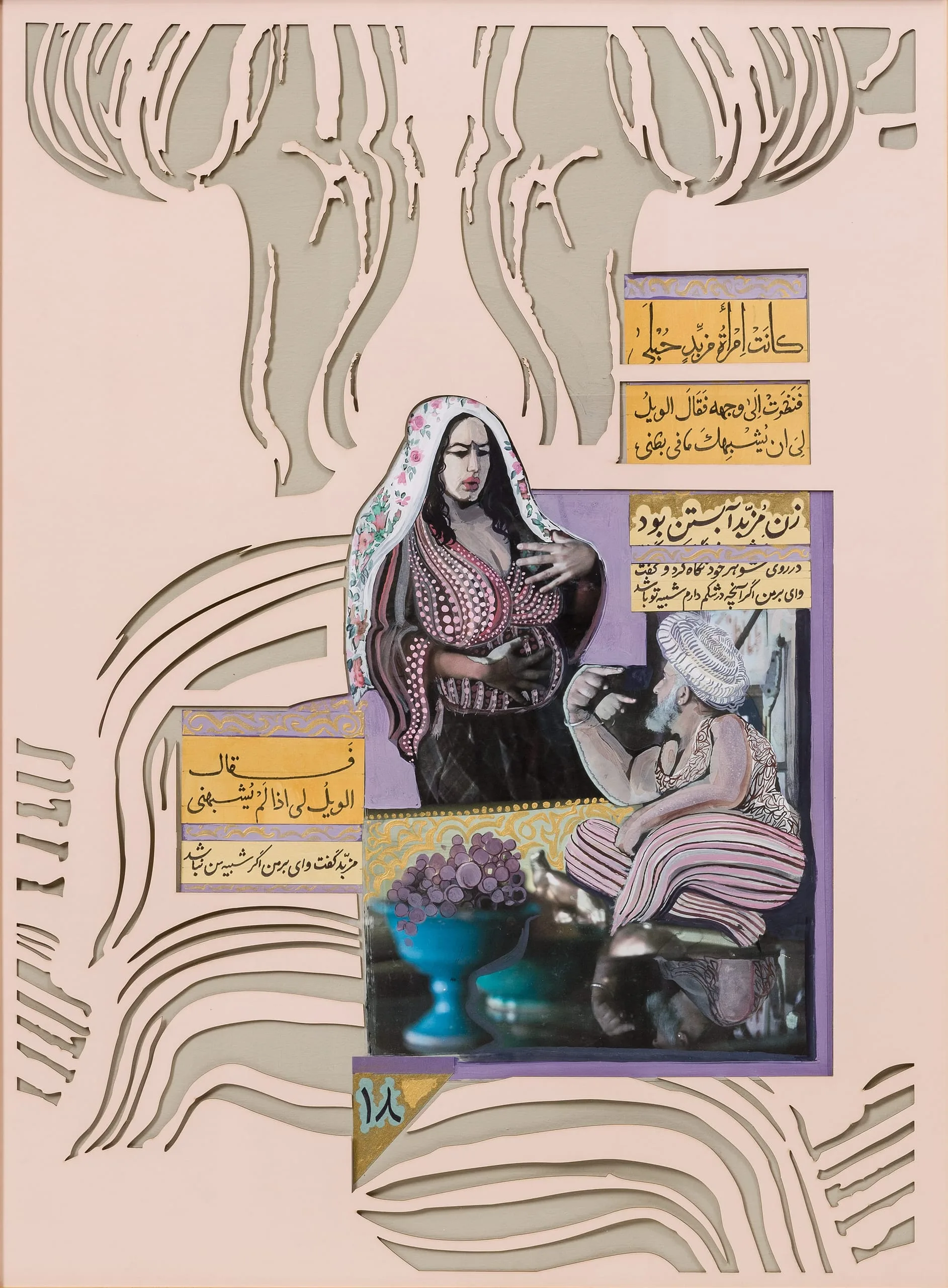
Persian miniature paintings were made to illustrate manuscripts that were often later dismantled and dispersed to satisfy the demands of modern-day collectors. Alluding to this tradition, this page emulates a detached manuscript folio. It belongs to an ongoing project currently comprising twenty-four works that visually narrate a fourteenth-century satirical text, the Risala-i Dilqusha (Joyous Treatise)—by the Persian poet Ubayd-i Zakani. The text accompanying each illustration explains the figural composition. This example reads: "While Muzabbid’s wife was pregnant, she looked at his face and said, ‘Woe to me if what is in my belly should look like you.’ ‘Woe to me if it should not!’ he said."
Of the quartet of artists who produced this collaborative work, the Haerizadeh brothers—Rokni and Ramin—are by far the best known. Exhibiting widely in the region and abroad, they are distinguished by their grotesque figures and often darkly humorous commentary on contemporary culture. Hesam Rahmanian focuses primarily on painting, while Iman Raad works mainly in embroidery and graphic design.
- Copyright
- © Ramin Haerizadeh, Rokni Haerizadeh, Hesam Rahmanian, and Iman Raad