LACMA

ShopMembershipMyLACMATickets
LACMA
Los Angeles County Museum of Art
5905 Wilshire Blvd.
Los Angeles, CA 90036
info@lacma.org
(323) 857-6000
Sign up to receive emails
Subscribe
© Museum Associates 2025

Museum Hours

Monday

11 am–6 pm

Tuesday

11 am–6 pm

Wednesday

Closed

Thursday

11 am–6 pm

Friday

11 am–8 pm

Saturday

10 am–7 pm

Sunday

10 am–7 pm


  • About LACMA
  • Jobs
  • Building LACMA
  • Host An Event
  • Unframed
  • Press
  • FAQs
  • Log in to MyLACMA
  • Privacy Policy
© Museum Associates 2025
Collections

Kem (Karl Emanuel Martin) Weber
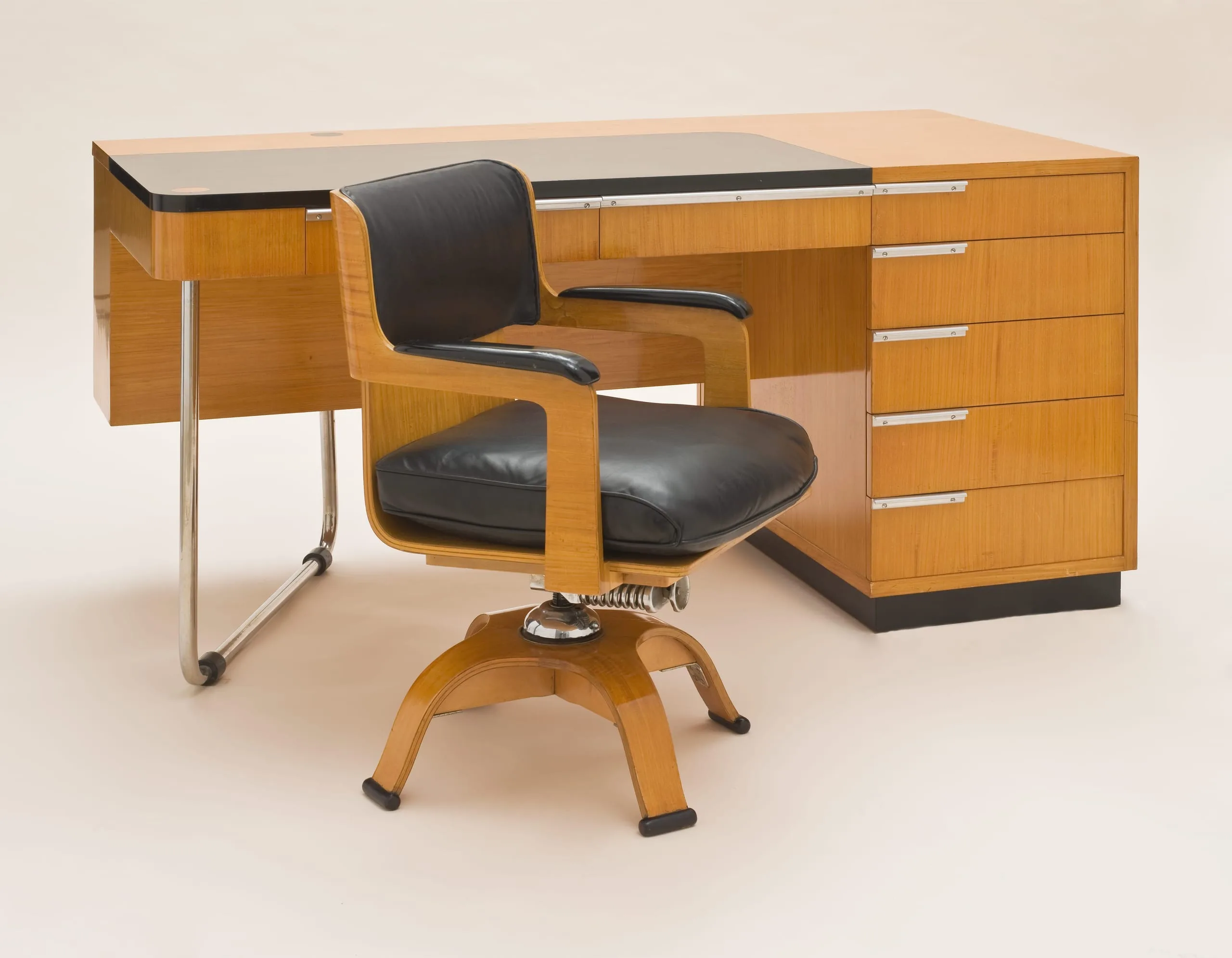
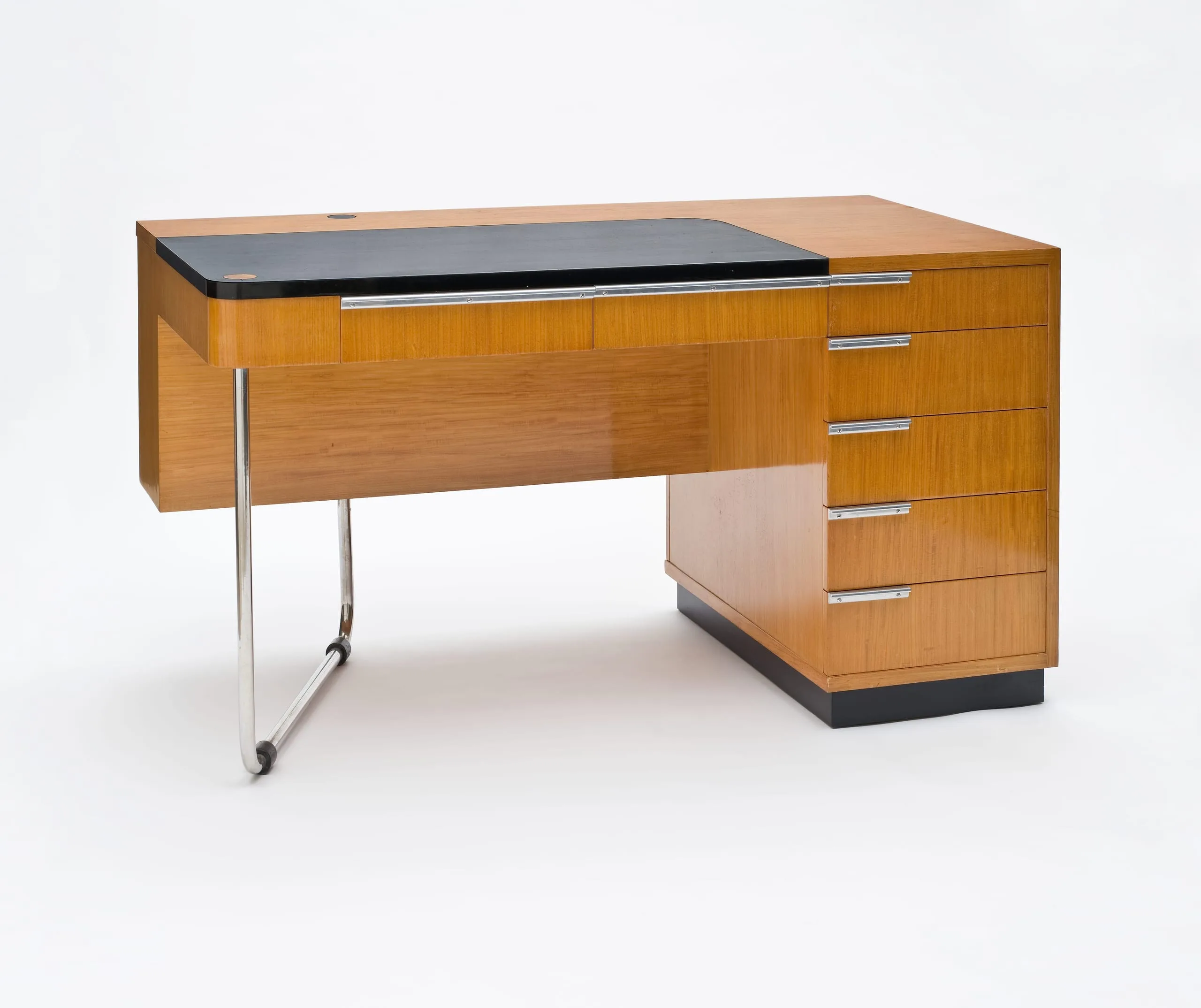
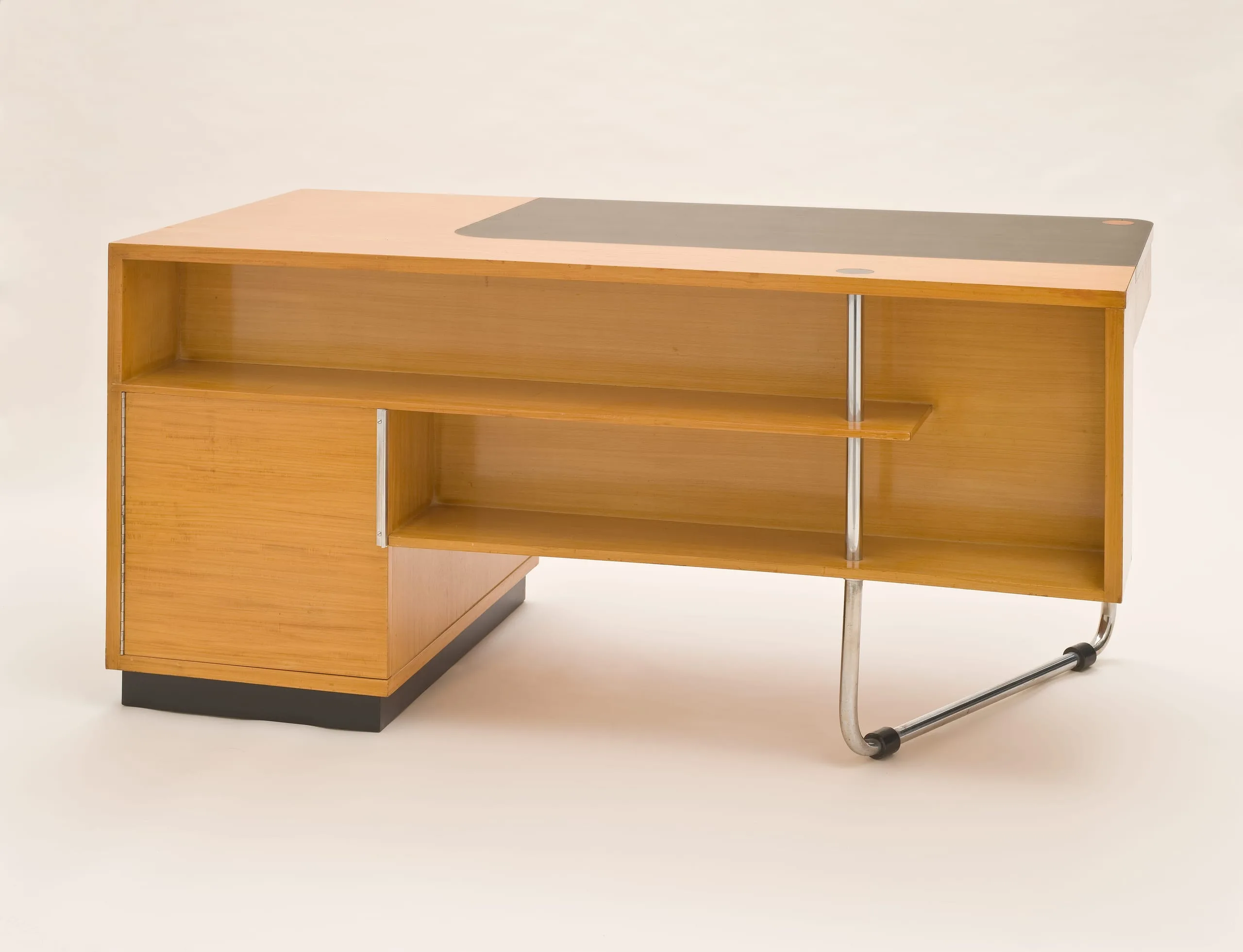
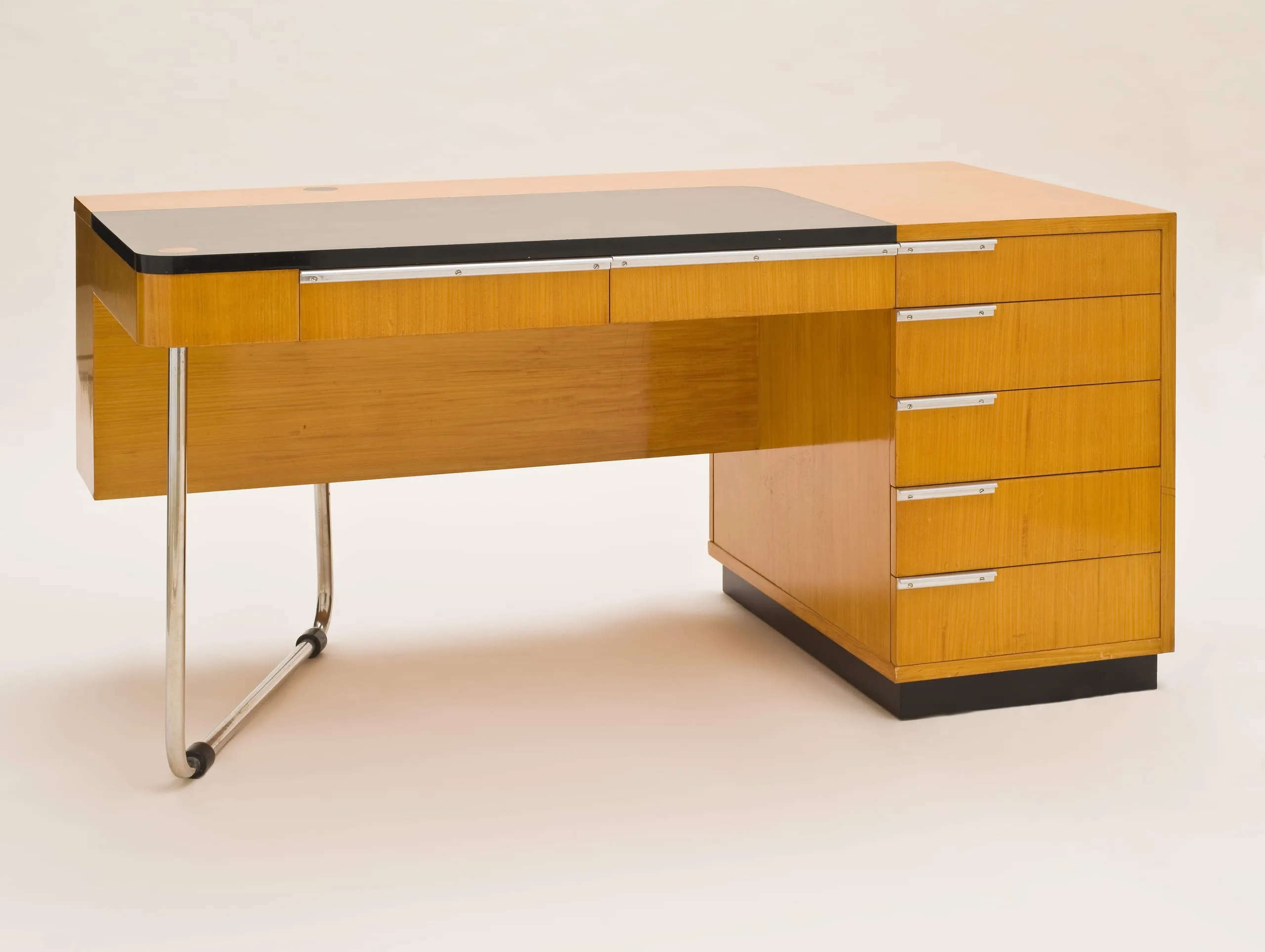
Desk and Chair from the Golden Gate International Exposition, San Franciscocirca 1938

Not on view
Mid-century modern honey-toned wood desk with black writing surface and chrome cantilever legs, paired with a matching bentwood swivel chair with black upholstered cushions
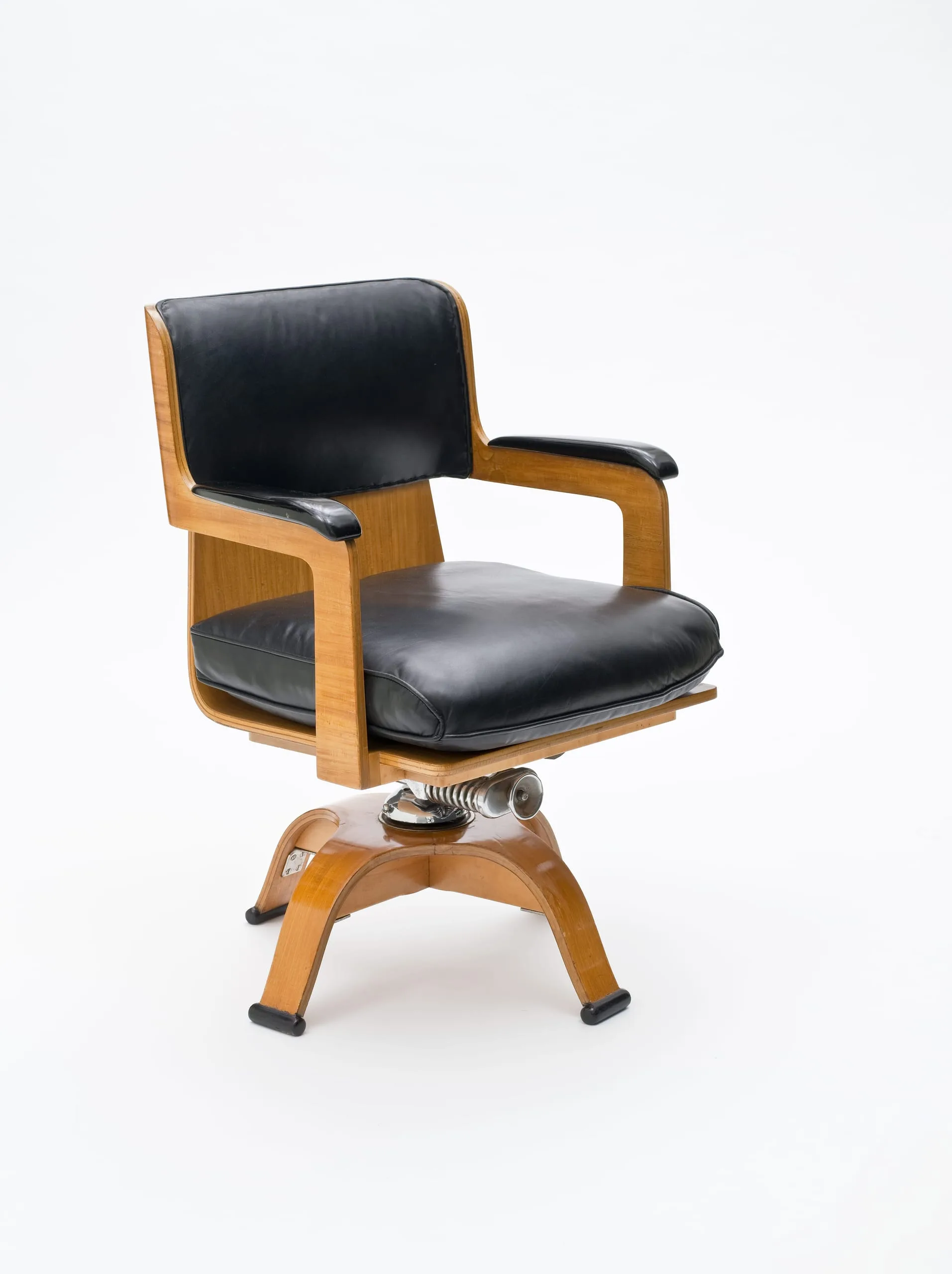
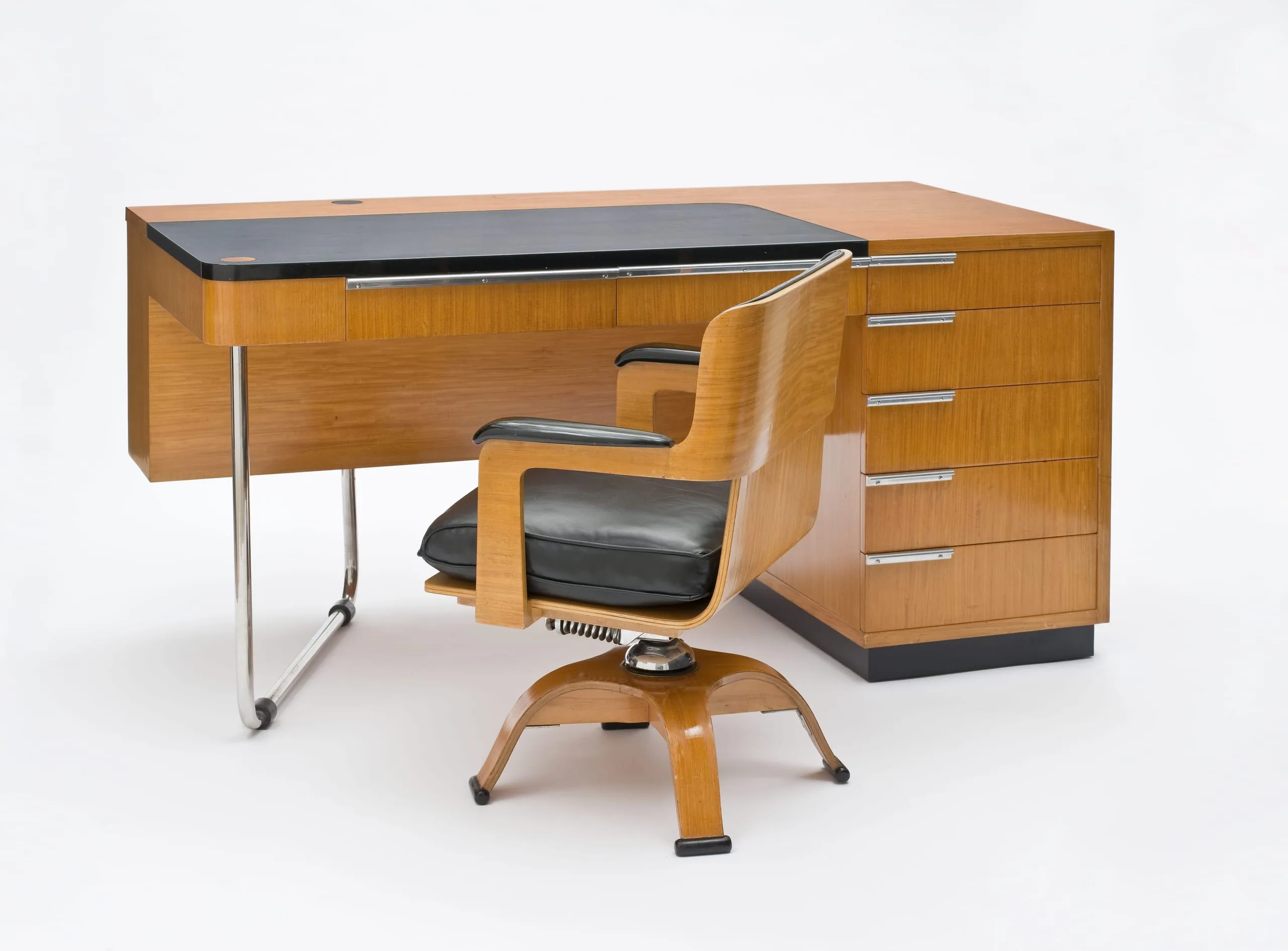
Art Deco desk and chair set in warm honey-toned wood veneer; the pedestal desk features a black glass top, chrome hardware, and four drawers on the right; the matching swivel chair has a bentwood frame, black leather upholstered seat and back, chrome cantilever legs, and a spring mechanism at the base.
Writing desk in light wood veneer with a black glass work surface, asymmetrical form featuring a four-drawer pedestal on the right and a cantilevered chrome tubular steel leg on the left, with chrome bar pulls on drawers and a black lacquered plinth base.
Modernist desk in light honey-toned wood veneer with open shelving, a recessed cabinet door at left, dark inset writing surface at top right, and a curved tubular chrome support leg at front right.
Modernist desk in light oak veneer with a black glass writing surface, chrome bar handles on four right-side drawers, and a single cantilevered chrome tubular leg on the left front.
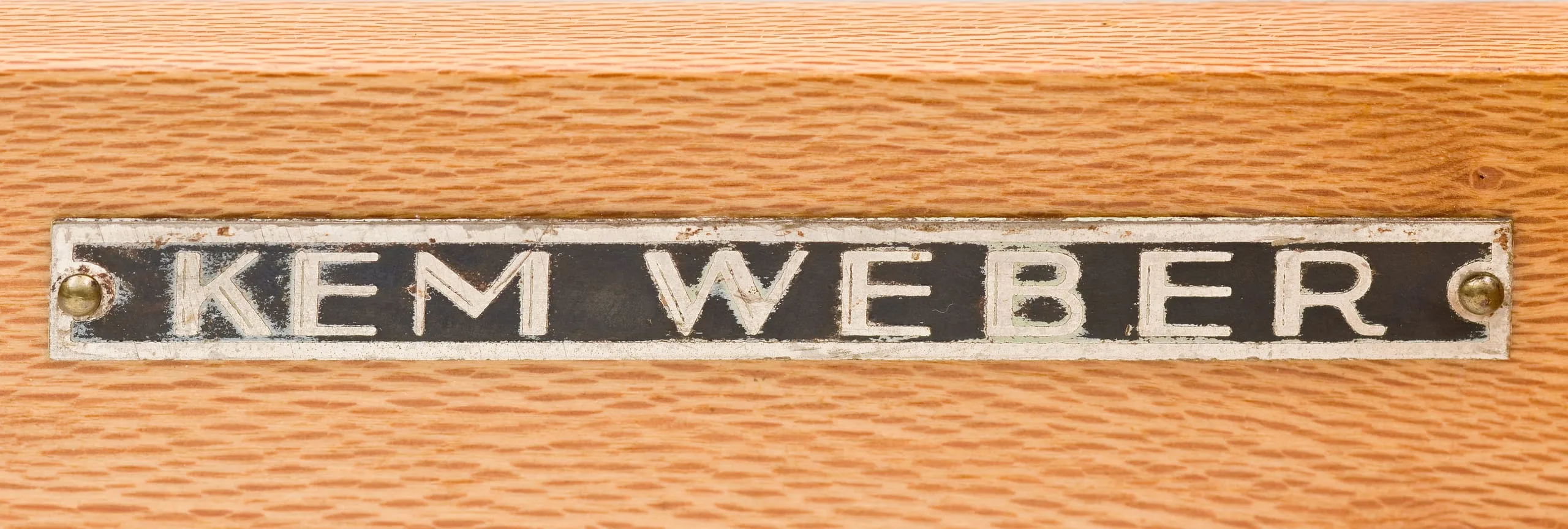
Close-up of a dark metal maker's plaque reading "KEM WEBER" in white block letters, affixed with brass screws to a light oak wood surface.
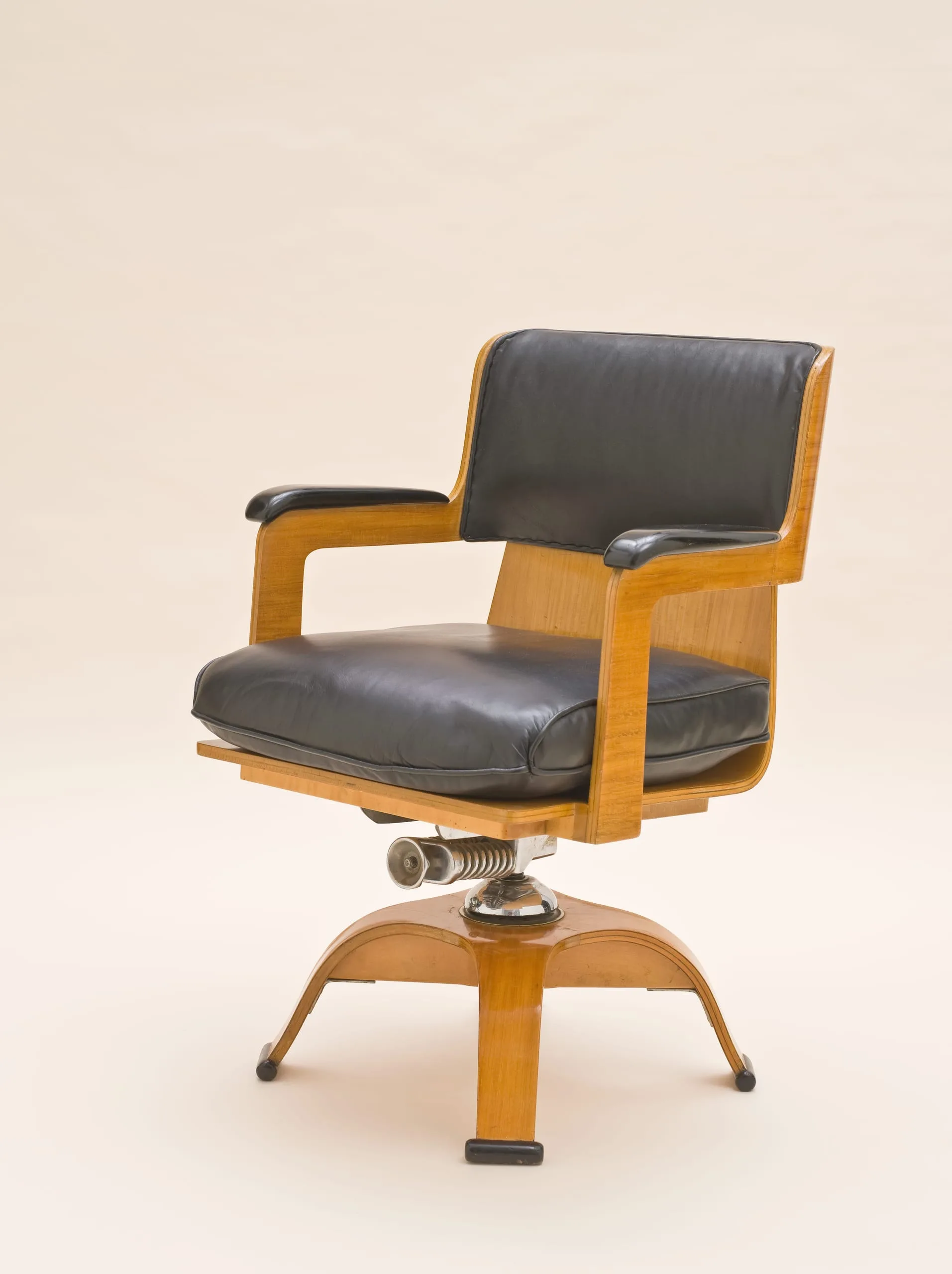
Swivel desk chair with warm honey-toned wooden frame and black upholstered seat, back, and armrests; chrome spring mechanism visible beneath the seat on a four-legged rotating base with rubber feet.
Swivel desk chair with warm honey-toned wood frame and black leather seat, back, and armrest pads; chrome spring mechanism visible beneath the seat; four-legged wooden base with rubber feet.
Artist or Maker
Kem (Karl Emanuel Martin) Weber
Germany, Berlin, active United States, California, Los Angeles, 1889-1963
Title
Desk and Chair from the Golden Gate International Exposition, San Francisco
Date Made
circa 1938
Medium
Satinwood, primavera, chrome, aluminum, resin, leather (replaced)
Dimensions
Desk: 30 1/4 × 60 × 30 in. (76.84 × 152.4 × 76.2 cm) Chair: 32 1/4 × 22 1/4 × 21 5/8 in. (81.92 × 56.52 × 54.93 cm)
Credit Line
Purchased with funds provided by the Decorative Arts and Design Deaccession Fund, Viveca Paulin-Ferrell and Will Ferrell, Shannon and Peter Loughrey, Heidi and Said Saffari, and Holly and Albert Baril
Accession Number
M.2010.7.1-.2
Classification
Furnishings
Collecting Area
Decorative Arts and Design
Curatorial Notes
This desk and chair was part of the room Kem Weber designed for the Palace of Fine and Decorative Arts at the 1939 Golden Gate International Exposition (GGIE) in San Francisco. Trained in Germany as a cabinetmaker and, later, as an architect and interior designer, Weber was the first of the great European émigré designers to come to California. Working for his teacher, architect Bruno Paul (a pioneer of German modernism), Weber traveled to San Francisco in 1914 to supervise the construction of the German section of the Panama Pacific World’s Fair. World War I intervened, and he was forced to stay in the United States. After the war he moved to Santa Barbara and then to Los Angeles, establishing himself as a successful industrial designer. From 1921 to 1927 he was the art director for the furniture store Barker Bothers, creating the Modes and Manners shop, one of the first to introduce modern design to California. In 1927 he opened his own studio in Hollywood, and had a wide ranging practice designing homes, interiors, and custom furniture as well as producing designs for furniture, silver, and clocks for manufacturers across the country.
By the end of the 1930s, Weber was focused mostly on interiors and architecture, and had achieved a national reputation for an inventive style that fit within the tenets of angular, pared down European modernism, but was less formal, characterized by aerodynamically inspired streamlining. Such was his renown that textile designer Dorothy Liebes, who was the director of the Decorative Arts section for the GGIE, invited him to install a room there. The importance of this commission in disseminating California design cannot be overstated – about a third of the invited rooms were by architects from the state, and they were displayed with those by international masters such as Marcel Breuer, Josef Frank, and Alvar Aalto. Millions of people saw these rooms and got their ideas for furnishing modern homes from them.
The desk, which has not been seen publically since the GGIE, is the embodiment of California modern, combining beautiful satinwood with the new materials of Bakelite and chrome plated steel. It was a custom design specially made for the room and shown at the GGIE with the equally innovative plywood chair. We don’t know if the chair was designed specifically for the GGIE since it also appears in a drawing for an office that was part of another critically important commission for Weber – the site plan, all buildings, and furnishings for Walt Disney Studios in Burbank, also completed around the same time, in 1938-1939. (Wendy Kaplan, Department Head and Curator of Decorative Arts and Design)
Selected Bibliography
  • Kaplan, Wendy, ed. California Design, 1930-1965: Living in a Modern Way. Los Angeles: Los Angeles County Museum of Art; Cambridge, Mass.: MIT Press, 2011.
  • Kaplan, Wendy, ed. Living in a Modern Way: California Design, 1930-1965. Los Angeles: Los Angeles County Museum of Art, 2013.
Selected Exhibition History
  • California Design, 1930–1965: "Living in a Modern Way". October 1, 2011 - June 3, 2012
  • California Design, 1930–1965: "Living in a Modern Way". October 1, 2011 - June 3, 2012
  • California Design, 1930–1965: "Living in a Modern Way". March 20, 2013 - June 3, 2013
  • California Design, 1930–1965: "Living in a Modern Way". March 20, 2013 - June 3, 2013
  • California Design, 1930–1965: "Living in a Modern Way". July 6, 2013 - September 29, 2013
  • California Design, 1930–1965: "Living in a Modern Way". July 6, 2013 - September 29, 2013
  • California Design, 1930–1965: "Living in a Modern Way". November 2, 2013 - February 9, 2014
  • California Design, 1930–1965: "Living in a Modern Way". November 2, 2013 - February 9, 2014
  • California Design, 1930–1965: "Living in a Modern Way". March 29, 2014 - July 6, 2014
  • California Design, 1930–1965: "Living in a Modern Way". March 29, 2014 - July 6, 2014