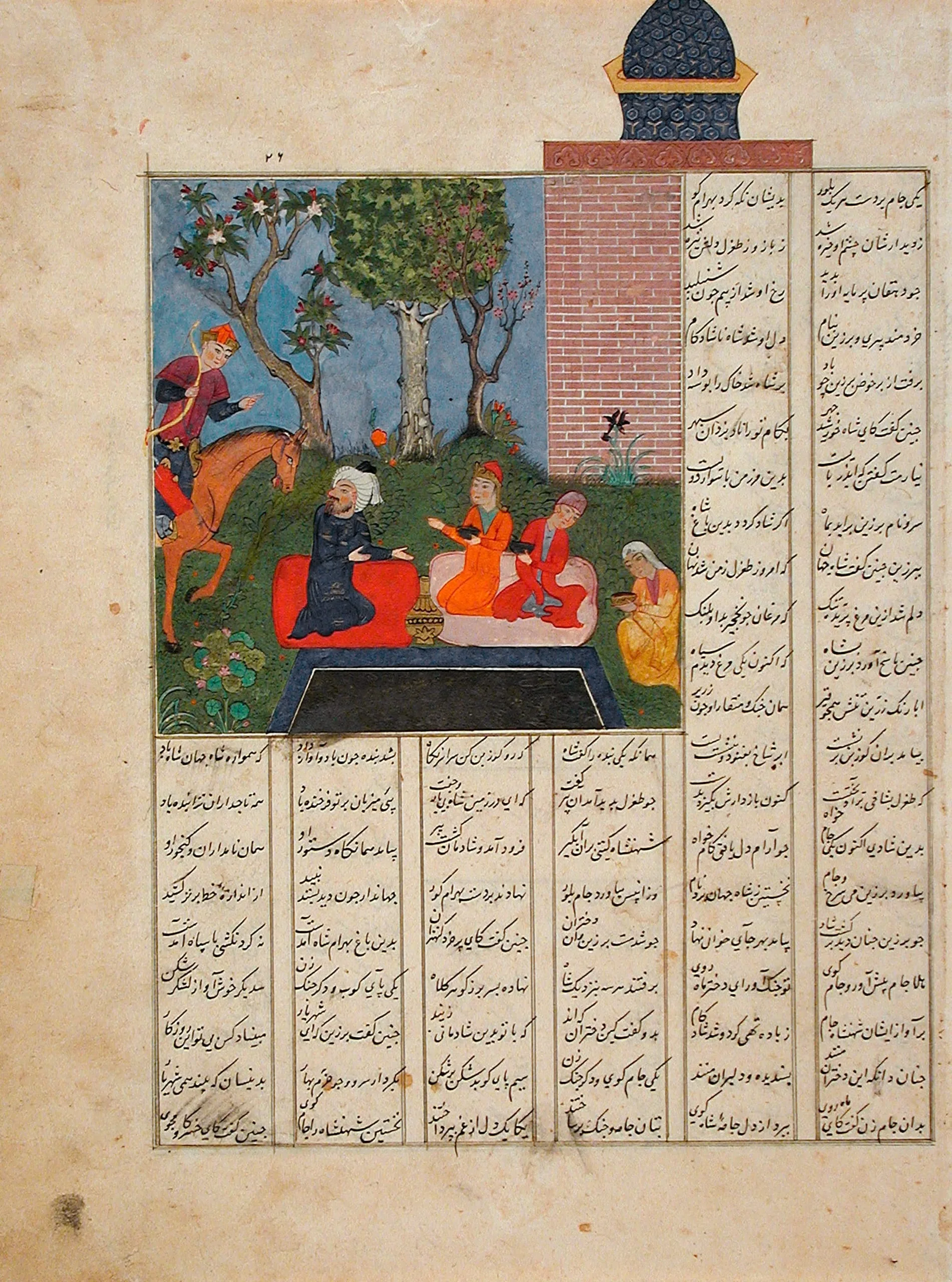
The Shahnama (Book of Kings) is an epic Persian poem composed by Firdausi (or Ferdowsi; circa 934-1020) in circa 977-1010. It narrates the legendary and historical past of the Persian Empire until the Arab Muslim conquest in the 7th century. Shahnama manuscripts were frequently produced throughout the Islamic world, including in South Asia. This folio and its set mates (57.17.3, 57.17.4, 57.17.7) are from a dispersed Shahnama that has stylistic antecedents from late 15th-century illustrated manuscripts produced in Herat, Afghanistan and Shiraz, Iran. (For example, see a folio from a Khavaranama (The Book of Eastern Exploits) of circa 1477 in the Aga Khan Museum, Toronto (AKM44.)
This folio depicts an episode from the story of the Sasanian King Bahram Gur (or Bahram V, r. 420-438). Famed for his hunting exploits, Bahram Gur is shown here on horseback searching for his lost dog when he encounters a farmer who invites him to meet his three daughters. A similar scene of Bahram Gur being entertained by a miller’s daughters is in a Shahnama of 1838 from Lahore, Pakistan, now in the Pierpont Morgan Library, New York (M.540, folio 326).
See also 39.12.72, 57.17.3, 57.17.4, 57.17.7, M.71.49.3, M.73.5.609, M.75.52, M.78.9.5, M.81.12a-b, M.85.189, M.90.160.1, and AC1993.187.1.