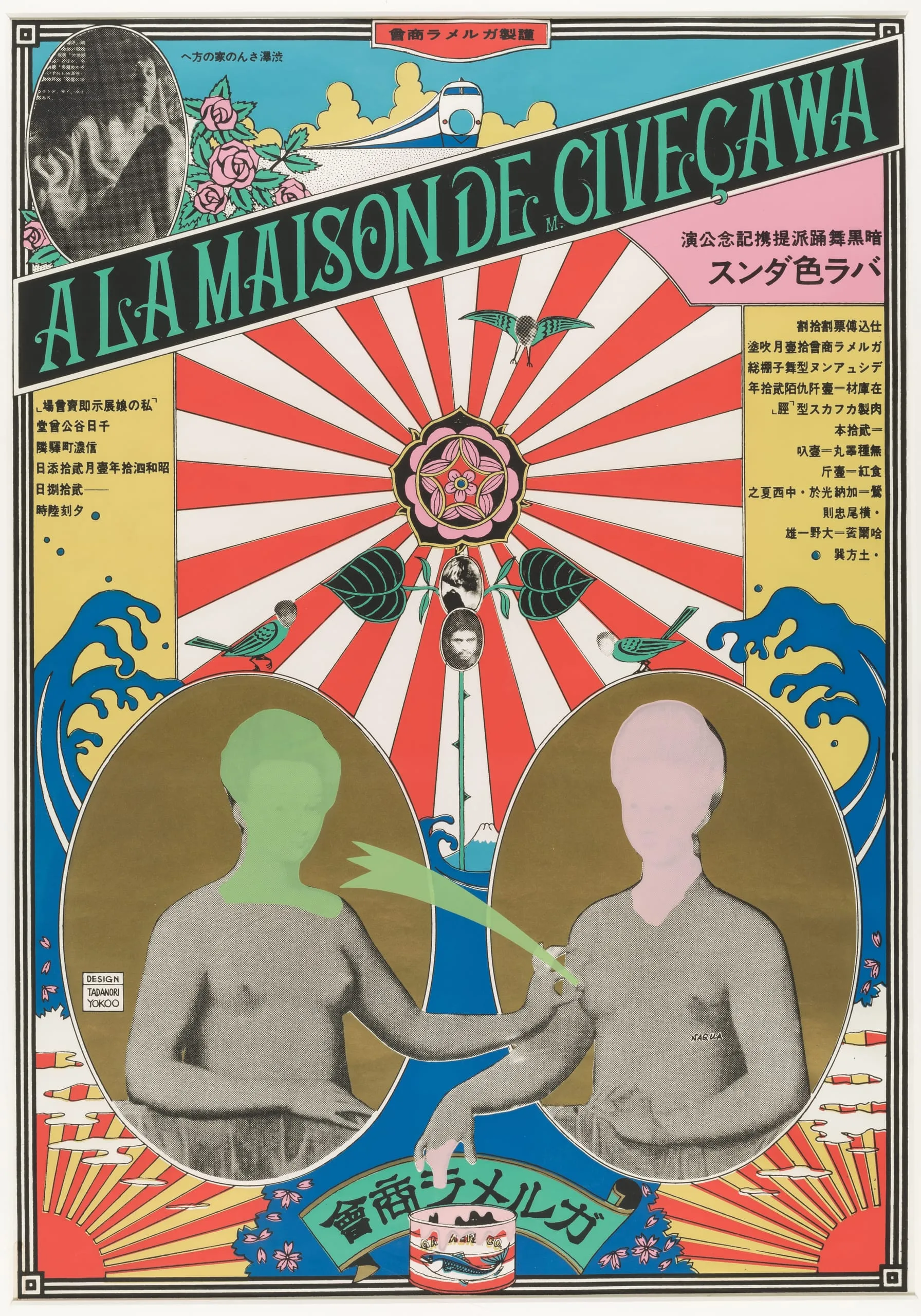
Called the "enfant terrible" of 1960s Japanese graphic design, Yokoo Tadanori rejected the international style abstraction of his peers in favor of an intensely personal collage aesthetic, brazenly layering eastern and western motifs. His posters for avant-garde dance and theater performances continually pushed boundaries, freely plucking imagery from classical and vernacular Japanese visual culture, the canon of Western art, and psychedelia. Decried by the established design community, Yokoo became a hero to the local youth culture and was widely acclaimed in America and Europe, the subject of one-man shows at MoMA in 1972 and the Stedelijk in 1974.
Rose-colored Dance: To M. Shibusawa’s House (À La Maison De M. Civeçawa) exemplifies the irreverent symbolism and manic energy that distinguished Yokoo’s early work. The poster announces a performance of the darkly erotic Rose-Colored Dance by pioneering choreographer Tatsumi Hijikata. The dance’s title references Tatshujiko Shibusawa, a Japanese scholar known for his translations of French works, especially those by the Marquis de Sade ("M. Civeçawa" has been described as an "archaic transliteration" of Shibusawa). Yokoo captured the blurring of Japan and Europe, as well as the unabashed sexuality of Hijikata and Shibusawa’s work. His design incorporates the famous and often appropriated figures from the anonymous French painting Gabrielle d’Estrees and One of Her Sisters (1594), transferring them from their original bathroom to ovals reminiscent of portraits of Japanese royalty. He heightened the provocative pose of the original painting – one nude woman pinching the other’s nipple – with the cheeky embellishment of squirting green milk.
The portraits are surrounded by motifs from Japanese culture: the wave from Hokusai’s classic print, the rising sun of Japan’s military flag (which had been banned during the United States occupation), and the high-speed Shinkasen train, an emblem of the country’s rapid modernization. The many colors on the vibrantly silkscreened design demonstrate the importance that Hijikata and his contemporaries placed on posters; despite their small budgets, theaters elected to produce these elaborate and expensive advertisements in order to extend the experience of their performances beyond the theater walls.
Staci Steinberger, Associate Curator, Decorative Arts and Design, 2021