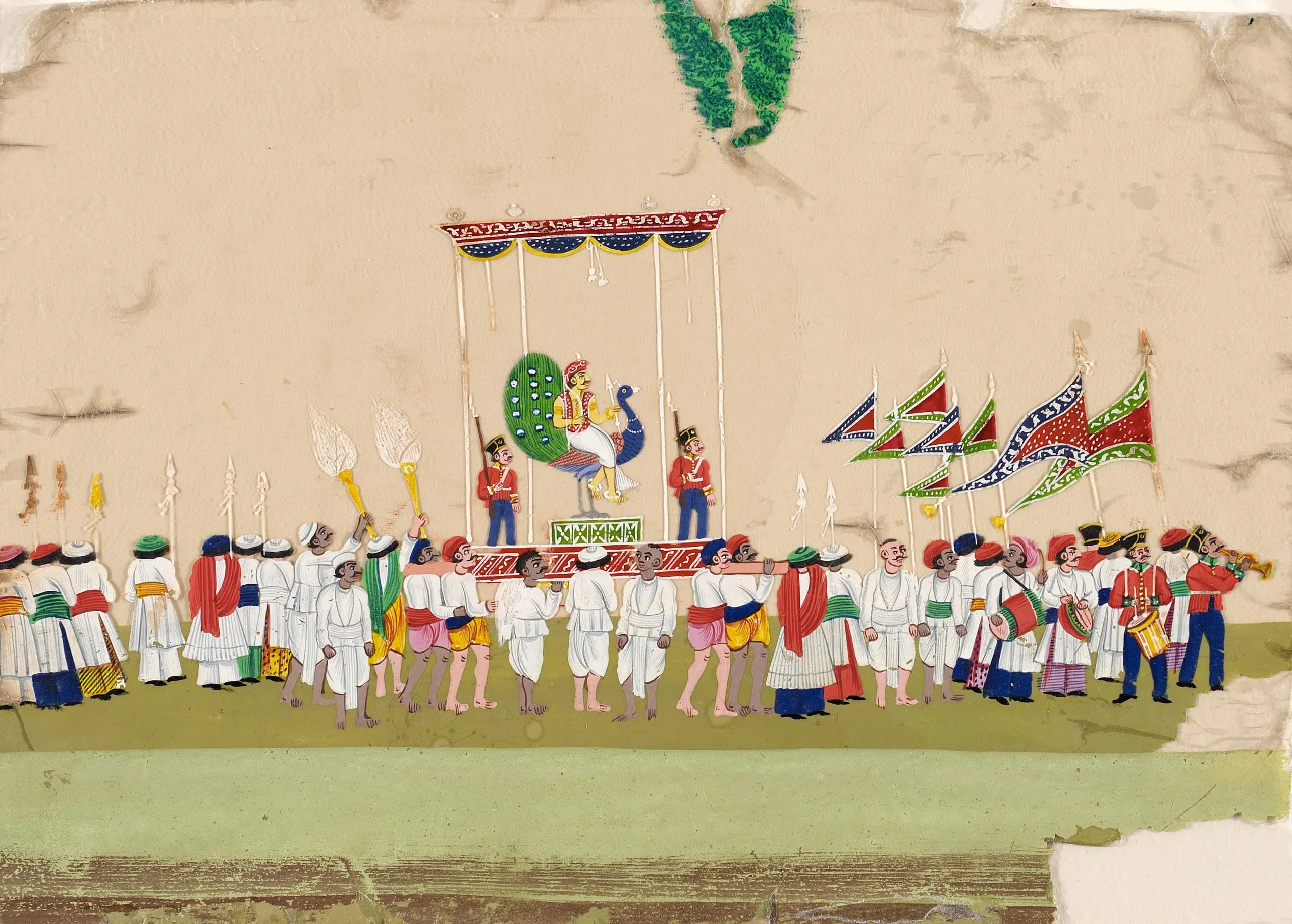
Beginning in the early 19th century in Murshidabad, images of festivals, ceremonies, occupations, and transportation modes were painted on mica. Known colloquially as talc paintings, mica was used by artists for making tracings as models (namuna) of their ancestral paintings. Mica was mined in the Chota Nagpur Plateau in eastern India. The mica crystals could be cleaved into thin elastic plates, which were suitable as a ground for illustrations and for making lanterns (see M.85.180). By the middle of the 19th century, mica painting spread to Patna, Bihar; Benares (Varanasi), Uttar Pradesh; and Trichinopoly (Tiruchirappalli), Puddukkottai, and Srirangam, Tamil Nadu. Each venue produced mica paintings in their own regional styles of standard and idiosyncratic subjects, including natural history studies done in Trichinopoly. Hundreds of mica paintings were collected by British patrons and visitors, many of which were sent home as gifts. By the end of the 19th century, the artform had been largely supplanted by photography.
In this painting, a life-sized clay image of the Hindu god Karttikeya mounted on his peacock vehicle (vahana) and holding a bow and arrow is being carried under a canopy on a palanquin while being guarded by two uniformed soldiers. The male retinue includes musicians, standard-bearers, and men waiving an honorific fly whisk made from the white tail-hairs of a yak. The image is being taken for immersion in water for ritual dissolution after worship.