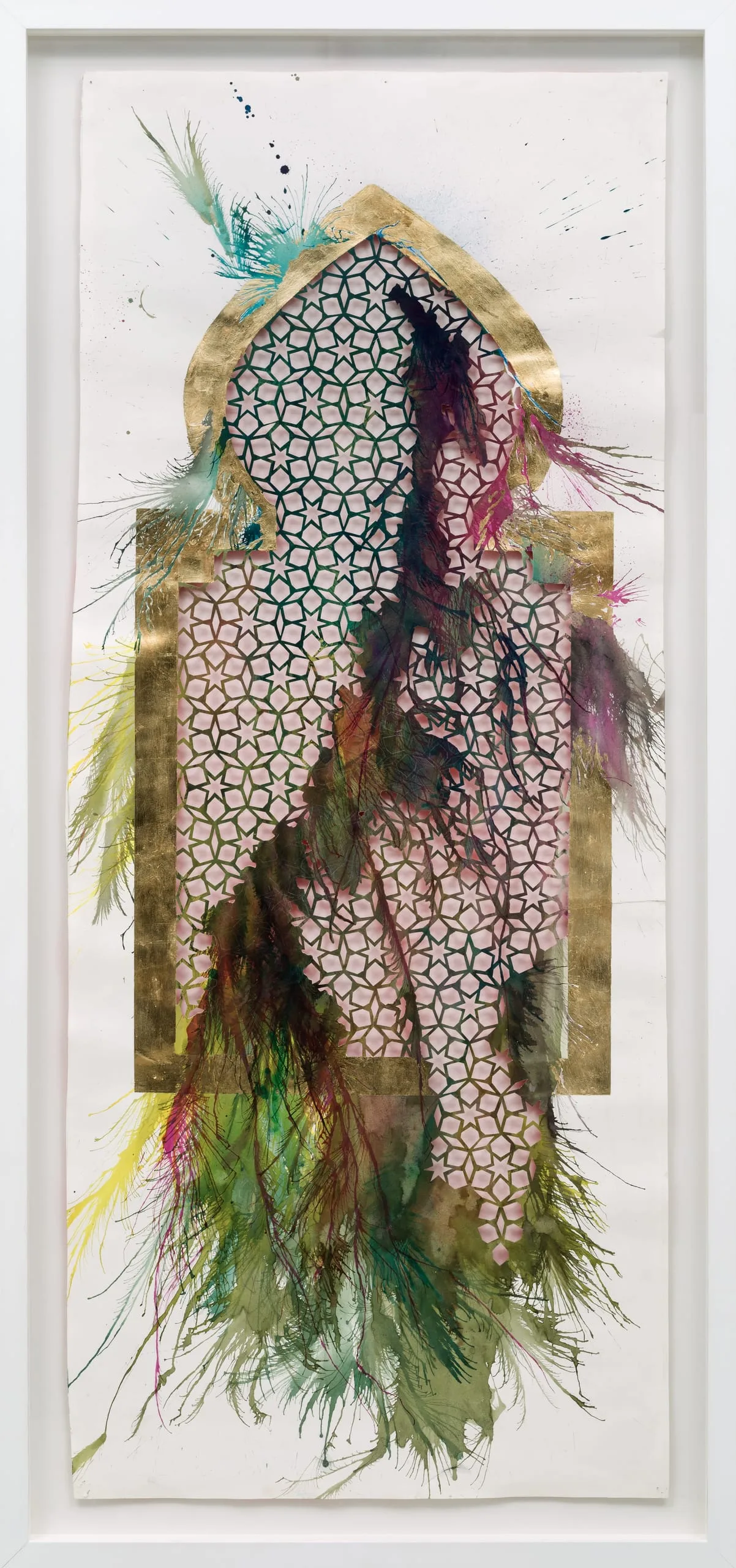
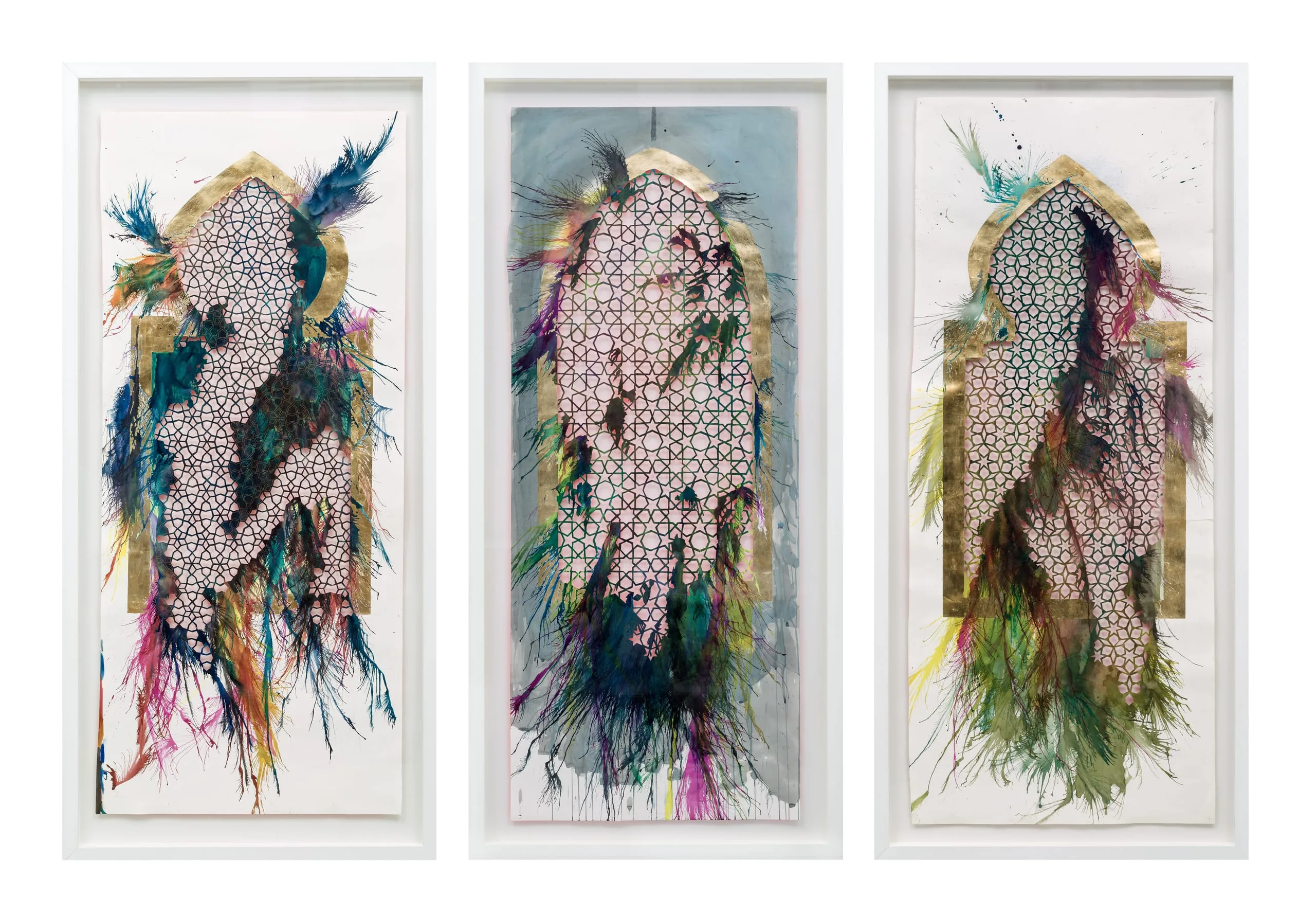
This trio of images (see M.2015.1, .2) belongs to a series inspired by the life of Huda Sha‘arawi, an early twentieth-century feminist, nationalist, and founder of the Egyptian Women’s Union. In the series Sherin Guirguis references a watershed event in which Sha‘arawi, on her return from an international conference on women’s suffrage, publicly removed her face veil at the Cairo railway station. Guirguis here continues her hallmark practice of using hand-cut paper embedded with paint, gold powder, and gold leafing, but she eschews her more usual abstraction by depicting architectural elements. These windows (hence the word shubbak, Arabic for "window," in the title), with their traditional geometric designs, establish a connection with the Bab al-Hadid railway station, where Sha‘arawi’s revolutionary act precipitated the eventual disappearance of veiling among upper- and middle-class Egyptian women.
Born in Luxor, Egypt, educated in the United States, and today based in Los Angeles, Guirguis produces work that investigates the tensions between the contemporary and the traditional and between East and West. Her often bold, neon palette subtly contrasts and harmonizes with her use of geometric patterns and designs associated with traditional Islamic art.