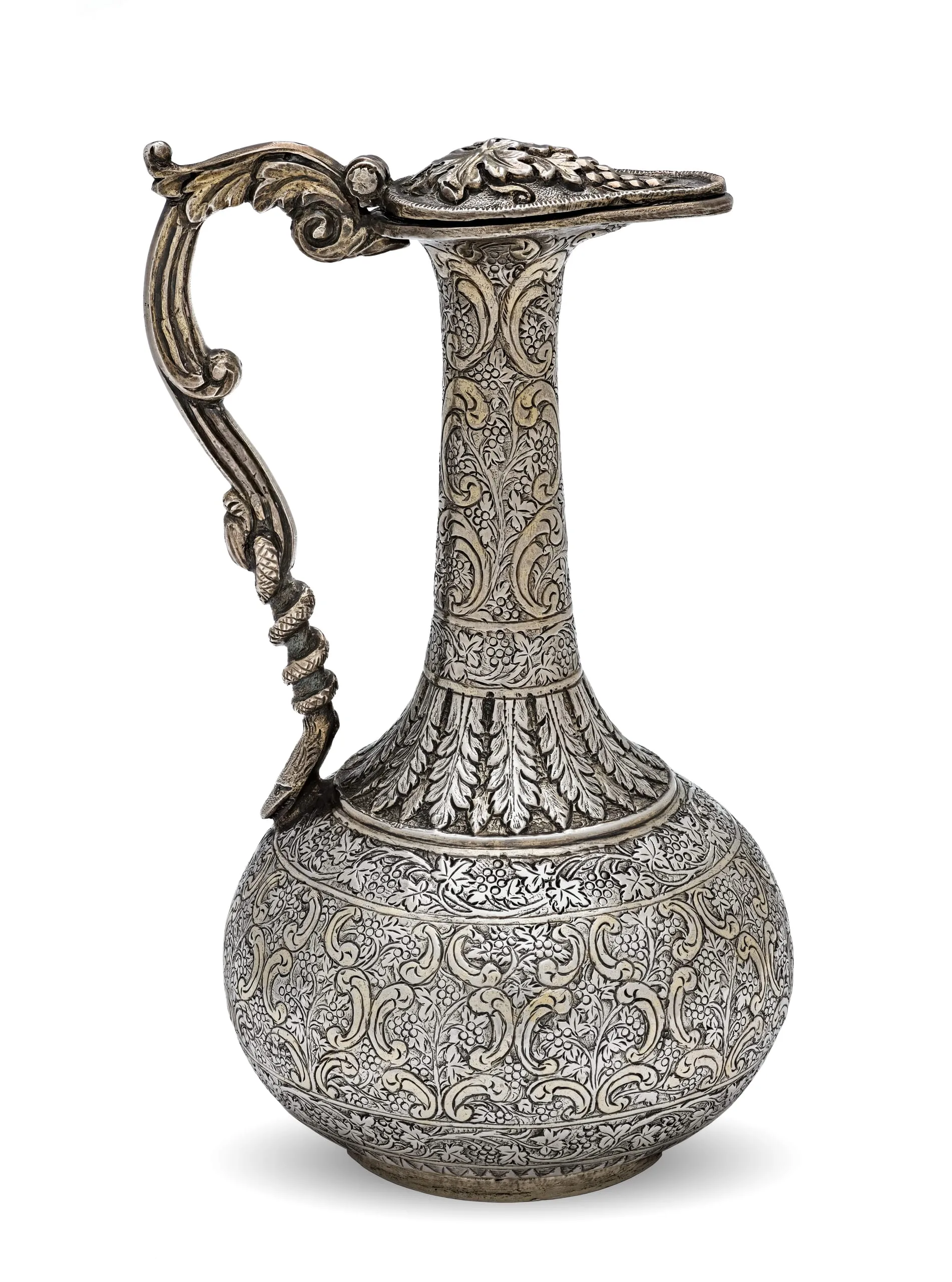
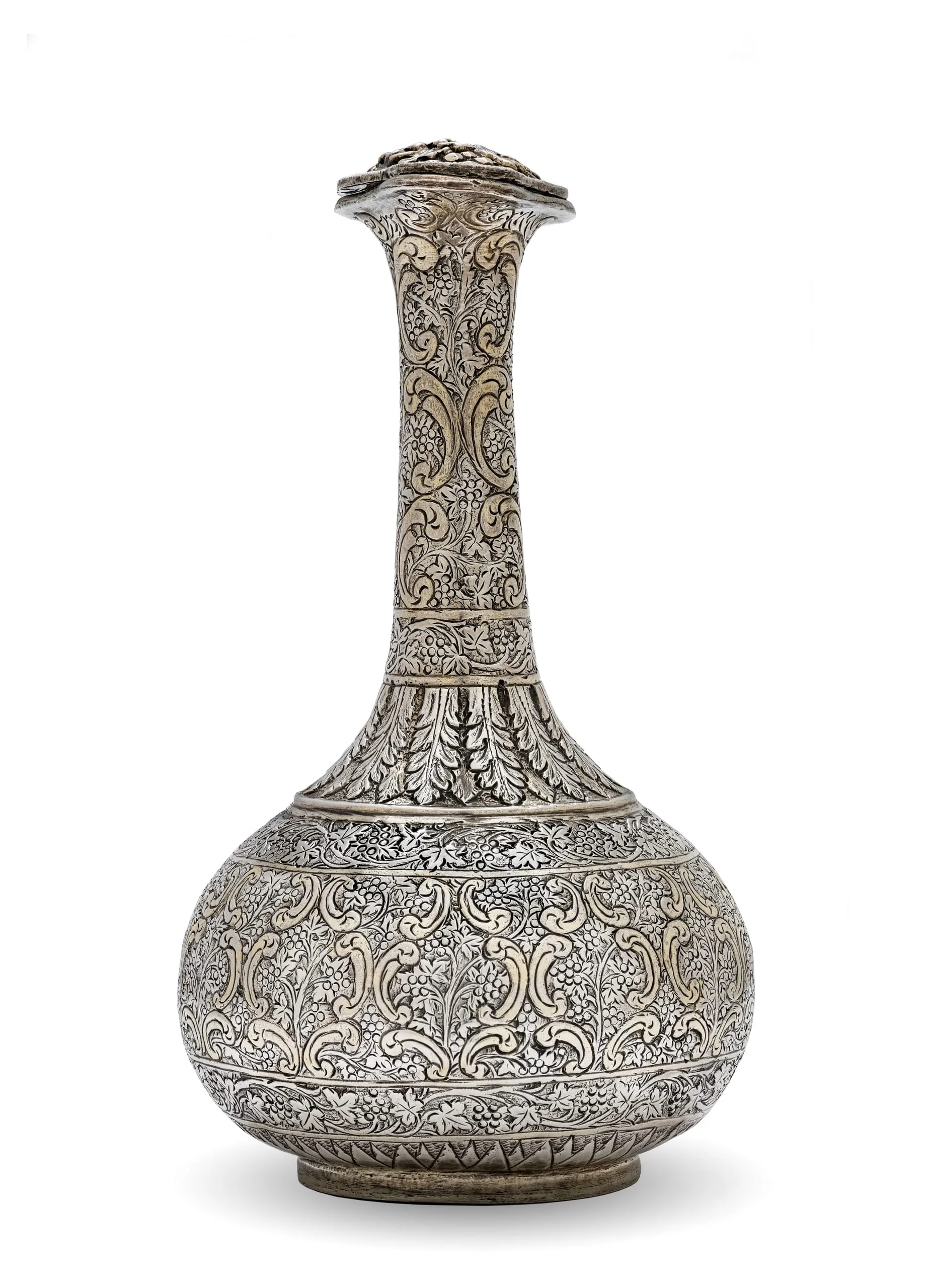
This wine vessel has a tall neck and compressed spherical body, with a sloped collar of acanthus leaves. The straight-rimmed mouth has a broad pouring lip, and its hinged, flat lid has a cast dome in the form of a grape bunch and grape leaves. The upper half of the handle has foliated volutes, and the lower half morphs into a coiled serpent. The ornamentation mirrors the vessel’s function, and the predominant ground pattern is that of chased grapevines with bunches and serrated leaves. Gilded arabesques form a latticelike design that accentuates the surface of the neck and central body.
In the European decorative arts tradition, the basic form of this wine vessel is called a shaft-and-globe decanter, its name derived from the elongated neck and spherical body. With the addition of a handle and pouring lip, the more complex form is accordingly known as a claret jug. The form of the shaft-and-globe decanter and the claret jug evolved in the late 17th century, paralleling similar vessel forms used in contemporaneous silver. By the 1880s the spherical body was sometimes compressed or flattened further into an onion shape, and many ornamental styles of decoration, as well as elaborate silver and gold mounts for glass decanters and claret jugs, were employed.
The LACMA claret jug also derives its morphological inspiration from the ubiquitous South Asian and originally Middle Eastern long-necked flask used for serving both water and wine, called a surahi, with which it shares a similar basic form apart from the attached handle. The flasks were made in a wide variety of media, including precious and base metals, jade, glass, and ceramic.