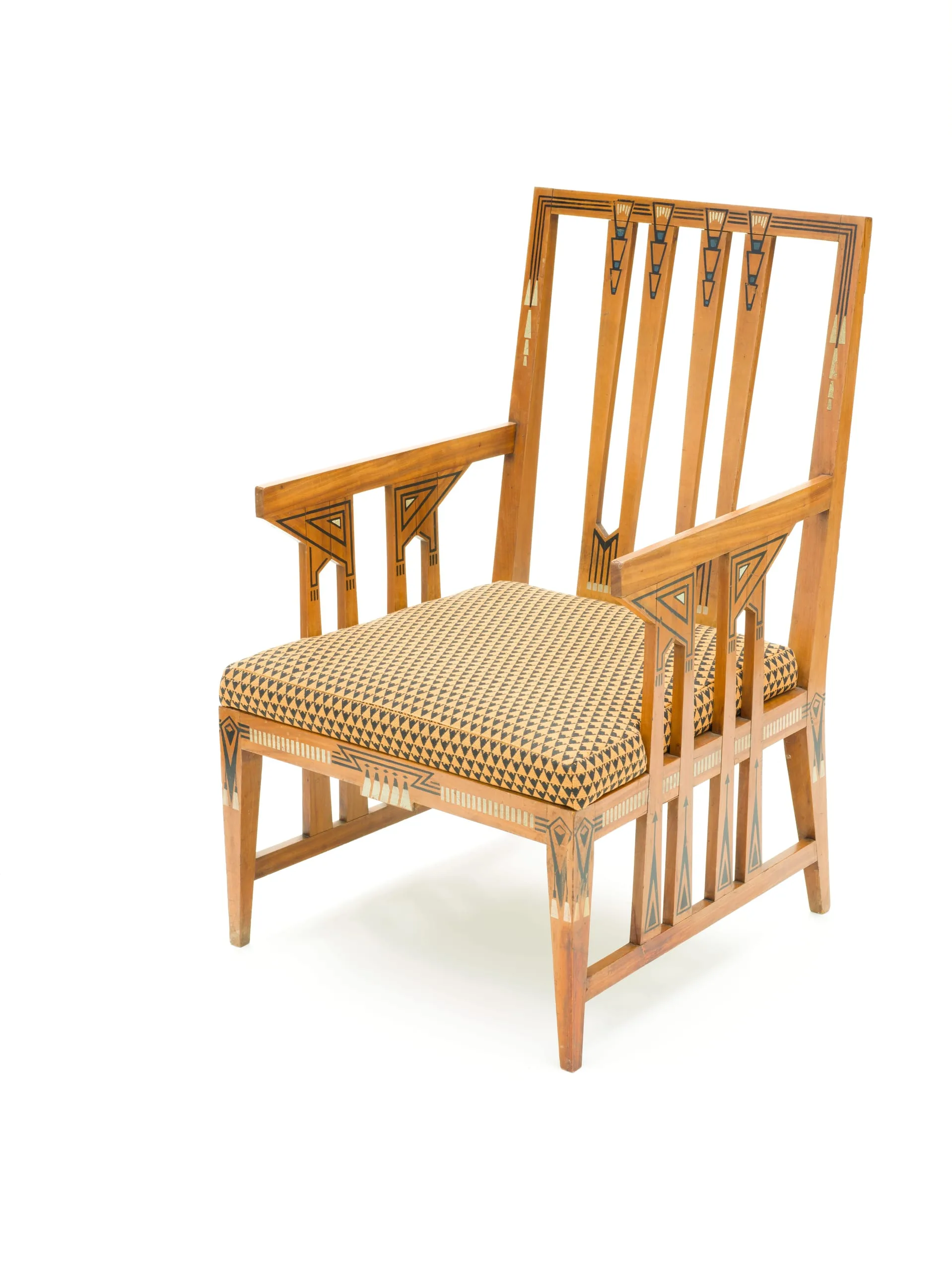
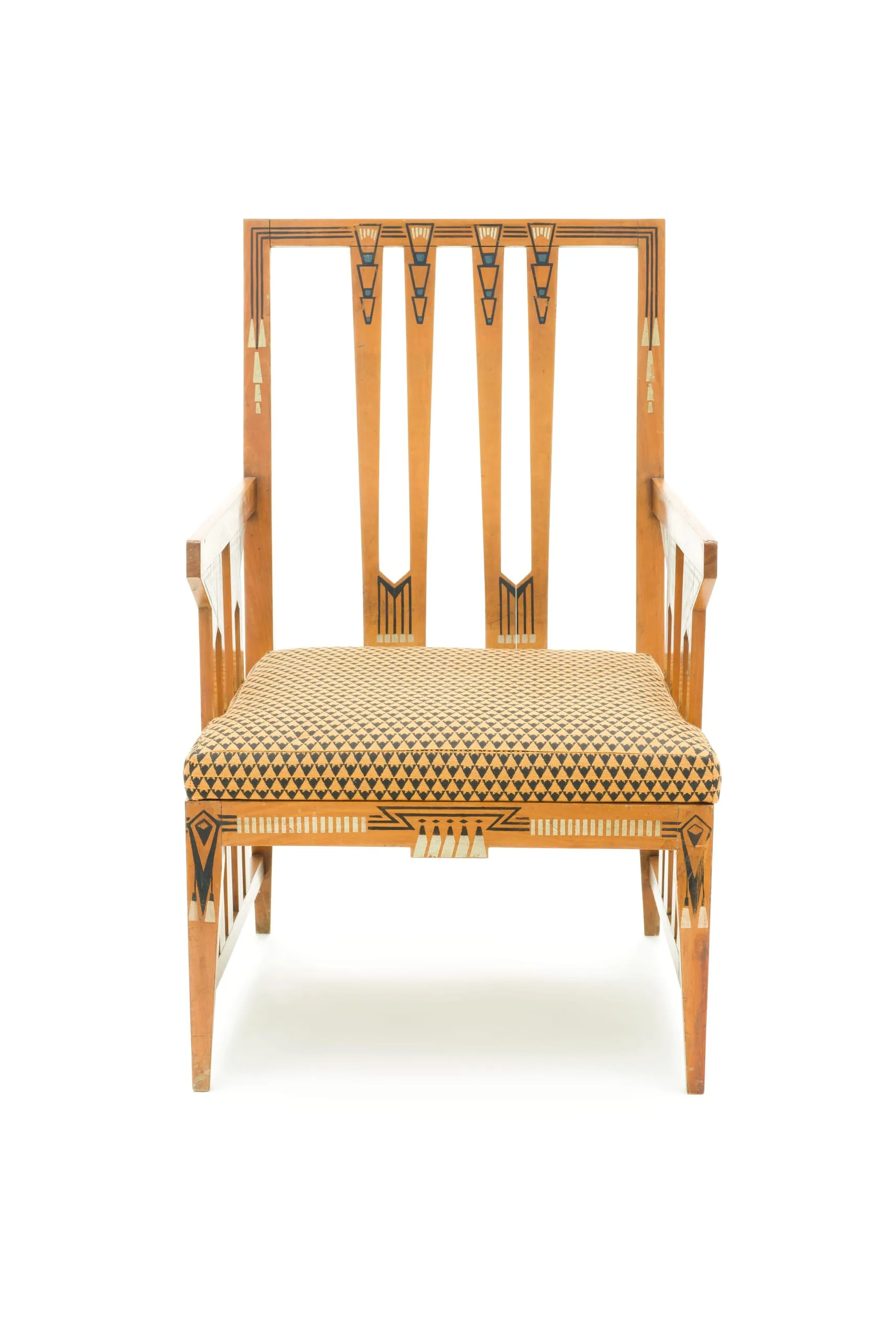
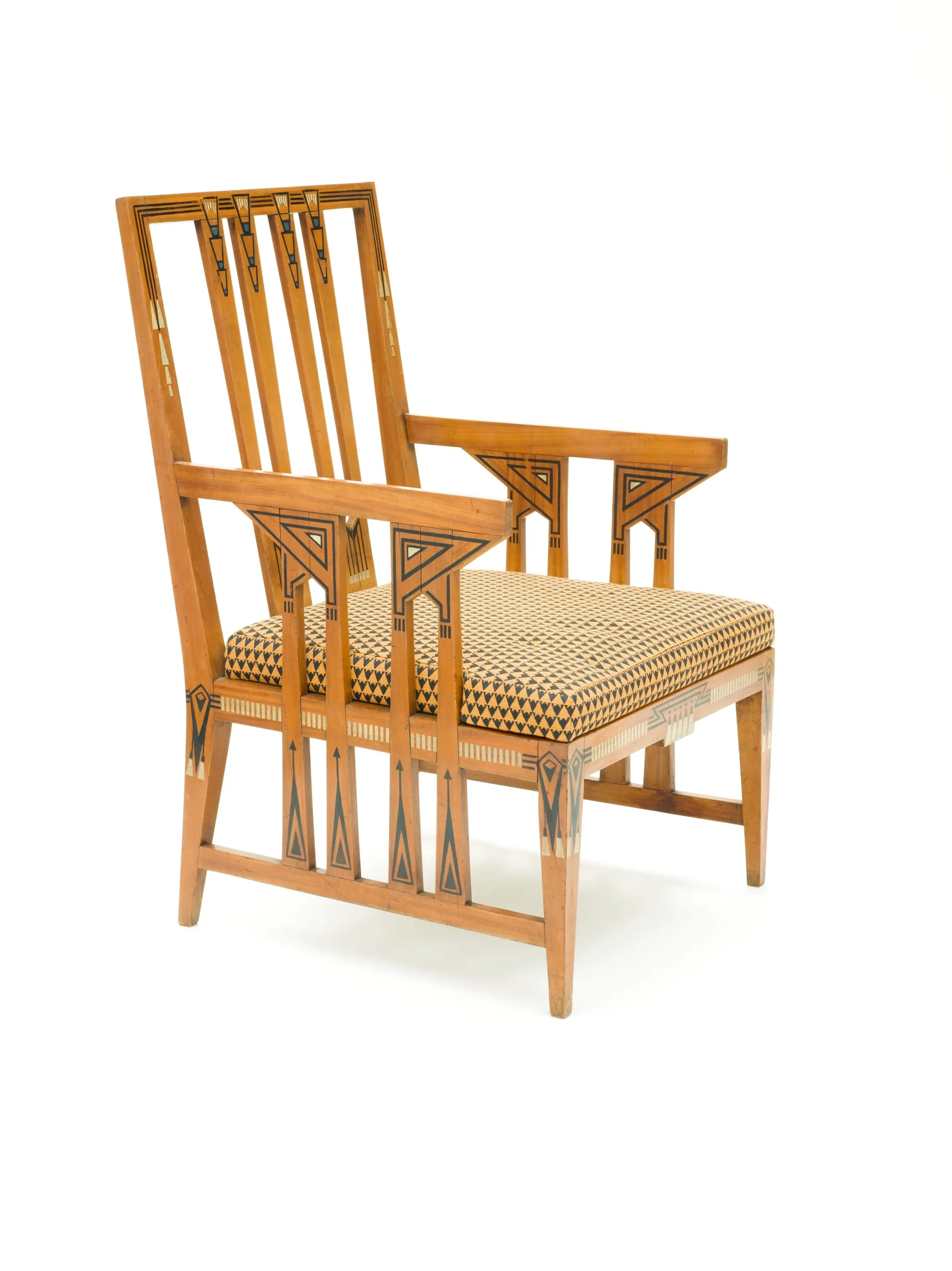
French architect Paul Auscher designed this armchair for his own home in Paris. Located at 5 rue de Talleyrand, the residence, constructed between 1910 and 1912, was part of a three-story structure intended by the architect for professional as well as private use. Designing the building as well as the furnishings, the architect created a gesamtkunstwerk (total design unity) characterized by restrained, geometric forms and ornamentation. These pieces are the only known furniture designed by Auscher; several other examples from his residence survive in the Musée d’Orsay collection.
The chair reflects much of the design vocabulary of the international Arts and Crafts movement. Its rectilinearity and abstract geometric decoration suggest the influence of the Wiener Werkstätte. But rather than using the costly inlay favored by this leading avant garde Viennese firm (which might well have been beyond Auscher’s means), he opted for modest stenciling, executed by Jean Kern. Such decoration defined Gustave Serrurier-Bovy’s "Silex" line, the egalitarian Belgian architect’s response to the challenge of producing low-cost furniture. The stenciled motifs are abstracted into simple forms, perhaps a reaction against the curvilinear Art Nouveau style that was popular in turn-of-the-century Paris and practiced by Auscher earlier in his career. Auscher’s most significant commissions were for commercial buildings, including department stores for Les Nouvelles Galeries and Felix Potin. This experience may explain Auscher’s hiring Etablissements Doré to build the furniture for his residence, as this Le Havre company specialized in fixtures and fittings for department stores.
Abbey Chamberlain Brach, Curatorial Assistant, Decorative Arts and Design, 2014