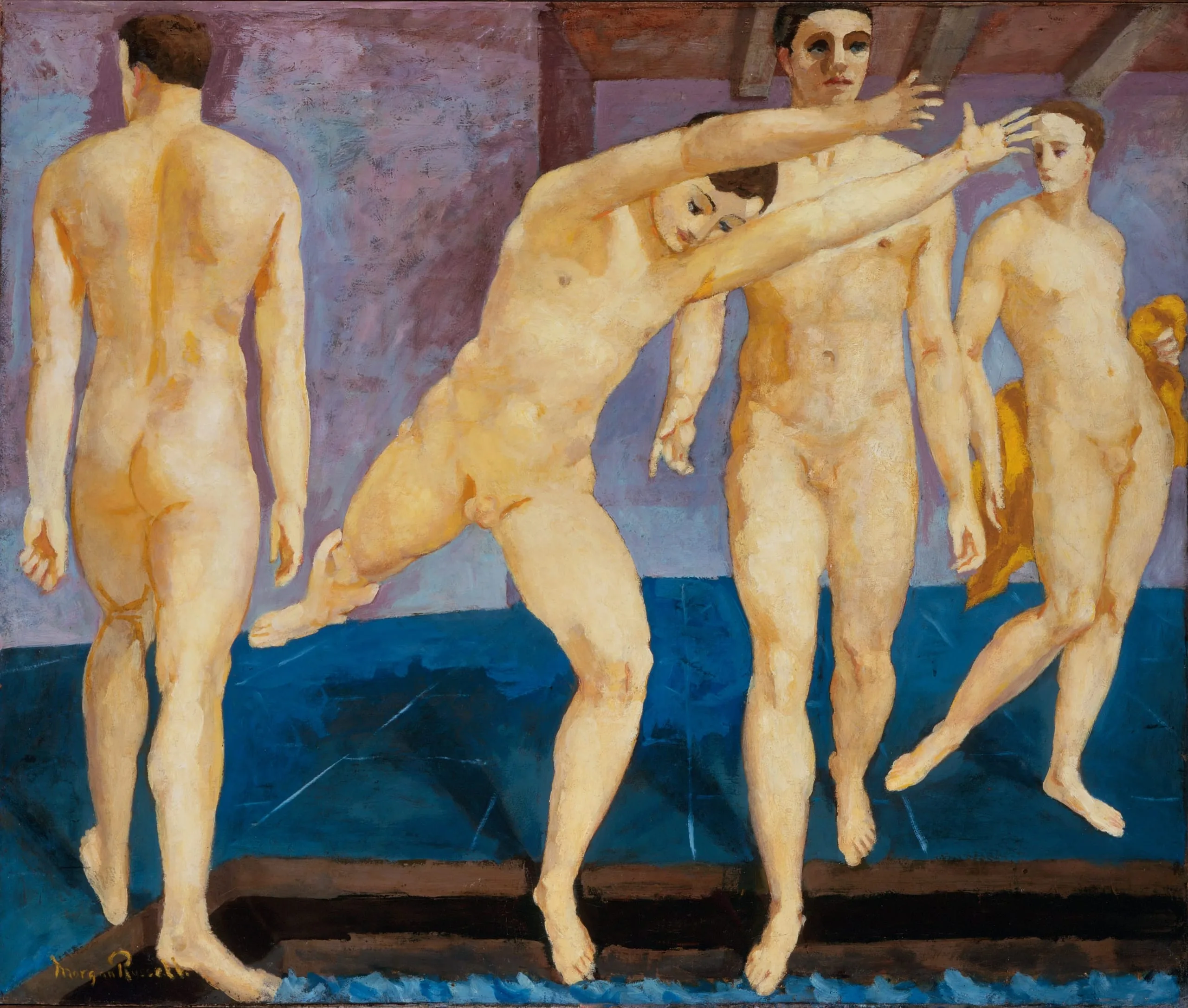
Many of Russell’s later canvases were of male nudes, and he considered these figure paintings to be his most significant work after the synchromies. Sometimes the nudes were depicted in a mythological guise but often they were bathers, as in Piscine. Russell was preoccupied with the heroic form of the human figure from his earliest days as an artist, when, inspired by Michelangelo, he sculpted a nude male; even the synchromies were based on the movement of the human form. In his late paintings Russell stressed the solidity of the nude’s body as would a sculptor.
Piscine reveals the artist’s fascination with the human physique. The lack of interaction between the figures would suggest that Russell explored different aspects of the body by painting one model in four different poses and from four different angles. Russell knew that a rich palette would distract from the figures, which he intended to be the primary expressive element, and consequently Piscine is limited to dull tones of gold and bluish purples. Color was always important to Russell, however, and in his late figure painting he based his palette on what he considered to be classic colors. As do the figures in his late religious paintings, the nudes in Piscine seem to float rather than to stand solidly at the edge of the pool.
Piscine was one of several paintings that the artist asked Frank L. Stevens to store for him. Unknown to Russell, Stevens buried the paintings. After Stevens’s death the paintings were disinterred, and Macdonald-Wright obtained some of them, including Piscine.