LACMA

ShopMembershipMyLACMATickets
LACMA
Los Angeles County Museum of Art
5905 Wilshire Blvd.
Los Angeles, CA 90036
info@lacma.org
(323) 857-6000
Sign up to receive emails
Subscribe
© Museum Associates 2026
  • About LACMA
  • Jobs
  • Building LACMA
  • Host An Event
  • Unframed
  • Press
  • FAQs
  • Log in to MyLACMA
  • Privacy Policy
© Museum Associates 2026
Collections

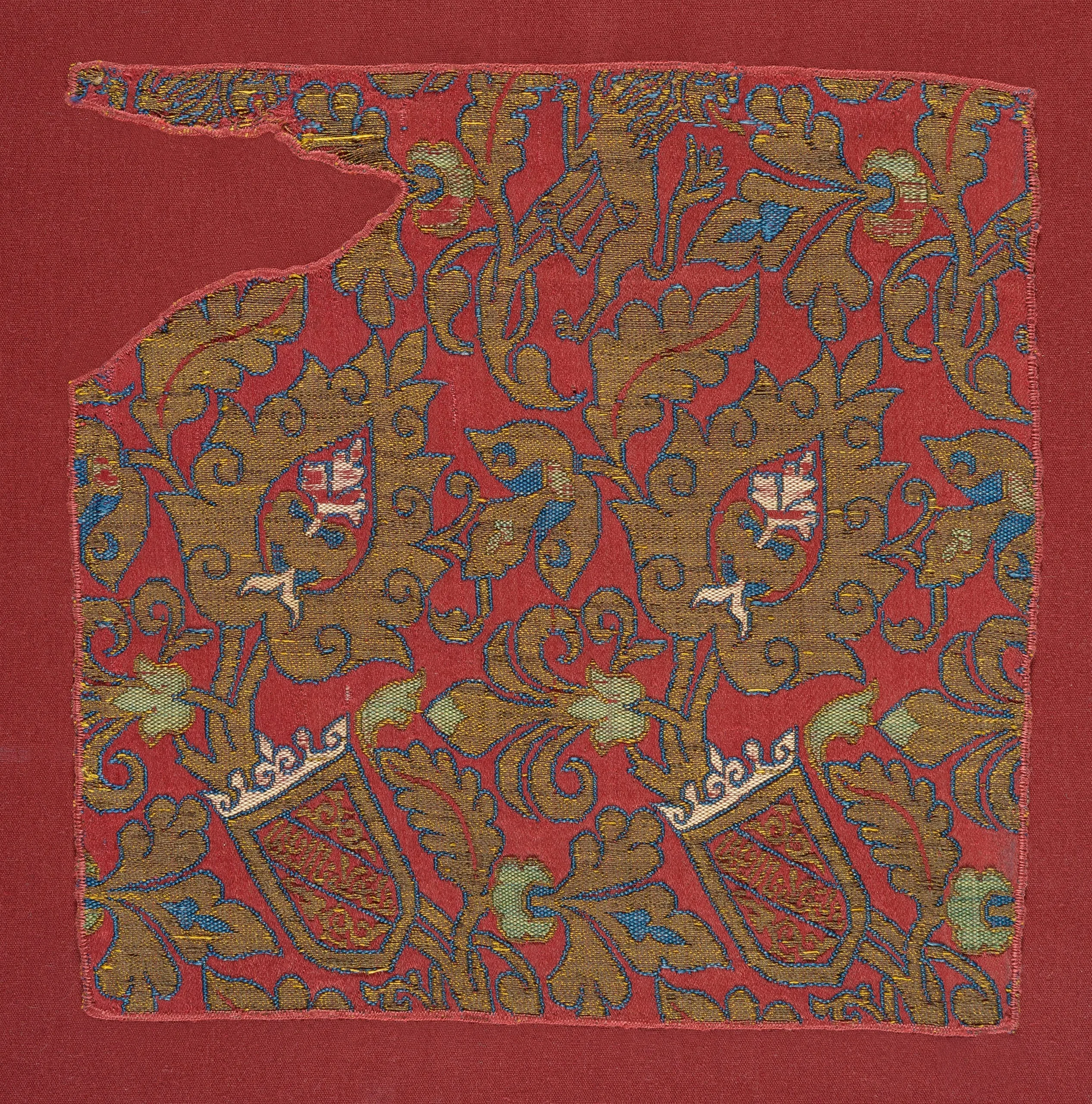
Textile fragment15th century

Not on view
Woven textile fragment with allover pattern of scrolling vines and lobed leaves in golden-tan, cobalt blue, and sage green on a crimson-red ground, with stylized pomegranate or artichoke motifs near the lower edge

Unknown, Textile fragment, 15th century, Los Angeles County Museum of Art, Los Angeles County Fund, photo © Museum Associates/LACMA

Title
Textile fragment
Place Made
Spain, Granada
Date Made
15th century
Medium
Silk satin with silk and gold metallic supplementary weft patterning bound in twill (lampas)
Dimensions
7 3/4 × 8 in. (19.69 × 20.32 cm) Frame: 15 3/4 × 15 3/4 × 1 7/8 in. (40.01 × 40.01 × 4.76 cm)
Credit Line
Los Angeles County Fund
Accession Number
55.57.19
Classification
Textiles
Collecting Area
Costume and Textiles
Curatorial Notes

Dating from the thirteenth to the fifteenth century, the Alhambra, in Granada, is one of the world’s most famous buildings and the best-preserved palace of medieval Islam. It is also the most significant artistic achievement of the Nasrid dynasty (1232−1492), which ruled Granada, the last Muslim kingdom in Spain. The Alhambra is both a well-fortified palace and a royal city. It is guarded by stone walls and towers on the exterior, which conceal on the interior an elaborate succession of gardens, courtyards, and intricately decorated rooms, some of which had veneers of carved and painted stucco and colorful tiles (see M.2002.1.685 and M.73.5.782). Vivid silk textiles, as here, in the form of wall hangings and soft furnishings, would also have enlivened the interior spaces.

Many Nasrid textiles, like this one, survive only as fragments; others passed into Christian hands, were converted into ecclesiastic vestments, and were preserved in that form. Several large silk curtains of the period have survived, and these attest to one of the ways sumptuous fabrics were used. This example and other related pieces may have once formed a similar wall hanging that added to the luxurious ambience of the Alhambra. Its vibrant color scheme is in accord with associated glazed tiles and painted stucco decoration.

2025
Selected Bibliography
  • Komaroff, Linda. Islamic Art at the Los Angeles County Museum of Art. Los Angeles: Museum Associates, 2005.

Related Unframed

Related Unframed

Coming Soon: Spring 2018 Wear LACMA
  • May 23, 2018
  • Editors
The Art of Costume and Textiles
  • October 6, 2016
  • Canan Cem
This Weekend at LACMA
  • October 3, 2014
  • Roberto Ayala
Over a Thousand Years Ago, Weavers Displayed Amazing Technical Skill
  • June 20, 2011
  • Catherine C. McLean