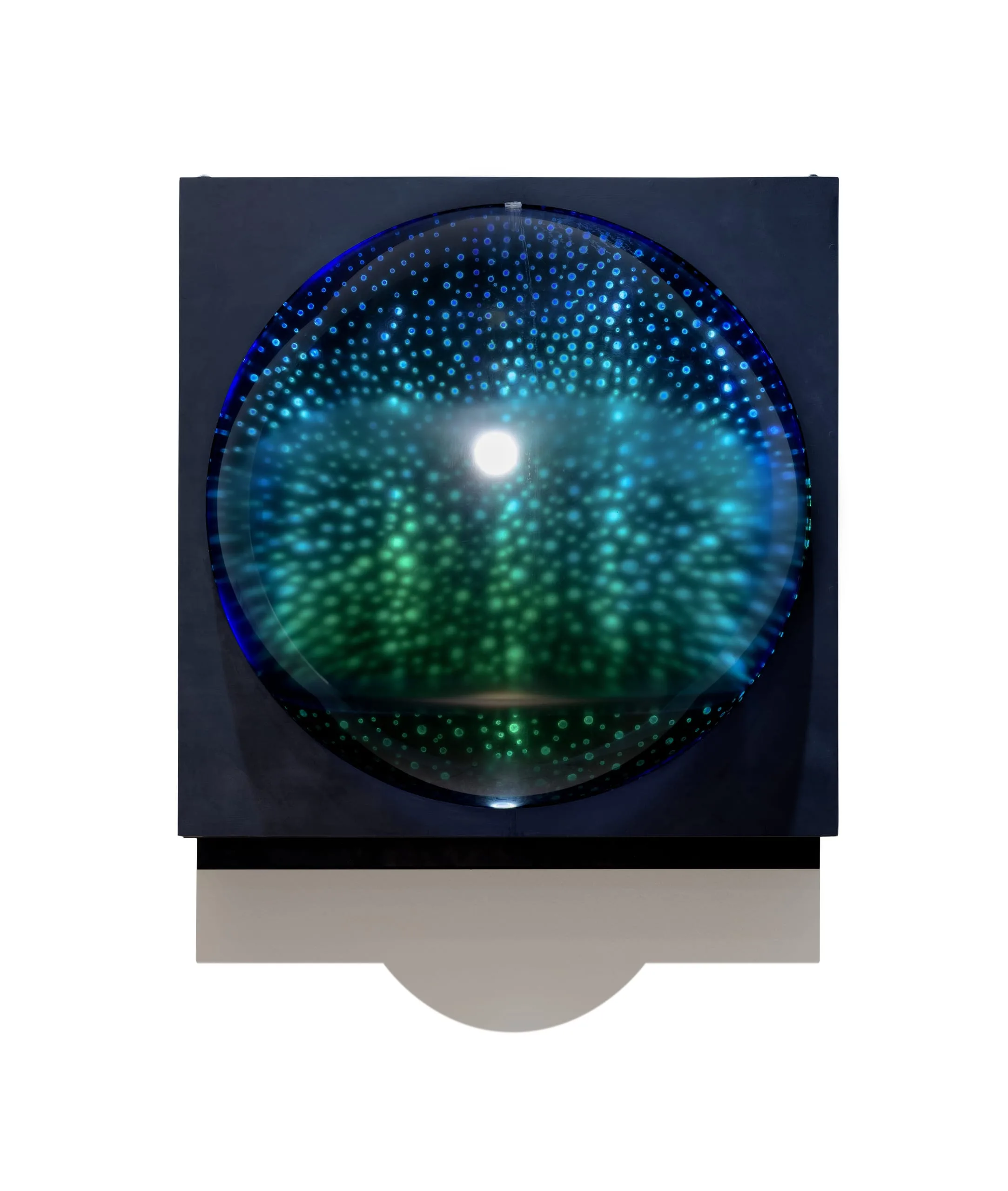
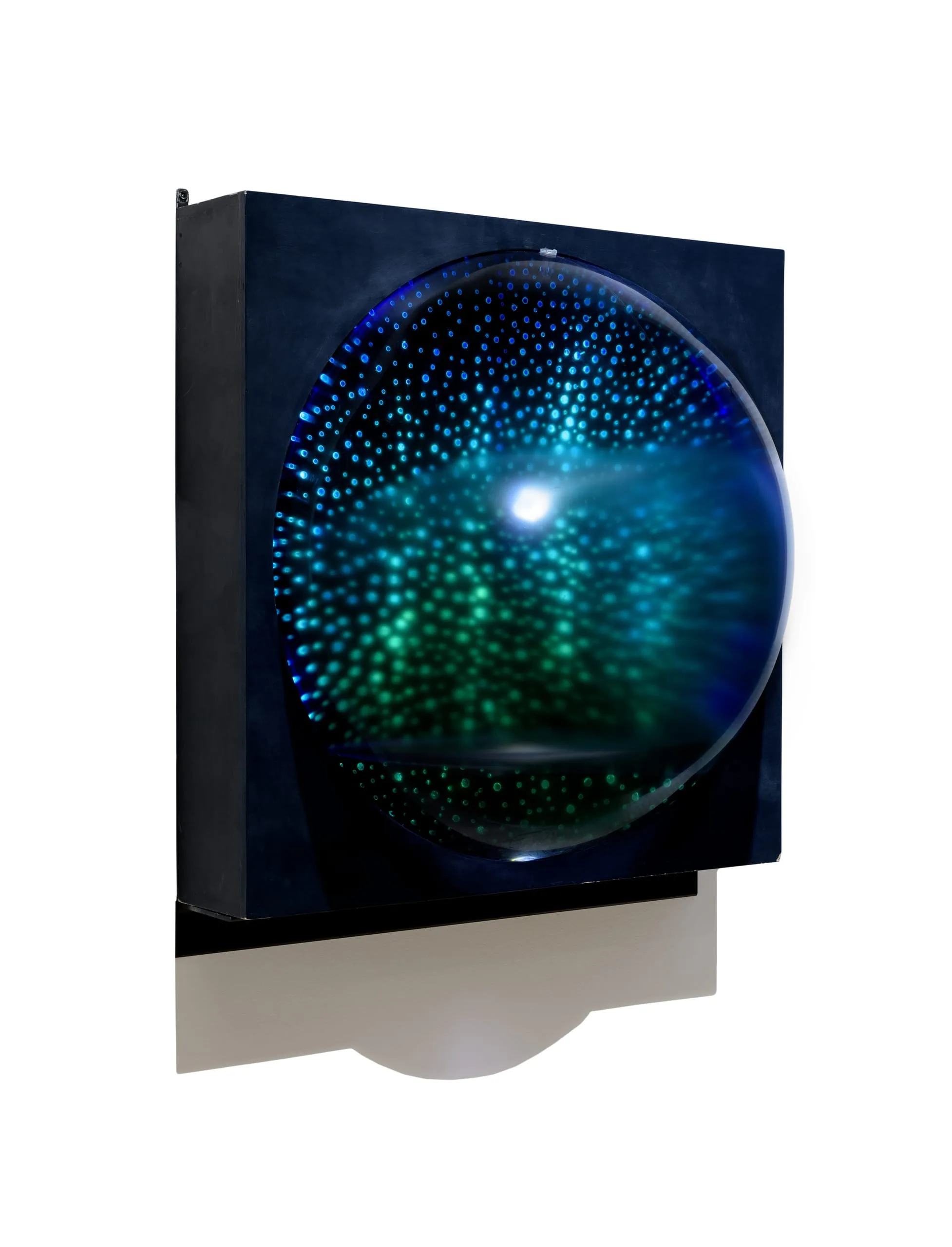
Hydroactivity exemplifies Gyula Kosice’s interest in science, technology, utopianism, and new materials such as Plexiglas. In a hemispherical plastic container affixed to a square black box, water is constantly recycled against a dark panel dotted with glowing green lights, evocative of outer space. The container imposes order on the water, while air activates the piece into poetic motion. For Kosice, this “architecturalization” of water had larger implications, suggesting that urban habitats could be developed in all spaces and dimensions, leading to a more democratic and sustainable human ecology. For example, The Hydrospatial City (Museum of Fine Arts, Houston), which consists of multiple sculptures and maquettes, embodies Kosice’s utopian vision for a new city suspended above ground to accommodate the planet’s overpopulation—a world where people would inhabit art in space. As he explained: “When you talk about artists, you’re talking about people who are trying to be ahead of their time, forerunners of something. If this isn’t the creator’s role, then who else is going to have the vision to make sense of things that are still unknown?”
Kosice emigrated from Czechoslovakia to Buenos Aires in 1928. He was a founding editor of the single-issue but legendary magazine Arturo (1944), along with Carmelo Arden Quin (1913–2010; M.2018.13), Edgar Maldonado Bayley (1919–1990), and Rhod Rothfuss (1920–1969). The journal was a milestone in the consolidation of a new generation of avant-garde artists in Buenos Aires interested in nonfigurative art. The Arturo group soon split into two opposing movements: Arte Madí and Asociación Arte Concreto-Invención (Concrete-Invention Art Association). Kosice was the most vocal member of Madí, and also its main theoretician and promoter. While many of his colleagues remained committed to geometric abstraction, he reinvented himself and became a successful international kinetic artist.
Ilona Katzew
2024