Porcelain production began in Japan in 1616 with the discovery of a suitable clay in Arita, an area located on the west side of Kyūshū, the southernmost of Japan’s five main islands. Subsequently, Arita became home to the country’s first porcelain kilns, which in the early years produced wares for domestic use. Prior to the mid-seventeenth century, the Chinese porcelain factories at Jingdezhen met the demands of the European market. However, the turbulent transition from the Ming (1368−1644) to the Qing (1644−1911) dynasty severely disrupted operations there. Forced to seek alternate sources, the Dutch East India Company turned to the nascent Japanese porcelain workshops to supply inventory for their customers in the West.
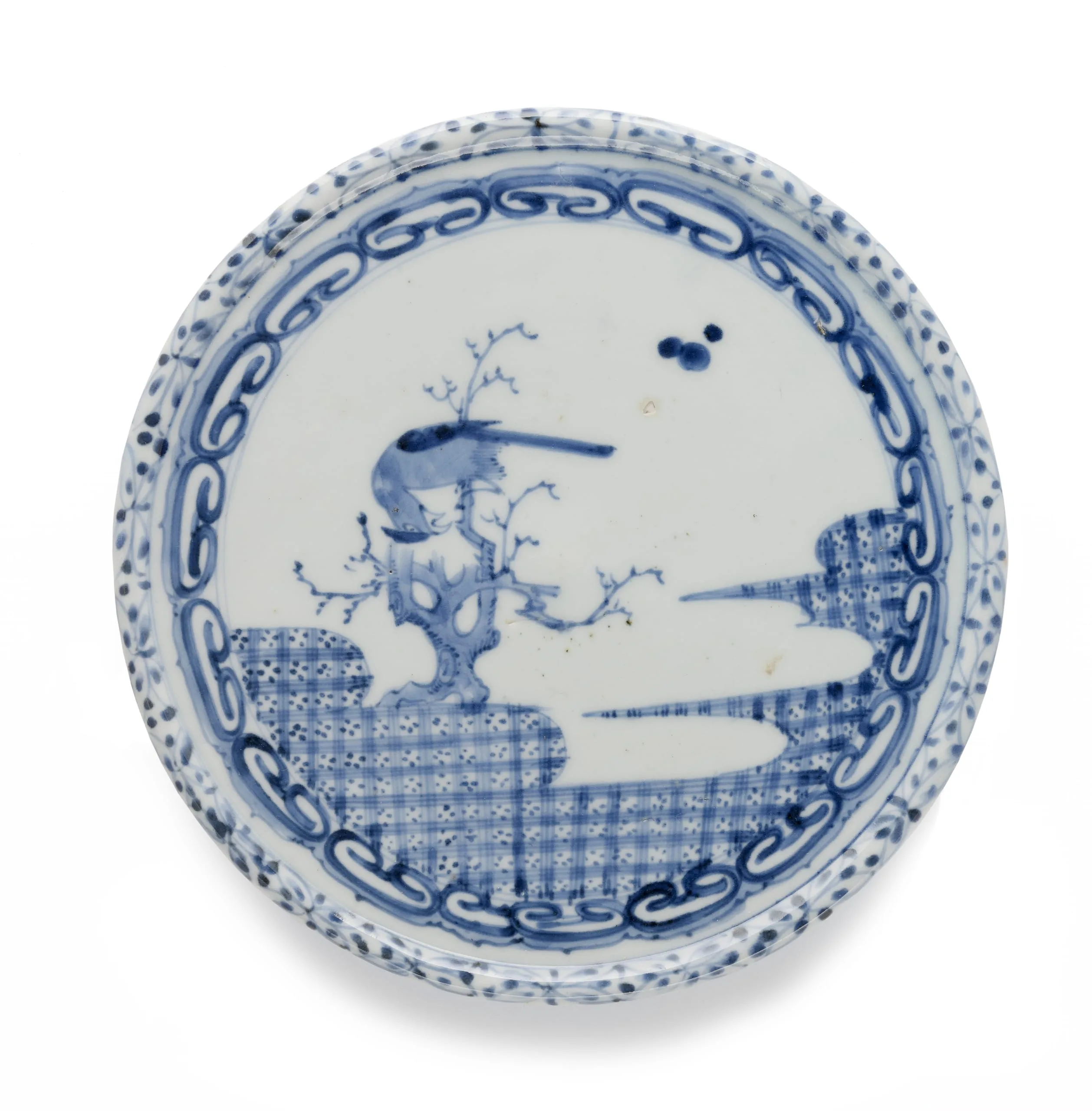
This dish is an example of early Japanese export ware, which tended to be decorated with a combination of Japanese and Chinese motifs. A hawk rests in a tree set against a white ground of stylized clouds executed in the traditional Japanese manner. The lower portion of the dish is covered with a popular checkerboard-like surface pattern of crossing lines and dots, seen on porcelain wares from China and Korea as well. This type of surface decoration, composed of connecting geometric shapes such as squares, circles, or diamonds, is known as a diaper pattern. The bold forms encircling the central image are known as nyoi-gashira (“scepter head”). The nyoi is a ceremonial scepter (M.83.89) carried by Buddhist priests. Its broad head mimics a cloud or reishi fungus. Here, the width of the scepter heads has been exaggerated and the repeated shapes linked to create a decorative border.
2025